

Hektoria: Record Glacier Retreat in Antarctica
Satellite observations have recorded a record-fast retreat of the Hector Glacier in Antarctica: over just 15 months, it lost about 25 kilometers in length. The study highlights the importance of monitoring such processes to assess future sea level changes.
Natura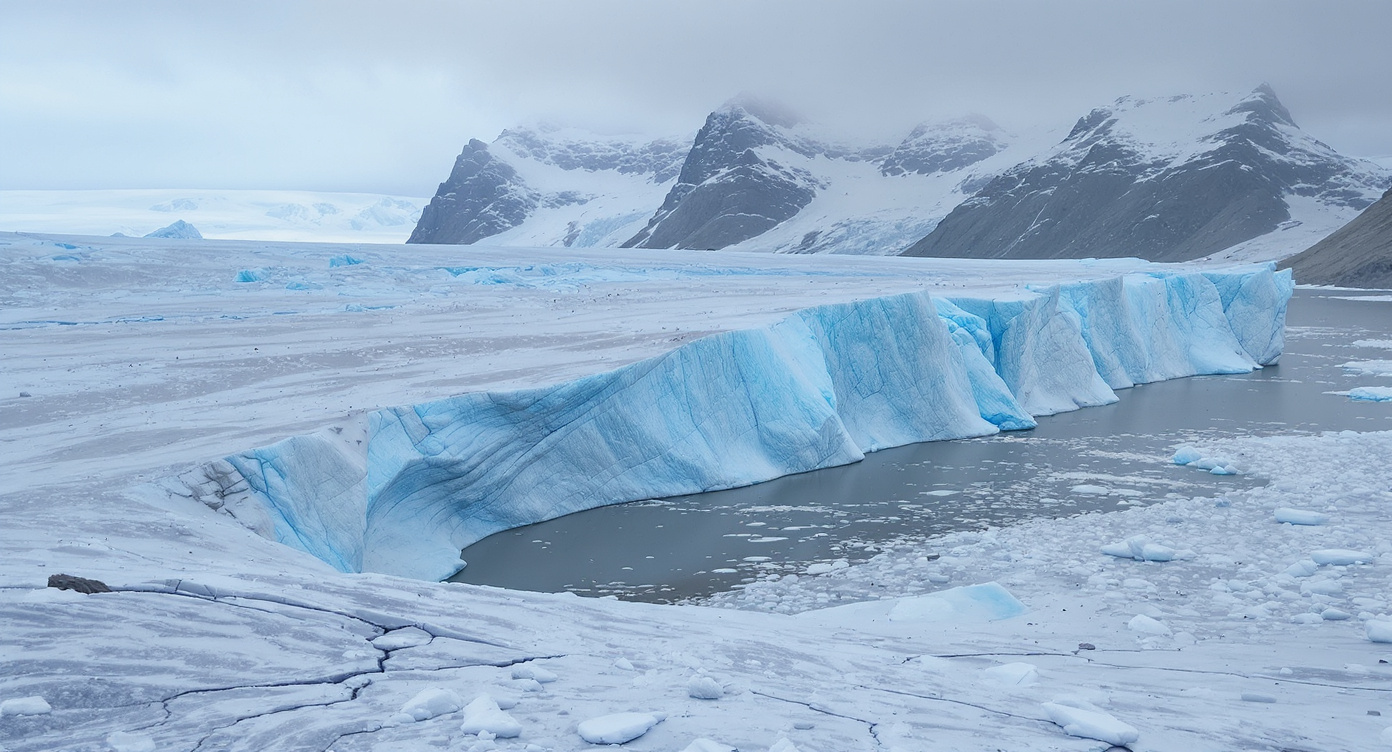
Rapid Retreat of the Hektoria Glacier in Antarctica
A comparative analysis of satellite images taken by the OLI instrument on the Landsat 8 satellite in October 2022 and March 2024 revealed a significant reduction in the Hektoria Glacier's ice shelf. Between November and December 2022, the glacier retreated by 8 kilometers after losing a 16-kilometer section of floating ice earlier that year.
Timeline and Scale of Changes
Between early 2022 and spring 2023, the Hektoria Glacier experienced a dramatic retreat, losing about 25 kilometers in length over 15 months. In just two months, the glacier's edge receded by more than 8 kilometers, marking the fastest recorded retreat of an ice shelf in modern observation history.
Studies using various remote sensing methods have shown that the glacier's shape and structure played a key role in this rapid collapse. The Hektoria Glacier begins on the Antarctic Peninsula and extends into the ocean, where its outer section forms a floating ice tongue. As a result of recent changes, the glacier has lost not only this tongue but also a significant portion of its ice shelf resting on flat bedrock, directly contributing to sea level rise. Although Hektoria is relatively small compared to Antarctica's largest glaciers, similar processes occurring in larger glaciers could have far more serious global consequences.
Historical Context
The collapse of the Hektoria Glacier began more than twenty years ago. In 2002, the disintegration of the Larsen B Ice Shelf, which had acted as a stabilizing barrier for Hektoria and neighboring glaciers, led to their thinning and retreat. By 2011, seasonal sea ice in the Larsen B embayment temporarily supported the glacier, allowing it to advance slowly.
In January 2022, the sea ice suddenly broke up, likely due to strong ocean waves, destabilizing the region. After this event, Hektoria Glacier began to change rapidly again: during the austral summer, the floating ice tongue broke apart due to repeated calving events, resulting in a retreat of about 16 kilometers. In the winter of 2022, the glacier temporarily stabilized, but satellite laser measurements, including data from NASA's ICESat-2 mission, showed continued thinning beneath the surface.
Destruction Mechanisms
Research revealed that the remaining ice in spring 2022 was still shelf ice, as confirmed by seismic data. The ice rested on a wide and relatively flat plain, allowing seawater to penetrate beneath the glacier during tides and temporarily lift sections of it. When the ice became thin enough, large pieces could suddenly break off and calve, triggering the second phase of the glacier's retreat, during which it lost another 8 kilometers in length.
The Role of Satellite Technologies
Modern satellite platforms such as NISAR and SWOT, developed by NASA and its partners, enable the monitoring of rapid glacier changes. NISAR can measure land and ice surface movement with centimeter-level accuracy, while SWOT, originally designed to track changes in water surfaces, is now also used to study the cryosphere, including ice shelves and sea ice.
Outlook
The Hektoria Glacier is expected to continue its gradual retreat as it loses mass and elevation. According to experts, the most intense phase of the collapse has already passed, and in the coming years, the glacier's movement will likely slow down. In the future, similar processes may affect other glaciers, especially as temperatures rise around the Antarctic Peninsula, leading to the loss of protective ice tongues and the transformation of glaciers into tidewater types, where their edges rest directly on the seafloor. Such glacier types are also common in Alaska and Greenland.