

Metals enhance the sting and pincers of scorpions.
A new study has shown that the stingers and pincers of scorpions contain certain metals that strengthen their structure. The distribution of these elements is linked to the specific hunting and defense strategies of different species.
Cursus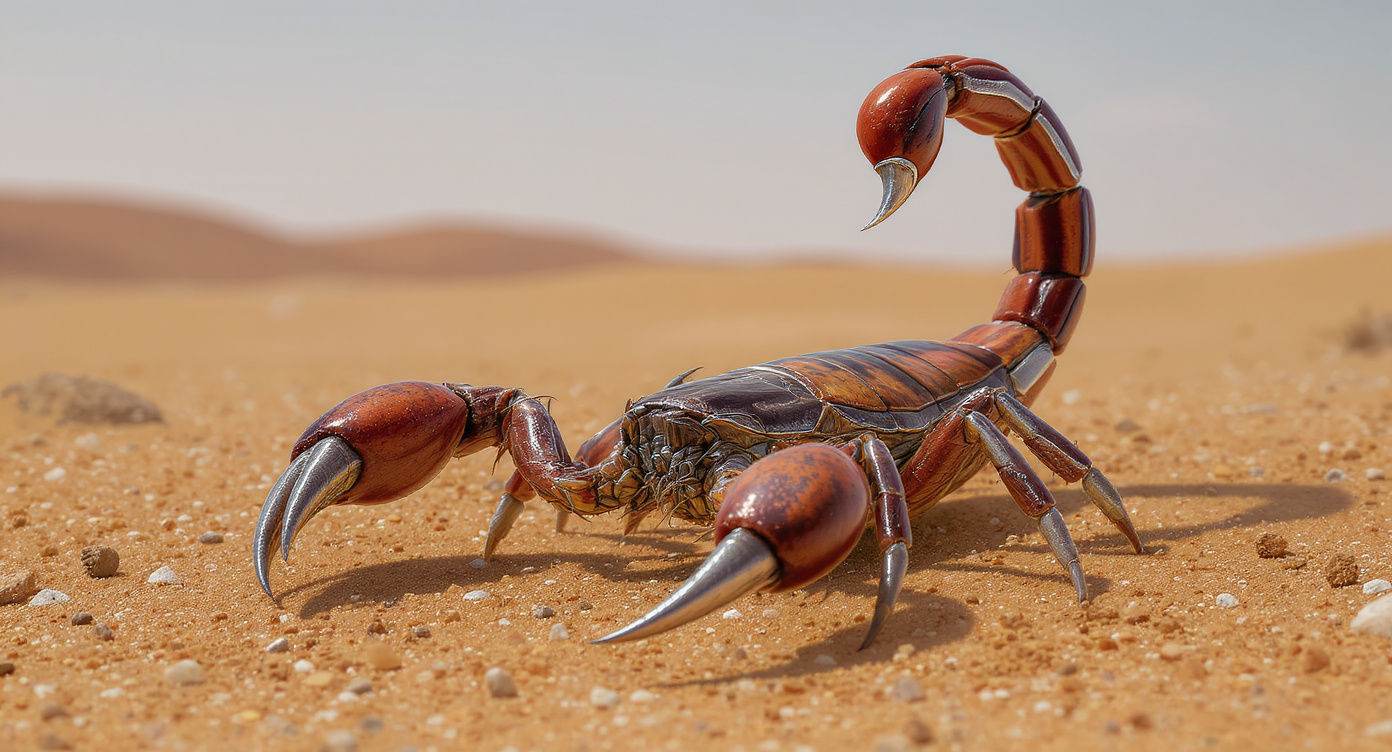
The pincers and stinger of scorpions contain areas enriched with metals. Recent research has shown that these structures feature specific elements, and their distribution is linked to the hunting and defense strategies of different species.
Scorpions are among the oldest predators on Earth and belong to the class of arachnids, along with spiders and mites. For both attack and defense, they use their pincers and a venomous stinger at the tip of their tail. Among the roughly three thousand known species, the structure of these organs varies: some have large, powerful pincers and a small stinger, while others have slender pincers and a large, elongated stinger.
It was previously observed that the pincers and stinger of scorpions contain metals that give these body parts extra strength. However, it remained unclear whether this was true for all species and whether the distribution of metals was related to their lifestyle and hunting habits.
Study of the structure of pincers and stinger
An international team of specialists examined 18 species of scorpions using electron microscopes and X-ray methods. This allowed them to closely study the structure of the stinger and pincer cuticle, as well as determine the distribution of metals within these structures. Special attention was given to the areas that experience the greatest mechanical stress during prey capture.
The analysis revealed that the stinger and pincers of scorpions contain transition metals that reinforce the chitinous parts of their bodies. At the tip of the stinger, a distinct layered structure was found: the outer layer is rich in zinc, while the next layer contains manganese. The boundary between these layers is visually distinct, with each element occupying a specific location.
In the pincers, metals are concentrated along the cutting edge of the movable part, which is involved in grasping prey. Here, zinc was detected, and in some species, iron as well. The rest of the pincer surface contains almost none of these elements. This distribution suggests that nature has reinforced precisely those areas that endure the greatest stress during hunting.
The role of iron and structural features
Iron is more commonly found in species with long, slender pincers, rather than in those with powerful pincers, as previously assumed. Long pincers are not designed for strong compression but must hold onto prey while the scorpion injects venom. Iron appears to increase the durability and longevity of these structures, protecting them from damage and wear.
Differences in metal composition
All studied scorpion species were found to contain metals, but their composition and concentration vary significantly. Different elements may be associated with various mechanical functions: zinc strengthens cutting surfaces, manganese is concentrated below the tip of the stinger—likely preventing breakage at the junction of hard and flexible areas—and iron supports the longevity of certain structures.
Prospects for further research
Researchers plan to investigate whether similar mechanisms are found in other arthropods, such as spiders, wasps, ants, and bees. To do this, a unified approach to analysis must be developed to accurately compare different species. This will help answer whether these animals use metals to reinforce their "tools" and how, through evolution, they have learned to employ such elements to improve their hunting and defense efficiency.
The scientific study was published in the journal Journal of The Royal Society Interface.