

Fungi create a network to exchange electrical signals
Japanese ecologists have, for the first time, recorded a stable exchange of electrical signals between wild mushrooms in their natural environment. The study revealed that mushrooms form dynamic communication networks, responding to the appearance of resources and even connecting genetically different organisms.
Cursus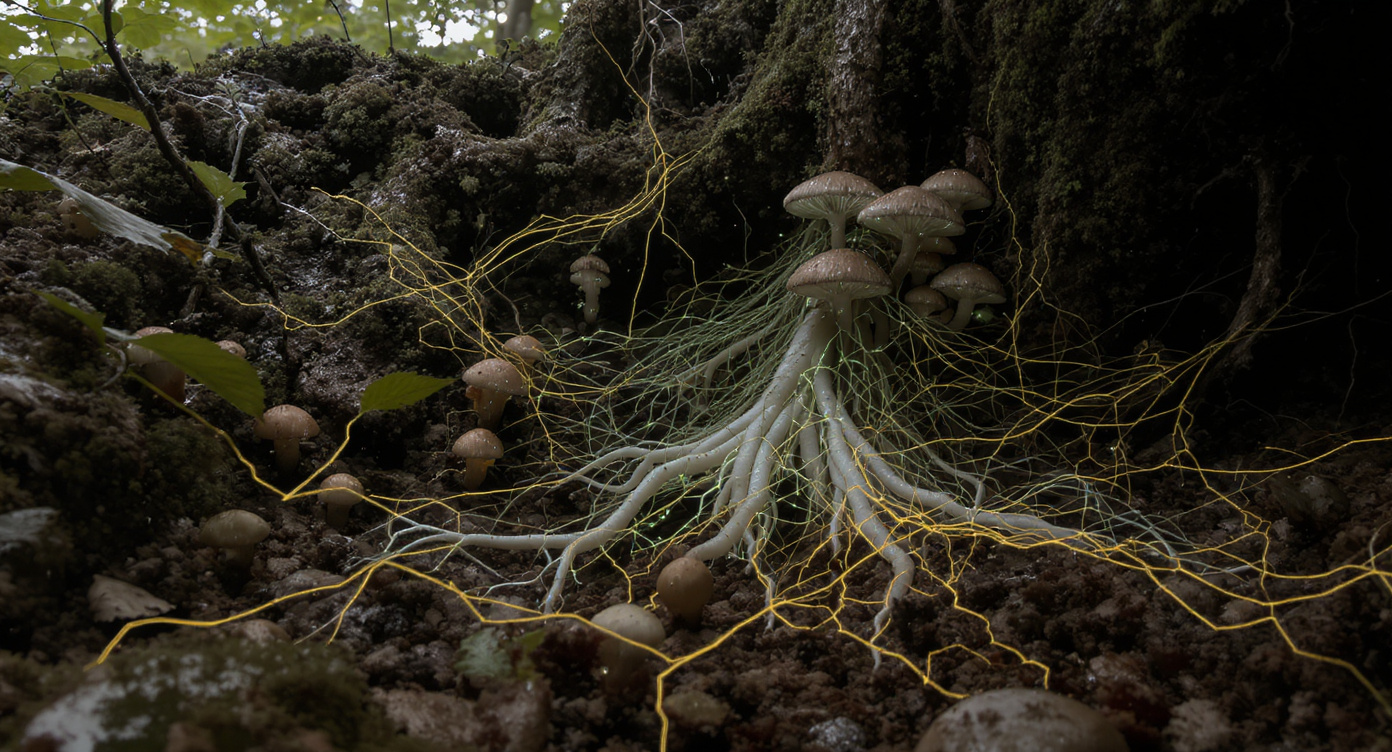
Japanese ecologists conducted continuous measurements of electrical potential in 37 wild mushrooms and recorded a directed exchange of electrical signals between them. Localized watering of the soil near one of the fruiting bodies triggered an immediate increase in information transmission throughout the entire underground network. This process unified even genetically diverse organisms into a single structure.
Studying Fungal Communication
Biologists have long suspected that the underground mycelial network in forests serves not only for transporting nutrients but also for transmitting information. Laboratory experiments have confirmed that fungi can exchange electrical signals, but large-scale communication in natural conditions has rarely been observed. The main challenges stemmed from the hidden location of hyphae underground and the unpredictable growth of fruiting bodies, making it difficult to collect reliable spatial data in the wild.
Experiment in an Oak Forest
In the spring, a 25-square-meter plot of oak forest in Japan’s Miyagi Prefecture was fertilized with urea, which led to a mass autumn growth of Hebeloma mushrooms. Thin medical electrodes were installed in the 37 emerging mushrooms to record potential differences every second over three and a half days.
Response to External Stimuli
To test the network’s response to external influences, 200 milliliters of tap water or human urine were poured at the base of individual mushrooms, and in one test, the entire plot was flooded with water. After the electrophysiological recordings were completed, all 37 mushrooms were collected and sequenced to determine their species and genetic relationships. The analysis of information flows was conducted using mathematical tools based on transfer entropy.
Analysis Results
The calculations showed that the mushrooms constantly exchanged electrical signals. The intensity of this exchange depended on both physical and genetic distance: the closer the mushrooms and the more closely related they were, the stronger the informational connection. However, the network was not limited to a single clone—stable signal exchange was observed even between genetically different individuals and even between representatives of two species: Hebeloma danicum and Hebeloma cylindrosporum.
Communication Features
The contribution to communication among the mushrooms was uneven. One mushroom (designated as Mushroom #1) acted as a communication hub, sending the most intense information flows to a group of neighboring mushrooms (#2, 3, 5, 15). Additionally, Mushroom #1 sent strong signals to a distant mushroom (#23), which belonged to a different species.
Impact of Stimulus Scale
The response to stimuli depended on the scale of the impact. When only one mushroom was watered, its electrical potential increased, and the level of signal exchange among all mushrooms in the plot rose significantly over the next 30 minutes. When the entire area was flooded, information transmission sharply decreased: each mushroom activated independently, and the coordinated network dialogue broke down due to overall informational noise.
Experiment with Urine
Adding urine, which Hebeloma mushrooms use as a nitrogen source, did not produce a noticeable effect, except for a slight spike in activity in Mushroom #1. This is attributed to temperature limitations: the experiment was conducted at +10 °C, and soil bacteria require about five days to convert urea into ammonia, which is of interest to the mushrooms. Since the recording cycle lasted only three days, the mushrooms did not have time to respond to chemical changes in the soil.
Conclusions
In their natural environment, mushrooms form dynamic communication networks and quickly respond to the local appearance of resources. The exact mechanism of interspecies communication is still unknown: signals may be transmitted either through intertwined hyphae of different species or via the release of chemicals that alter the acidity and electrical balance of neighboring colonies.