

The oldest ancestor of apes has been discovered in Egypt
An international team of scientists has discovered fossils of the ancient primate Masripithecus moghraensis in Egypt, a species closely related to the ancestors of modern apes. This discovery could reshape our understanding of the geography of their evolution, highlighting the significant role of North Africa.
Cursus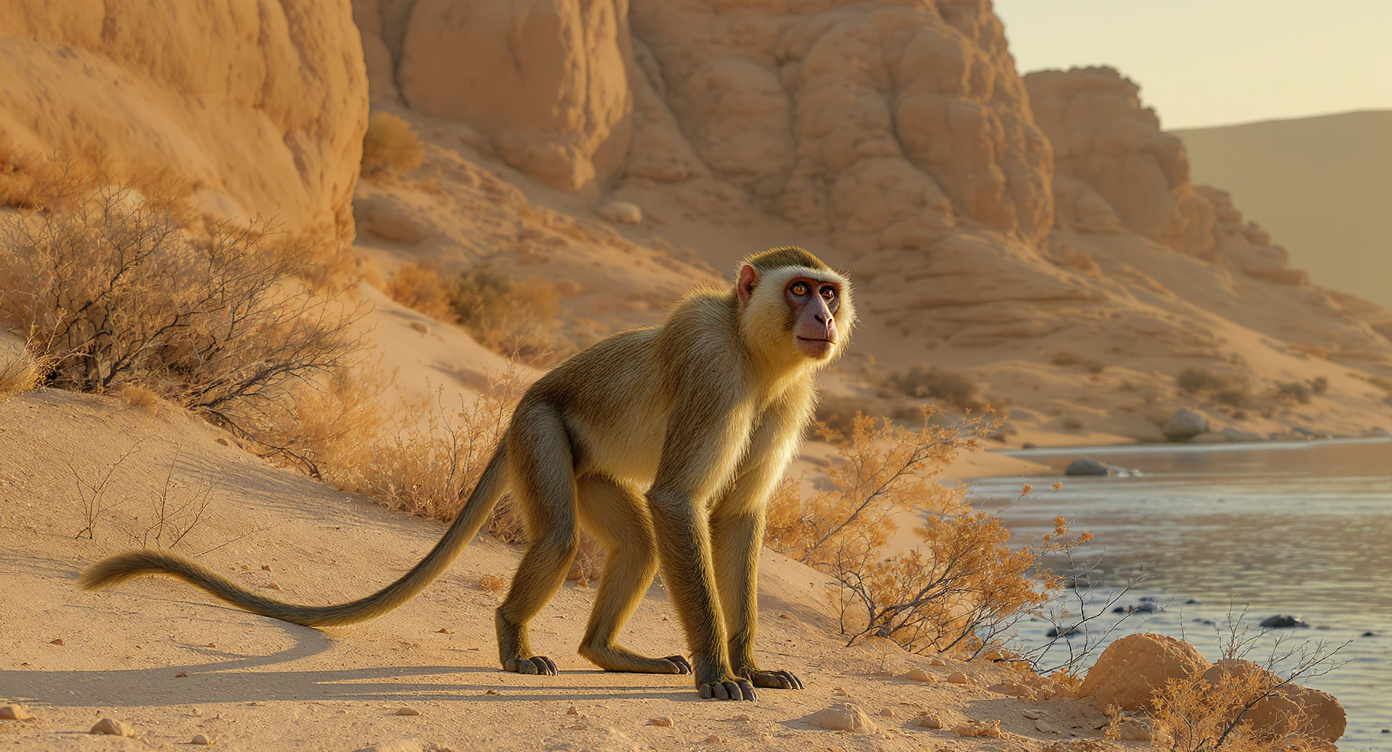
An international team of researchers has discovered the fossils of an ancient primate, identified as the closest known relative to the evolutionary line leading to modern apes. The newly described genus and species has been named Masripithecus moghraensis, with the fossils estimated to be 17–18 million years old. This discovery could significantly reshape our understanding of ape origins, as their evolution was previously thought to be primarily linked to East Africa, while the new evidence points to a different region.
Evolutionary Divergence of Primates
About 25 million years ago, the group of Old World monkeys (Catarrhini) split into two evolutionary branches: apes (Hominoidea) and monkeys (Cercopithecoidea). It is believed that this event took place in the Afro-Arabian region.
During the Miocene epoch (23 to 5 million years ago), apes exhibited remarkable diversity and eventually spread across Europe and Asia. However, the precise location and timing of their common ancestor’s emergence remained unknown for a long time.
New Discoveries in Egypt
In 2023 and 2024, paleontological excavations in the Wadi Moghra area of northern Egypt uncovered jaw fragments and teeth from two ancient primates in layers dating back 17–18 million years. In total, four specimens were found, the most valuable being the front part of a lower jaw with well-preserved teeth, including large canines and molars, belonging to a single individual. The second primate was represented by only a partial jaw.
Analysis led to the identification of a new genus and species for science—Masripithecus moghraensis. The genus name combines the Arabic word Masr (“Egypt”) and the Greek pithēkos (“ape”), while the species name refers to the discovery site. Research has shown that this creature is among the closest relatives of the evolutionary line leading to modern apes.
Morphological Features
The key trait that allowed researchers to classify the find as an ape was a unique combination of jaw features characteristic of this primate group. Special attention is given to the large canines, premolars, and molars with rounded and heavily textured chewing surfaces. The second and third molars of Masripithecus moghraensis are nearly identical in size.
These features suggest a flexible diet: Masripithecus moghraensis likely fed mainly on fruit but could also consume harder foods such as nuts. The primate’s body mass is estimated at 21–28 kilograms. The size of the canines in the first specimen indicates it was a male; the jaw structure of the second also suggests a male. Both primates were comparable in size to a small female common chimpanzee.
Research Limitations
A complete reconstruction of this ancestor’s lifestyle is hindered by the lack of limb bones, making it impossible to determine whether the animal moved primarily in trees or on the ground.
Significance of the Discovery’s Geographic Location
The most surprising aspect of the find is its geographic location. Previously, most major discoveries of ancient apes came from East Africa, so the unearthing of fossils in the continent’s north was unexpected. This evidence could change our understanding of where ape evolution began. Further research in this region may provide new insights into the early evolution of Hominoidea.
The scientific article detailing these findings was published in the journal Science.