

Fire-resistant panels made from sawdust and stuvite mineral
Researchers have developed fire-resistant panels made from sawdust and the mineral struvite, which offer high strength and are lighter than cement boards. The new material can also be recycled after use.
Cursus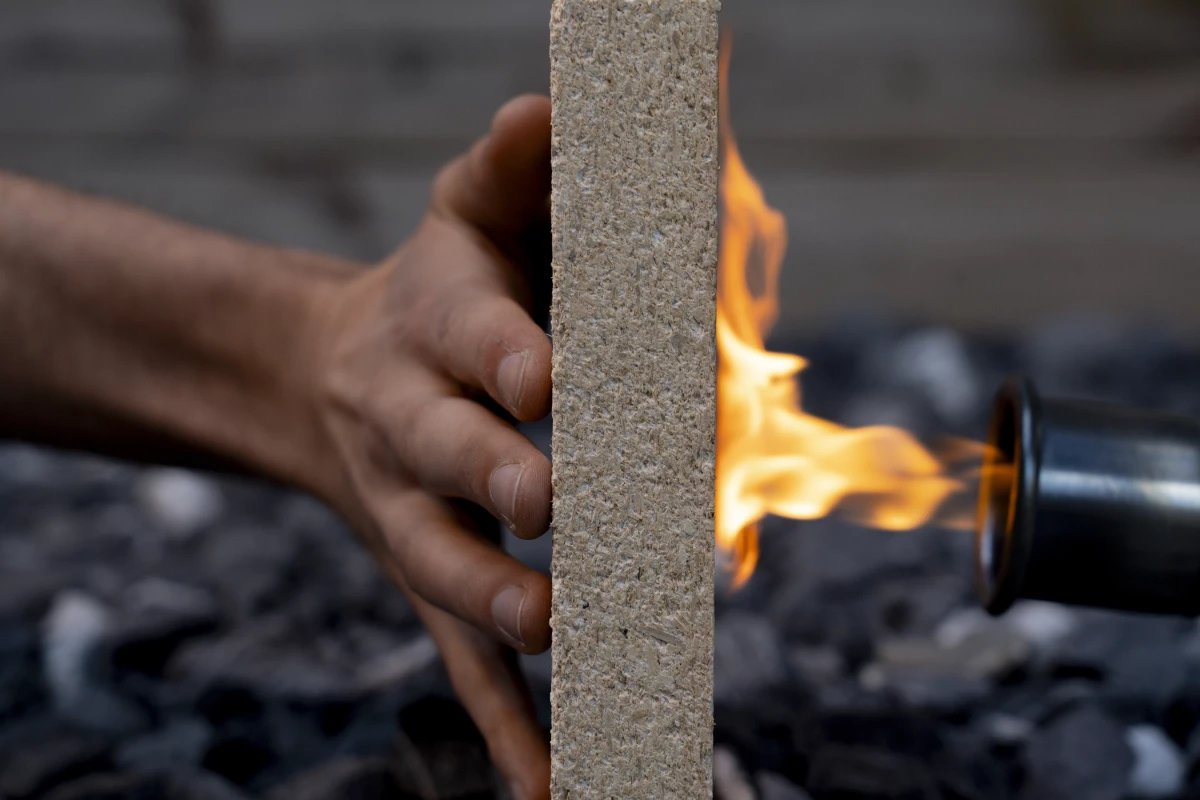
When it comes to fire-resistant materials, sawdust is usually not the first option that comes to mind. However, specialists have developed a method to use sawdust in combination with a mineral commonly found in kidney stones.
This mineral is struvite, a crystalline, colorless magnesium ammonium phosphate known for its fire-protective properties. Despite this, struvite is quite brittle and requires the addition of other components to improve its strength.
Sawdust, a byproduct of the forestry and woodworking industries, was chosen as such a component. Typically, sawdust is burned for energy or disposed of in landfills.
Previous attempts have been made to combine sawdust with struvite to create fire-resistant panels suitable for interior partitions in buildings. However, the crystallization process of struvite made it difficult to form a strong bond with the wood particles.
Researchers from ETH Zurich, Empa, and the Polytechnic University of Turin have found a solution to this problem. Using an enzyme derived from watermelon seeds, they managed to control the crystallization of struvite from an aqueous suspension of the mineral precursor, newberyite. As a result, large crystals formed, filling the gaps between the spruce sawdust particles and creating a strong composite material.
The resulting panels were pressed into shape for two days, then removed and dried at room temperature. Tests showed that the panels had greater compressive strength perpendicular to the grain compared to the original spruce wood.
The material also demonstrated high fire resistance thanks to the struvite. When heated, the mineral decomposes, releasing water vapor and ammonia. During this process, struvite absorbs heat from the environment, creating a cooling effect. Additionally, non-flammable gases are released, displacing air and reducing the oxygen available to the fire, which helps the panel char quickly and lowers its flammability.
Initial tests indicate that the panels provide a level of fire protection comparable to cement-bonded particle boards, but with a lower weight.
Unlike cement boards, which are typically discarded after building demolition, struvite-based panels can be recycled. The material is ground up, heated to 100°C, the sawdust is separated, and newberyite is precipitated again for reuse.
The research results have been published in the journal Chem Circularity.