

Two new exoplanets discovered orbiting the star GJ 887
Astronomers have confirmed the existence of two new exoplanets orbiting the red dwarf GJ 887, one of which lies within the habitable zone and may have conditions suitable for liquid water. Further research will help scientists learn more about the potential for life in this system.
Cursus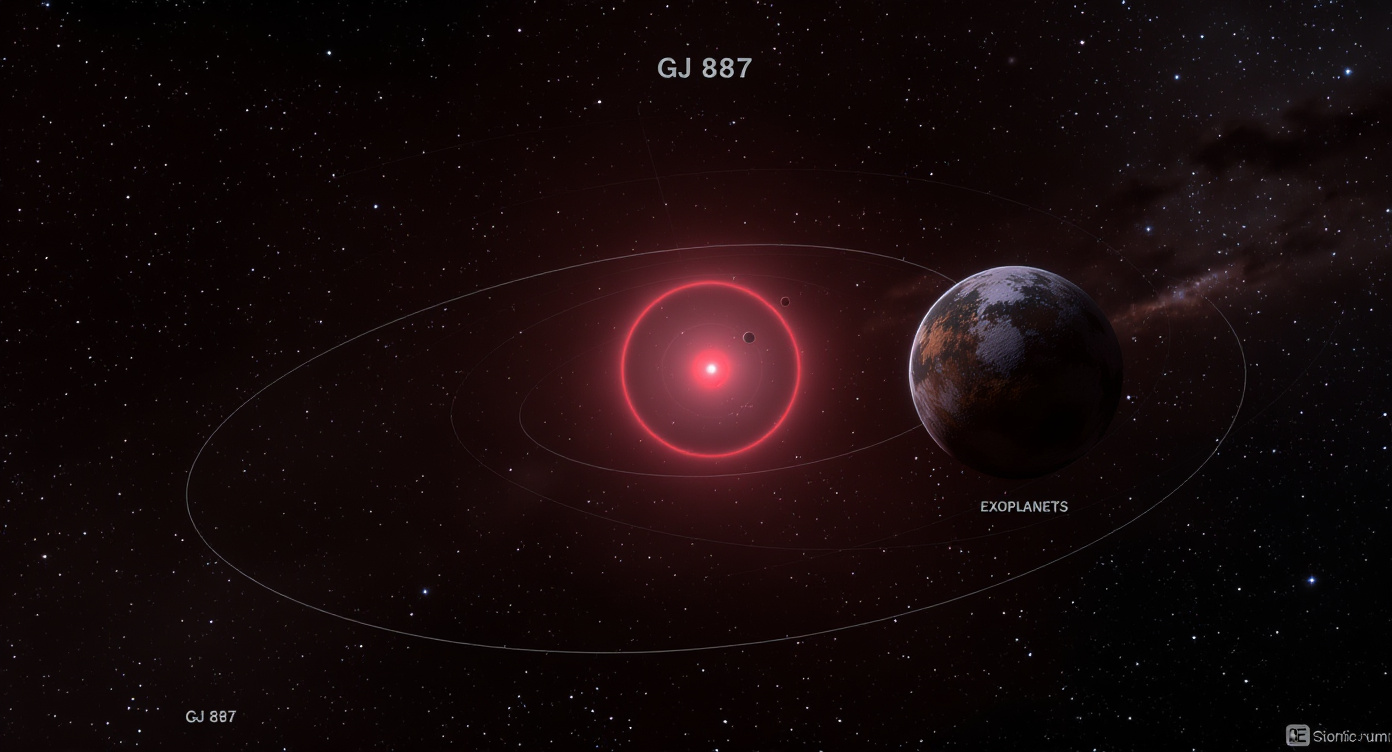
Astronomers have discovered two new exoplanets orbiting the red dwarf star GJ 887, using data collected from various telescopes and satellites. One of the newly found planets is located in a zone where conditions may be suitable for liquid water to exist.
For many years, scientists have been observing stars to study their composition and search for new exoplanets. Recent research has confirmed the existence of two new planets around the star GJ 887, with one of them situated in the habitable zone.
GJ 887 is a red dwarf located about 10.7 light-years from Earth. Previously, three exoplanets had already been discovered in this system. New data obtained with the HARPS and ESPRESSO spectrographs have made it possible to confirm the presence of two more planets orbiting this star.
Combining these results with photometric observations from the TESS satellite and the All-Sky Automated Survey revealed that the latest discovered planet, designated GJ 887 d, completes a full orbit around the star in 50.8 days. This planet is also located in the habitable zone. Its mass is about six times that of Earth, classifying it as a super-Earth. According to calculations, it could be either rocky or covered by an ocean.
Further studies and observations are needed to confirm these findings and to gather more information about the planetary system of GJ 887. Such research could provide new insights into the potential for life elsewhere in the universe.