

Jealousy in Baboons: Emotions Similar to Humans
A new study has shown that baboons in the wild display jealousy similar to that of humans: older offspring often interrupt interactions between their mothers and younger siblings, not for their own benefit, but to disrupt their closeness. These findings support the idea that complex emotions emerged in primates long before humans appeared.
Cursus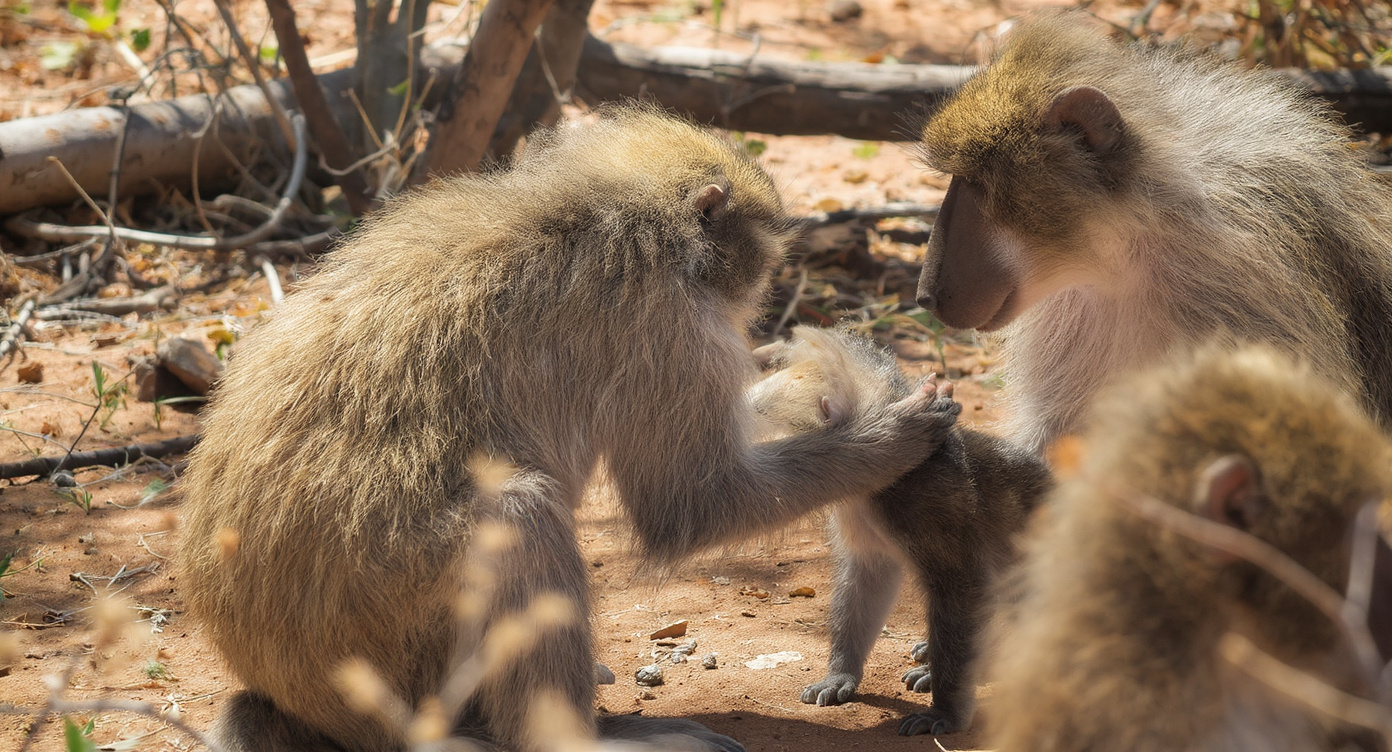
When a mother pays attention to her younger offspring, the older child often stays close by—becoming persistent, noisy, and inventive in order to draw attention to themselves. The older sibling may interfere, push the younger one away, or distract the mother, simply to disrupt their closeness. Many families are familiar with this kind of behavior. Now, similar scenes have been observed in the wild—among baboons in South Africa.
Jealousy in Humans and Animals
Jealousy in humans has long been a subject of scientific interest, especially in families where children compete for their parents’ attention. Older children often interrupt their mother’s interactions with younger siblings, even if they gain no direct benefit from it.
But are animals, particularly primates, capable of feeling jealousy? Scientists have debated this for decades. Most studies of emotions in monkeys have been conducted in laboratories and with a limited number of subjects, so convincing data from the wild has been lacking, even though many primatologists have suspected similar mechanisms exist in animals.
Studying Baboons in the Wild
A team of Finnish researchers led by Aksel Delone from the University of Turku set out to fill this gap. For most of 2021, the researchers observed families of chacma baboons (Papio ursinus) in the Tsau//Khaeb National Park in Namibia. From dawn to dusk, they followed large family groups of these monkeys on foot. In these groups, males leave after reaching sexual maturity, while females stay and give birth every 1.5–2 years. This means several siblings grow up together, creating an ideal environment for studying competition and emotions.
Grooming as a Social Ritual
The scientists focused on grooming—mutual fur cleaning—which serves not only a hygienic purpose but also an important social function. Grooming strengthens bonds, soothes, and demonstrates attachment; for baboons, it is comparable to hugging or a heartfelt conversation among humans.
The researchers recorded how juveniles and adolescents reacted when their mother groomed another of her offspring. The scene was strikingly familiar: the older baboons constantly tried to interrupt, stood between the mother and the younger sibling, pushed the rival away, loudly expressed their displeasure, or pretended they wanted to play with the one being groomed.
Testing the Hypotheses
To understand the motives behind this behavior, the scientists considered several hypotheses. The first—the “jealousy hypothesis”—suggested that the goal of the interference was specifically to disrupt the interaction between the mother and the other offspring, even if the initiator did not benefit directly. Alternative hypotheses proposed that the older sibling simply wanted to interact with the mother or with their brother/sister.
Data analysis clearly supported the jealousy hypothesis. The behavioral patterns of the baboons mirrored what psychologists observe in human children.
- First, adolescents approached their mother more often when she was grooming a younger sibling than when she was alone or interacting with adults. If the juvenile simply wanted contact with the mother, they would have shown this behavior at any convenient moment.
- Second, there was selectivity: adolescents were twice as likely to interfere if the mother was grooming a younger sibling, especially if it was a brother or sister of the same sex. Special attention was given to so-called “mother’s favorites”—those who received more maternal grooming.
- Third, these interventions rarely achieved the desired result: in less than 10% of cases did the initiator end up being groomed by the mother. In most episodes, the mother ignored the jealous one’s actions and continued caring for the younger sibling. This shows that the main goal was not to receive affection themselves, but to stop it for the other.
Comparison with Other Primates
The researchers also noted that as baboons age, their tendency to interfere decreases, which matches the human pattern where childhood jealousy usually fades over time.
Earlier, signs of jealousy had also been observed in great apes, such as chimpanzees. In experiments, chimpanzees showed negative reactions—interference and aggression—when a new individual appeared, protecting an important social contact from “intrusion.” This pattern fits the behavioral criteria for jealousy.
However, there is an important difference: previous studies were mostly conducted on captive animals and focused on relationships between adults, not within families. The work with baboons is unique because the scientists observed them in their natural environment and systematically analyzed behavior within family groups. For this reason, the Finnish researchers consider their findings among the most convincing to date.
The Significance of the Study
Although the idea of jealousy in primates is not new, the results from the Finnish team significantly strengthen the hypothesis that complex emotions appeared in our evolutionary relatives long before the emergence of the genus Homo.
The scientific article was published in the journal Proceedings of the Royal Society B.