

New code unveils the secrets of dark matter
Physicists have developed a new computational tool for modeling self-interacting dark matter, opening up new possibilities for studying its role in the formation of galaxies and the structure of the universe. This new code enables researchers to investigate extreme processes, such as gravothermal collapse, with high accuracy and reduced resource requirements.
Cursus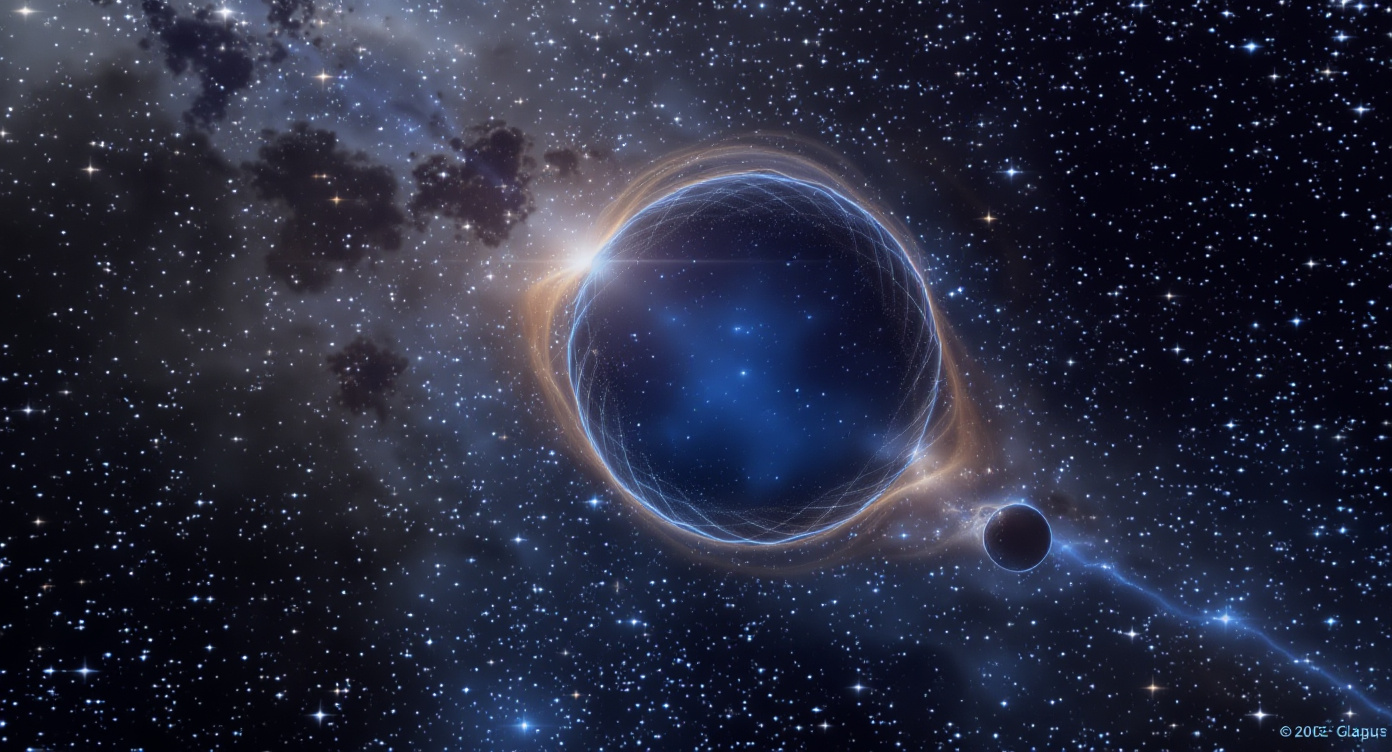
For nearly a century, dark matter has remained one of the most mysterious topics in cosmology. Although it cannot be observed directly, its gravitational influence is what shapes galaxies and the large-scale structure of the Universe. At the Perimeter Institute, two physicists are investigating how a special type of dark matter—self-interacting dark matter (SIDM)—might affect the development and evolution of cosmic structures.
New Methods for Modeling SIDM
In a recent study published in Physical Review Letters, James Gurian and Simon May introduced a new computational tool for studying the impact of SIDM on galaxy formation. Their approach allows for the modeling of particle interactions that were previously difficult or nearly impossible to simulate accurately.
SIDM is a theoretical form of dark matter whose particles can collide with each other, but do not interact with ordinary (baryonic) matter made up of protons, neutrons, and electrons. These collisions occur through so-called elastic self-interactions, which can significantly influence dark matter halos—massive clusters surrounding galaxies that determine their evolution.
Gravothermal Collapse and Its Significance
The self-interacting nature of SIDM can trigger a process known as gravothermal collapse within dark matter halos. This phenomenon is linked to a paradoxical property of gravitational systems: as they lose energy, they actually become hotter rather than cooler. As a result, the inner core of a halo grows increasingly hot and dense, which over time can lead to a dramatic collapse of the core.
Challenges in Modeling and a New Software Solution
For a long time, modeling structures formed by SIDM was a complex challenge. Existing methods worked well only under certain conditions: some were effective for diffuse dark matter and rare collisions, while others were suited to high-density environments with frequent interactions. However, there was no suitable method for intermediate cases.
To address this gap, Gurian and May developed a new software code called KISS-SIDM. This program bridges the gap between existing simulation methods, providing high accuracy with significantly lower computational costs. The code is available to other researchers and can even run on a standard laptop, making it a convenient tool for testing various SIDM parameters.
Growing Interest in SIDM
Interest in self-interacting dark matter has grown in recent years, partly due to puzzling features observed in galaxies that do not always fit standard models. As Perimeter Institute researcher Neil Dalal notes, new anomalies in observations may require the introduction of new physics in the dark sector. Previously, precise calculations of cosmic structure formation in such models were impossible, but the method developed by Gurian and May opens new possibilities for studying the evolution of dark matter with significant interactions.
Perspectives and Fundamental Questions
The collapse of dark matter cores is particularly intriguing because it may leave observable traces, including possible links to the formation of black holes. However, the ultimate outcome of this process remains an open question. The ability to study such extreme conditions in detail using the new code is an important step toward answering some of the deepest questions about the nature of dark matter and the structure of the Universe.