

How the pufferfish creates mysterious circles on the seabed
The small pufferfish creates intricate geometric circles on the sea floor to attract a mate and provide a safe environment for its eggs. These remarkable structures are built within a week and disappear after spawning. This fascinating phenomenon occurs not only off the coast of Japan but also in Australia.
Cursus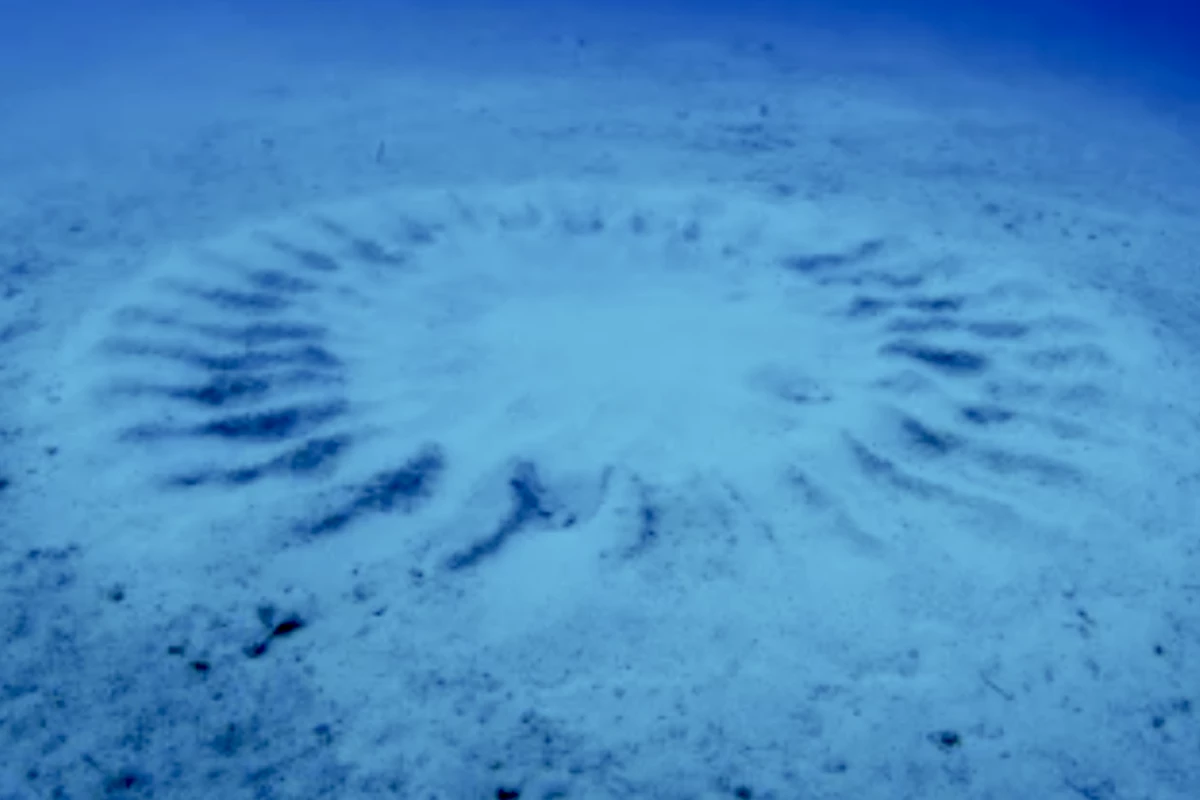
In 1995, divers first noticed mysterious "crop circles" on the seabed near Amami Oshima Island in southwestern Japan. It took decades for scientists to discover who creates these geometrically precise structures and why they appear every year.
The Mystery of the Sea Circles
These circles, up to two meters in diameter, are etched into the smooth sandy bottom. They are not just mounds of sand—ridges and grooves radiate from the center like the spokes of a wheel. For a long time, researchers considered them one of the ocean’s unsolved mysteries.
An Unusual Architect
When scientists finally uncovered the origin of these circles, the answer was no less astonishing: they are built by a small male pufferfish of the Torquigener genus, about 10 centimeters long. Using its fins and body, the fish painstakingly shapes these underwater megastructures to attract a mate and create a safe environment for its eggs. David Attenborough called this pufferfish "probably the greatest artist of the natural world."
How the Circle Is Built
Research has shown that the circle consists of deep radial grooves along the outer ring and labyrinth-like shallow furrows in the center. During construction, the pufferfish repeatedly digs grooves, moving from the outer edge toward the center in straight lines. Modeling these actions confirmed that the complex pattern emerges from the repetition of simple movements by the fish.
The nest’s structure is far more geometrically organized than any other known fish nest. The male starts by pressing its belly to the sand, forming the central spot of the future circle, then digs sand with its fins and body, leaving hundreds or even thousands of marks. Gradually, radial grooves appear, forming the characteristic circular shape. Once the form is ready, the fish returns to the center and creates a labyrinthine pattern. The circles are visible even from the water’s surface, though they are built at depths of 10–30 meters.
Functionality and Female Choice
The outer ring of the circle is made up of numerous radial ridges and depressions, while the central zone is leveled and decorated with a delicate pattern. The center is enriched with fine sand, and the ridges may be adorned with fragments of shells or coral.
Why invest so much effort in a temporary structure vulnerable to currents? The circles play a crucial role in reproduction: after construction is complete, females inspect several nests, choosing the most attractive one for spawning. One of the females’ preferences is the presence of fine sand in the center, which is the first to be washed away by currents, so the male builds a new nest each breeding season.
Engineering the Underwater Nest
The entire construction takes 7–9 days. The male maintains the geometry by swimming over the sand and fanning its fins, creating straight segments. Later studies showed that the elegance of the structure is not due to complex thinking, but to the repetition of simple actions—a phenomenon known as "emergent complexity."
The circle’s design is also functional: it sorts sediment inside, creating ideal conditions for egg development. The circular ridges do not serve as a physical barrier but redirect water currents so that fine sand accumulates in the center, forming a calm, oxygen-rich zone protected from destructive flows.
The Life Cycle of the Circle
When the female arrives, she inspects the circle, swimming along the ridges and over the center. If she likes the nest, she lays eggs in the fine sand at the center. After spawning, the circle quickly disintegrates under the influence of currents. The male stays to guard the eggs but does not maintain the structure—next season, he builds a new nest in a different location.
The Spread of the Phenomenon
For a long time, it was believed that only Torquigener albomaculosus built such circles, but in 2020, scientists discovered similar structures at depths of at least 129 meters off the northwest coast of Australia, more than 5,500 km from Japan. A hybrid autonomous underwater vehicle recorded 21 circular structures strikingly similar to those in Japan.
It is still unknown whether other species of pufferfish living at greater depths build such nests, or if this is a unique trait of a single species. Further samples are needed to confirm this.
Scientific Significance
The discovery not only sparked interest among scientists and the general public but also provided new insights into the behavior and evolution of pufferfish worldwide. In 2022, a 3D model of the famous circle was created, detailing how the male pufferfish uses physics and environmental features to successfully reproduce in challenging underwater conditions.
You can watch how the pufferfish creates its intricate nest in a BBC Earth episode narrated by David Attenborough.