

Orcas and dolphins have teamed up for a joint hunt
For the first time, scientists have observed orcas and dolphins hunting together for Pacific salmon off the coast of Canada. Using advanced technology, researchers discovered that these species not only coordinate their actions underwater but also share their catch, challenging previous assumptions about their interactions.
Cursus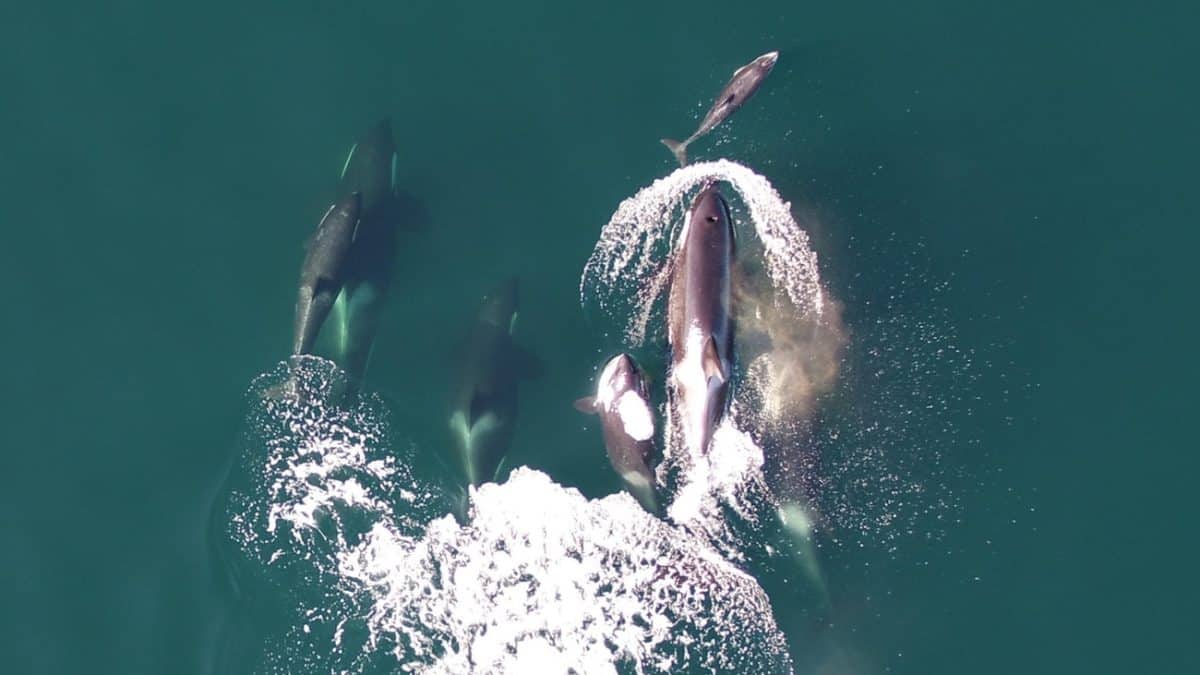
Along the Canadian coastline, marine biologists have observed a unique phenomenon: orcas and dolphins teaming up to hunt Pacific salmon together. These marine mammals dive into deep, dark waters and, after a successful hunt, share their catch. This is the first documented case of cooperative hunting between two different species of marine mammals.
Characteristics of Coastal Inhabitants
In the cold waters off the coast of British Columbia live the so-called "resident" orcas (Orcinus orca ater, or R-type orcas according to Russian classification). This subspecies of orca feeds almost exclusively on Chinook salmon (Oncorhynchus tshawytscha), the largest species of Pacific salmon.
These same waters are also home to Pacific white-sided dolphins (Lagenorhynchus obliquidens). Compared to orcas, dolphins are more social and communicative, and their diet is more varied—mainly herring and small fish.
Unusual Behavior and Scientific Hypotheses
Long-term boat observations revealed that dolphins calmly swim just a few meters from orcas, showing no signs of fear. This surprised scientists, as different species of marine mammals usually compete or behave aggressively toward each other. For example, another orca subspecies—Bigg’s orcas (Orcinus orca rectipinnus, or T-type orcas)—actively hunt dolphins and seals.
Researchers have proposed two main hypotheses to explain this behavior:
- Dolphins use orcas as a "living shield" to protect themselves from more dangerous predators—namely, Bigg’s orcas. In this case, it’s not cooperation but a dolphin survival tactic.
- Dolphins steal food from orcas—a phenomenon known in biology as kleptoparasitism, where one species benefits at the expense of another without providing any advantage in return.
However, neither hypothesis explains why territorial and possessive orcas tolerate the presence of dolphins and show no aggression toward them. Additionally, the murky water and great depths where these interactions occur have made it difficult to get a complete picture of what’s happening.
New Technologies Reveal Secrets
In 2020, an international team of marine biologists led by Sara Fortune from Dalhousie University (Canada) conducted a comprehensive study using modern technology: drones, movement sensors, acoustic devices, telemetry tags, and compact cameras. The equipment was attached to the backs of nine "resident" orcas near the northern part of Vancouver Island.
During the study, 258 encounters between dolphins and orcas were recorded, all occurring during the search, capture, or consumption of salmon. In 25 cases, orcas changed course to follow dolphins, and in total, they turned toward dolphins 102 times.
Cooperative Underwater Hunting
The most fascinating events took place underwater. Data from acoustic sensors and cameras showed that orcas and dolphins dove together to depths of up to 60 meters—where large Chinook salmon hide among rocks and crevices. In these dark conditions, echolocation became crucial.
Analysis of the acoustic data revealed that in the presence of dolphins, orcas often reduced their own echolocation activity to "listen in" on the dolphins’ clicks. If orca echolocation is like a "flashlight beam," dolphins, by scanning the water, act more like a "floodlight," greatly expanding the acoustic "field of vision" and helping to locate prey more quickly.
Sharing the Catch
After a successful hunt, an orca would bring a large Chinook salmon to the surface and tear it into pieces to share with members of its group. At this moment, dolphins would approach the orca’s head and pick up leftover fish. For dolphins, Chinook salmon are too large to catch and swallow whole, so these scraps become a valuable food source. Remarkably, orcas—usually very protective of their catch—showed no aggression toward the dolphins.
Alternative Opinions
Not all researchers agree with Fortune’s team’s conclusions about interspecies hunting cooperation. Some experts, such as Canadian marine biologist Brittany Visona-Kelly from Ocean Wise, note that in her drone studies, orcas often ignored or even avoided dolphins. She suggests that the main benefit for dolphins is protection from Bigg’s orcas, rather than joint hunting.
Nevertheless, Sara Fortune emphasizes that the collected data indicate coordinated actions, not just random "scavenging." Orcas deliberately followed dolphins, not simply tolerated their presence.
This case demonstrates how complex and unexpected relationships between different species of marine mammals can be, and how modern technology helps uncover the mysteries of the underwater world.