

The PHySL soft lens will give robots vision without electronics.
Scientists have developed a soft hydrogel lens called PHySL that can focus using light alone, without any electronics. This breakthrough opens up new possibilities for soft robotics and medical devices. The biomimetic technology makes robots more flexible and safer for interacting with living organisms.
Ingenium
Analog cameras are far less efficient than biological eyes. If you've ever held a DSLR camera, especially one with a zoom lens, you know how heavy they can be and how long and tricky it can be to adjust the focus.
Even digital SLR cameras, despite their speed, can't shift focus as subtly and automatically as our eyes do thousands of times an hour. Camera lenses are rigid and bulky, and to focus, they must be physically moved back and forth—unlike our eyes, which instantly adapt to different distances.
Nature has given us soft, compact, and flexible eyes that can instantly switch focus from a glistening spiderweb in the sunlight right in front of us to a distant horizon. But while this is second nature for humans, who will take care of robots' vision?
Biomimicry for Robots: The Next-Generation Soft Lens
To enhance robotic vision, Kory Chen and Shu Jia from the Georgia Institute of Technology have developed an innovative solution for robots—a photosensitive hydrogel soft lens called PHySL. In their article in Science Robotics, they describe this invention as a "bioinspired photosensitive soft robotic lens."
Instead of traditional bulky and fragile lenses with mechanical actuators, PHySL uses soft hydrogel (water-based) polymers that can mimic the function of muscles. This lens adapts to the required focal length by contracting and stretching, just like the human eye, rather than moving forward and backward. The design was inspired by the ciliary muscles of the human eye.
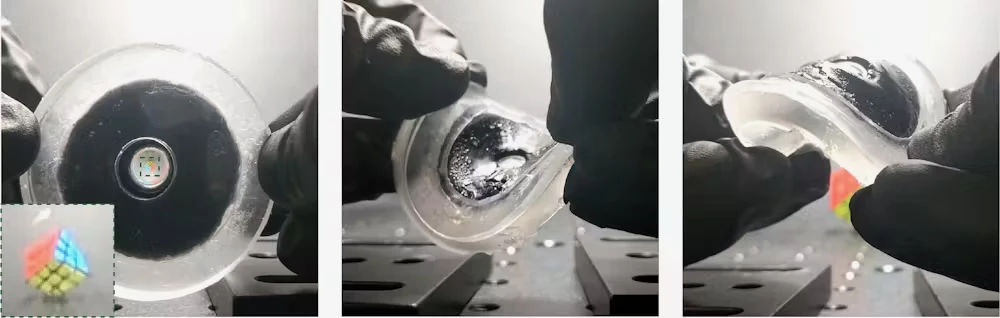
PHySL doesn't require an electronic signal to adjust—it responds directly to light. This allows for precise focus control by illuminating different parts of the lens. As the authors note, "by using a dynamic hydrogel actuator that autonomously harnesses optical energy," PHySL provides "significant focus adjustment through fully optical control." The absence of rigid materials makes the lens flexible, durable, and safe, especially when in contact with living organisms.
Advantages for Soft Robotics and Medicine
While metallic robots from Pixar and Star Wars do just fine with glass or polymer eyes, the new generation of autonomous machines—soft robots—and various biomedical tools must operate in natural environments or inside living organisms without causing harm.
Thanks to its biomimetic design, PHySL is soft, low-power, and autonomous, making it ideal for surgical endoscopes and grippers designed to handle delicate objects. The flexibility of soft robots allows them to access environments that are inaccessible or dangerous for rigid machines.
These features are especially important for wearable electronics, such as skin-like sensors, and for internal devices like hydrogel implants, since they can move and stretch without damaging surrounding tissues.
Technological Challenges and Future Prospects
Although soft smart materials have long been used in grippers and actuators, integrating them with optical systems has been challenging: traditional soft lenses often required liquid-filled chambers or actuators that couldn't function without electronics. This increased complexity, risk of damage, and required inconvenient connections. PHySL, activated by light, eliminates the need for electronics and the complications that come with them.
Inspired by their success, Chen and Jia plan to further improve PHySL by using new hydrogels that respond more quickly to light and provide stronger contractions. They are also exploring applications of these developments in cameras. A prototype camera without electronics has already been created, in which PHySL is integrated with a specially designed photosensitive microfluidic chip—intended for use in soft robots to provide vision without electronics.
If this system proves successful, the soft descendants of WALL-E and R2D2 could embark on underwater adventures or, in miniature form like in "Fantastic Voyage," explore the inner world of the human body.