

Drones are learning to land on branches using touch sensors.
Researchers from Delft University of Technology have developed a drone equipped with tactile sensors that can safely land on tree branches even in low-visibility conditions. This new approach complements visual systems and opens up opportunities for observing nature without unnecessary noise or excessive energy consumption.
Ingenium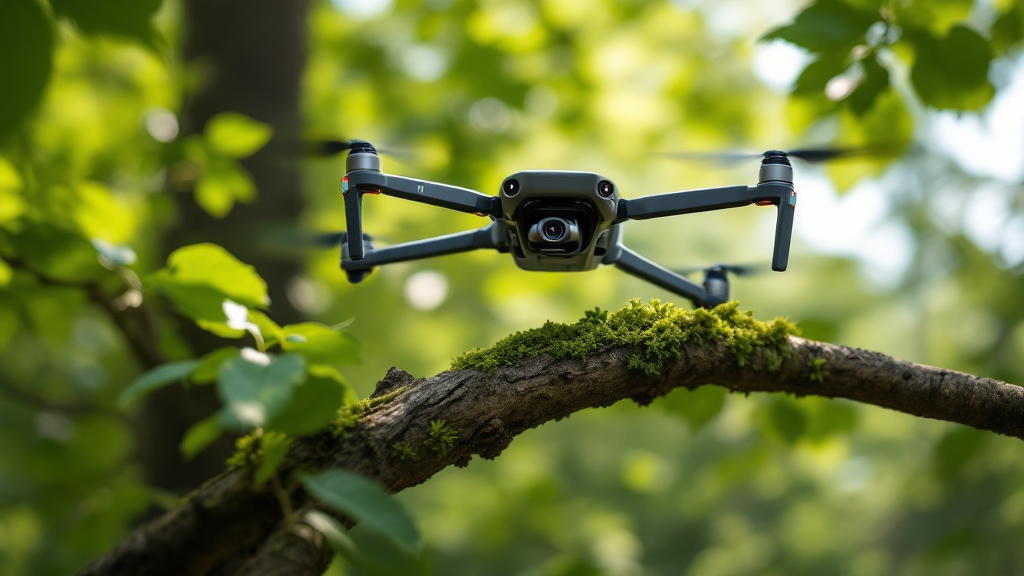
Unmanned aerial vehicles are being used in a variety of fields, including military operations and environmental research. However, ensuring the safe landing of drones, especially in challenging weather conditions, remains one of the most difficult tasks.
Challenges of Drone Landing
For wildlife observation, drones need to remain close to animals without being noticed or making noise, so as not to disturb them. Keeping a drone hovering is not always feasible, as it quickly drains the battery and generates noticeable noise. Landing on tree branches could solve this problem, but implementing such a function is technically complex.
Various nature-inspired solutions have been proposed in the past: drones with cat-like claws or with membranes resembling flying squirrel wings to slow down their descent. However, the challenge of precise landing on tree branches has remained unsolved.
Limitations of Visual Systems
Typically, drones use cameras to determine where and how to land. In forests, the camera's view can be obstructed by branches and leaves, making it difficult to accurately identify the position of a branch.
A New Approach: Tactile Sensors
Researchers at Delft University of Technology have developed a new drone prototype capable of using tactile feedback to land on branches. The prototype is equipped with three flexible "fingers," each made up of three segments, increasing the contact area and allowing the drone to grip the branch.
Each finger contains three tactile sensors embedded in a soft silicone shell. When a sensor touches a branch, it sends an electrical signal, registering the contact. By knowing which of the nine sensors was triggered, the drone can determine the branch's position, size, and orientation—much like a person identifying an object by touch with their eyes closed.
The Landing Process
First, the drone uses its camera to roughly locate the branch. As it approaches, it begins to feel for the branch with its fingers until physical contact is made. The drone then adjusts its grip, wraps its fingers around the branch, and secures them with built-in springs, allowing it to hold its position without using extra energy.
Test Results
Testing showed that the drone successfully landed on branches in over 99% of cases. Even with a margin of error of up to 60 cm in determining the branch's position, the drone was able to correct itself and land safely.
Significance of the Development
The goal of the project is not to completely replace cameras, but to complement visual systems with tactile sensors, especially in situations where visual information is not reliable enough.
The research was published in the journal Nature npj Robotics.