

Cracks accelerate the destruction of the Thwaites Glacier
A new study has shown that cracks in the Thwaites Ice Shelf are accelerating its disintegration, undermining the stability of the entire system. This could increase Antarctica’s contribution to global sea level rise.
Cursus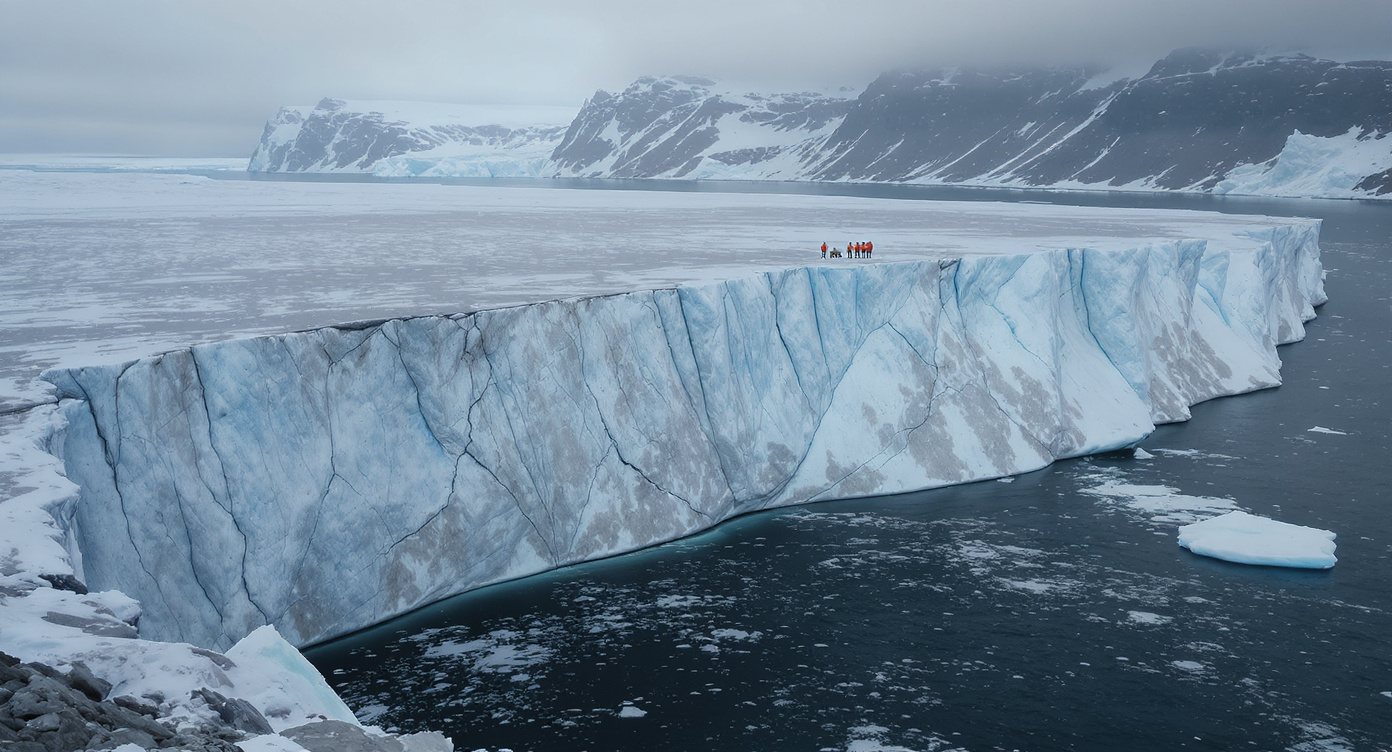
The Thwaites Glacier in West Antarctica, often referred to as the "Doomsday Glacier," is changing more rapidly than most other glacial and oceanic systems on Earth. Its future behavior remains one of the main uncertainties in projections of global sea level rise. The eastern Thwaites Ice Shelf (TEIS), a part of this system, is partially anchored by a pinning point on its northern edge while floating in the ocean. Over the past twenty years, increasingly prominent cracks have appeared on this shelf, especially around the main shear zone located upstream from the pinning point.
New Study of the Thwaites Ice Shelf
A recent study published in the Journal of Geophysical Research: Earth Surface (AGU, 2025) offers the most detailed analysis to date of the gradual disintegration of the TEIS. The research was conducted at the Centre for Earth Observation Science under the leadership of Debanshu Banerjee, with contributions from Dr. Karen Alley (CEOS), Dr. David Lilien (Indiana University Bloomington), and other renowned glaciologists. This work is part of the TARSAN project, which is a component of the International Thwaites Glacier Collaboration (ITGC), aimed at identifying the factors driving changes in this glacier.
Methods and Key Findings
Using satellite observations, ice velocity measurements, and GPS data from 2002 to 2022, the team closely tracked the formation and development of cracks in the TEIS shear zone. Their analysis revealed that the gradual widening of these cracks weakened the shelf’s connection to the pinning point. As this connection deteriorated, the upstream ice began to move faster, further reducing the mechanical stability of the shelf.
The researchers identified four distinct stages of structural weakening and made two main conclusions. First, the cracks expanded in two separate phases: initially, long cracks formed along the direction of ice flow, followed by shorter cracks that cut across the flow. Second, they discovered a positive feedback loop: the cracks accelerated ice movement, which in turn led to further disintegration. This accelerating cycle has played a significant role in the recent decline in the shelf’s stability.
Implications for Antarctica’s Future
The study notes that the pinning point, once a key stabilizing factor for the TEIS, has gradually become a source of instability. The four-stage model of structural weakening may serve as a warning for other Antarctic ice shelves that appear to be undergoing similar phases of vulnerability. If the breakdown of such floating shelves continues, the Antarctic Ice Sheet could contribute even more to future global sea level rise.