

A deep-sea worm transforms poison into protective armor
Scientists have discovered a deep-sea worm that transforms deadly toxins into protective crystals, using them as its own armor. This finding changes our understanding of survival in extreme environments.
Cursus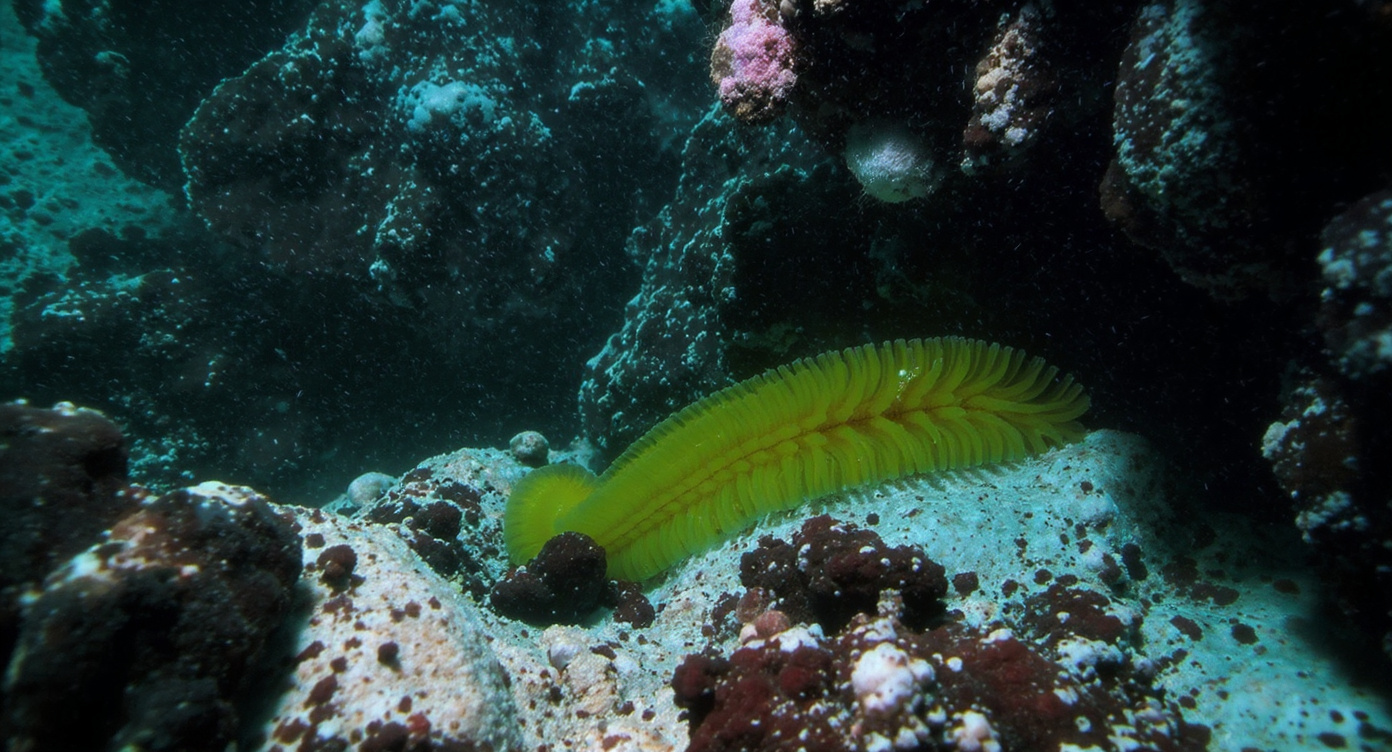
At the bottom of the ocean, where hydrothermal vents release poisonous substances and metals into the water, lives a remarkable organism—the bright yellow worm Paralvinella hessleri. This deep-sea worm has mastered a unique skill: it can transform deadly elements into protective armor, neutralizing arsenic by turning it into crystals.
Discovery of an Unusual Worm
A recent study published in the journal PLOS Biology reveals one of evolution’s most astonishing chemical achievements. Scientist Chaolun Li from the Institute of Oceanology in China, along with colleagues, discovered the unique marine worm species Paralvinella hessleri. This organism inhabits the hydrothermal vents of the Okinawa Trough off the coast of Japan, where water temperatures can reach up to 300 °C.
The worm’s habitat is fascinating not only for its extreme heat but also for its water, which is saturated with metals and chemical compounds that constantly flow into the surrounding environment.
How the Worm Handles Toxins
In this toxic mix, where arsenic concentrations reach lethal levels, researchers found that the worm possesses a unique ability to crystallize arsenic inside its cells, thereby neutralizing its toxicity. But how does this bright yellow resident of the vents manage such a feat?
Biomineralization: Turning Poison into Armor
Scientists discovered that the worm’s vivid color comes from microscopic granules located in the epithelial cells of its skin and gills. These granules are saturated with arsenic, which makes up about 1% of the worm’s total body mass, and almost all of it is in the most toxic form—arsenite. As hydrothermal fluids cool, minerals crystallize and coat surrounding surfaces, creating a dynamic environment with ever-changing chemistry.
Instead of allowing the poison to destroy its body, the worm transports arsenic into membrane-bound vacuoles, where it reacts with another toxin—dissolved hydrogen sulfide. Inside these cellular “laboratories,” the two poisons combine to form solid orpiment crystals (As₂S₃), turning a deadly threat into inert, sparkling deposits.
“I was amazed when I saw on the screen of the underwater vehicle how the bright yellow worms Paralvinella hessleri stood out against the white biofilm and the dark landscape of the hydrothermal vent,” recalls co-author Dr. Hao Wang. “It was hard to believe that any animal could not only survive but thrive in such an extreme and toxic environment.”
Molecular Defense Mechanisms
Transforming poison into crystals requires special coordination. Proteomic analysis showed that the membranes around the yellow granules are rich in transport proteins, including one associated with multidrug resistance. Its role is to transport arsenic directly into the vacuoles, where mineralization occurs. Hydrogen sulfide enters by a different route: a specialized hemoglobin in the worm carries it into the same vacuoles, delivering the final ingredient for this deep-sea “alchemy.”
Chemical Evidence
To determine the source of the hydrogen sulfide, the research team measured sulfur isotopes in P. hessleri and other animals living at various distances from the vents. The worm’s signature matched exactly with the H₂S gas from the hydrothermal emissions, confirming that it obtains hydrogen sulfide directly from the toxic fluids erupting beneath it. Rather than fighting toxins, the worm uses them, turning danger into its own protection.
The Significance of the Discovery
This discovery changes our understanding of life in extreme environments. Instead of avoiding toxins or relying on symbiotic microbes for protection, P. hessleri turns them into building material, locking the poison away in mineral form. Researchers suggest that similar strategies may be found in other deep-sea vent species, depending on the chemistry of their habitats.
Since only one other organism—a scaly-foot gastropod—is known to mineralize hydrogen sulfide, this finding expands the short list of species with such biochemical abilities. Nevertheless, P. hessleri remains largely mysterious: it lives beyond the reach of laboratories and can only be accessed with deep-sea submersibles, making it difficult to fully study the mineralization process.
The next step for scientists will be to determine how the worm’s sulfide armor forms at the molecular level. This work could reveal the structural “choreography” of turning poison into mineral and broaden our understanding of the biochemical limits of life—where survival depends on mastering the most dangerous elements in the environment.
“We hope this model will inspire scientists to rethink how marine invertebrates interact with toxic elements in their environment—and perhaps even use them,” the study authors write.