

Water on Jupiter is distributed extremely unevenly.
New modeling has shown that water in Jupiter's atmosphere is distributed extremely unevenly due to the complex interaction between precipitation and atmospheric vortices. This discovery will help plan future missions to study gas giants with greater precision.
Cursus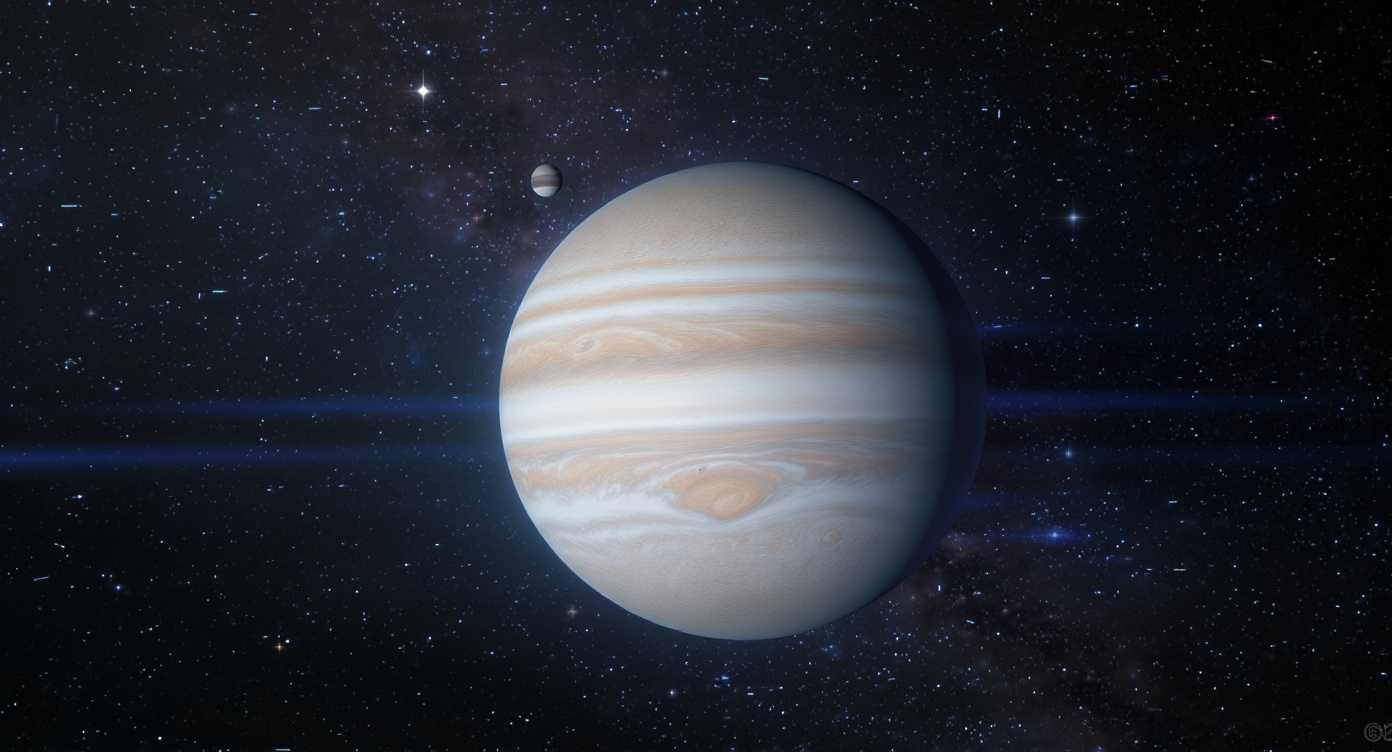
New computer modeling has revealed that water in Jupiter's atmosphere is distributed extremely unevenly. Rain and powerful turbulent flows carry moisture tens of kilometers deep into the planet, resulting in water concentrations in some regions being up to ten times higher than in others.
Jupiter's Influence on the Solar System
Jupiter was the first planet to form in our Solar System. Its immense mass and strong gravity have significantly affected the orbits of Earth and other planets. Understanding how much water is present on Jupiter and where it is located is crucial for unraveling the mystery of water’s origin on Earth—a question that remains open in planetary science. Previous missions, such as Galileo in the 1990s, detected water in Jupiter’s equatorial regions, but it was unclear whether these findings were representative of the entire planet.
Challenges in Studying Jupiter’s Atmosphere
Jupiter’s appearance, with its swirling bands and giant storms, is the result of complex atmospheric dynamics. This beauty also creates major challenges for measuring the chemical composition at depth. NASA’s Juno spacecraft, currently orbiting the gas giant, is tasked with determining the planet’s total water content. The new study helps identify which regions are best suited for measurements to obtain the most accurate results. Similar difficulties arise when studying ice giants like Uranus and Neptune, where other substances, such as methane, condense in the atmosphere.
A New Model of Jupiter’s Water Cycle
To better understand how water is distributed, researchers from the California Institute of Technology developed a new model of Jupiter’s hydrological cycle. Their results were published in the journal Proceedings of the National Academy of Sciences.
The scientists used a high-resolution computer simulation that recreated conditions in Jupiter’s mid-latitudes. The model covered an atmospheric region 45,000 kilometers wide and 60,000 kilometers long, extending from depths with a pressure of 87 bars up to the upper layers at 0.002 bars.
The calculations took into account key features of Jupiter: its rapid rotation (a day lasts just 10 Earth hours) and the specifics of its water cycle—how water vapor condenses to form clouds, falls as precipitation, and then evaporates again at depth. The initial conditions assumed that deep in the atmosphere, water is evenly distributed, with its amount being three times the solar oxygen abundance.
Modeling Results: Complex Moisture Structure
The simulation showed that turbulent flows and rainfall create a complex three-dimensional structure of moisture distribution. Precipitation carries water deep below the visible cloud layer, drying out the upper layers and making the lower atmosphere much wetter at depths of tens of kilometers. This process creates vertical heterogeneity. Large-scale vortices and waves then mix air masses horizontally, but not randomly.
The movement of air currents is strongly influenced by the planet’s rotation. The dynamics of these processes are described by a physical quantity known as potential vorticity. The model demonstrated that this factor governs the mixing of water across latitudes. As a result, at a pressure level of seven bars, water content can vary by more than a factor of ten: in some regions, its concentration is lower than the solar value, while in others it is significantly higher. This explains why local measurements do not provide a complete picture of Jupiter’s total water reserves.
The Importance of This Research for Future Missions
This study clarifies why water on Jupiter is distributed so unevenly. It is the result of a complex interplay between precipitation, which creates vertical separation, and powerful atmospheric vortices that mix moisture across latitudes.
The model suggests that to accurately measure Jupiter’s total water content, probes need to descend to depths where all precipitation has evaporated. These findings will help interpret data from the Juno mission and guide the planning of future spacecraft to study other gas giants in the Solar System.