

Termites use bioprotection to safeguard their fungal farms.
Termites protect their mushroom farms from harmful fungi using a sophisticated strategy: they isolate infected areas and cover them with soil enriched with antifungal microorganisms. This approach allows them to effectively preserve their crops and prevent the spread of infection.
Cursus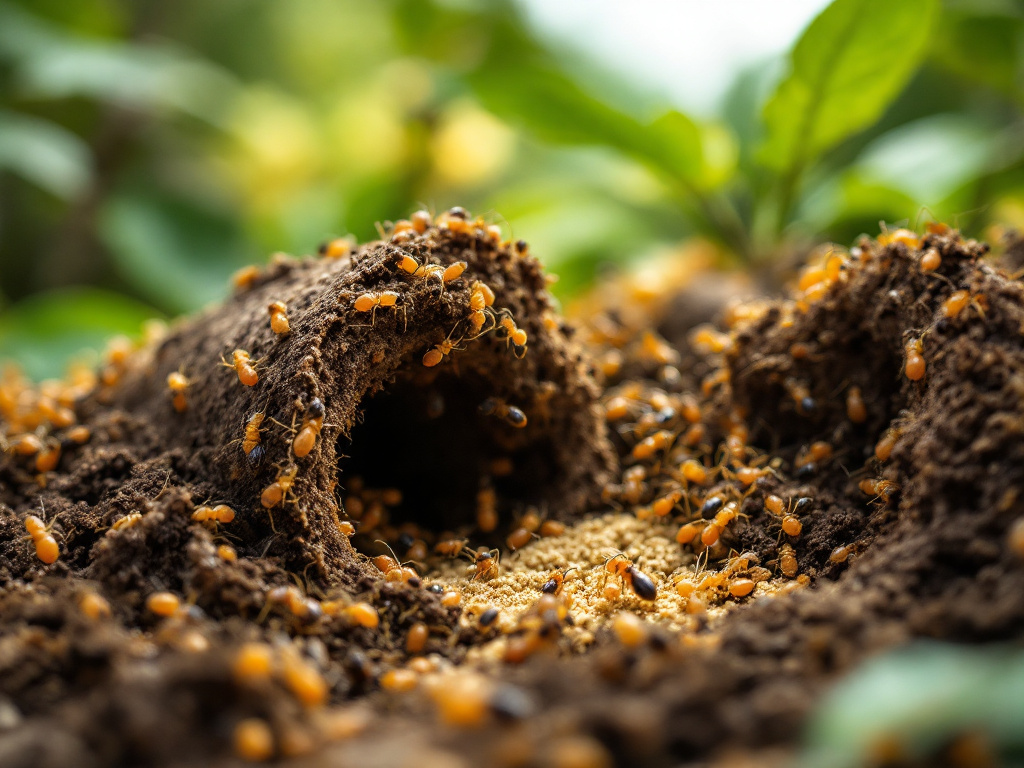
Termites that cultivate fungi for food employ a sophisticated strategy to protect their fungal plantations from harmful weed fungi. They isolate infected areas and cover them with soil enriched with substances that suppress the growth of dangerous fungi.
Fungiculture in Termites
Certain termite species, much like humans, practice agriculture. For example, Odontotermes obesus cultivates the edible fungus Termitomyces in its nests, which serves as the main food source for the entire colony. However, these plantations are threatened by the weed fungus Pseudoxylaria, which can quickly spread and destroy the crop. For a long time, it remained a mystery how termites defend their fungi against this threat.
Hypotheses and New Discoveries
Biologists hypothesized that termites use symbiotic microbes that produce fungistatic compounds—substances that inhibit fungal growth. However, it was unclear how the insects could use this "biological weapon" without harming their own crops.
An international team of researchers has uncovered how termites protect their fungal farms. The results of their work were published in the journal Science.
Experiments and Observations
Scientists observed termite behavior when Pseudoxylaria appeared on their fungus combs made from chewed wood. In a series of experiments, researchers placed a small amount of the harmful fungus onto the fungal mass and monitored the insects' response.
In 29.82% of cases, termites first removed the clump of harmful fungus, then covered the spot with soil pellets, and finally thoroughly cleaned the entire surface. This tactic proved highly effective: in 94.12% of cases, it completely stopped the spread of infection. Simply removing the weed was less successful.
When the infection was severe, termites acted differently: instead of removing the fungus, they completely isolated the infected area by "sealing" it with soil. Complete isolation was observed in 57 out of 101 cases and was effective in 89.47% of them. Partial isolation, used in 32 cases, stopped the spread of the fungus in only 56.25% of cases.
The Role of Soil and Microbes
Analysis of the soil capsules showed that these pellets themselves possess fungistatic properties. When researchers used sterile soil that had not been processed by termites, it did not suppress the growth of the weed fungus. This confirmed that termites add microorganisms to the soil that help combat the harmful fungus.
Integrated Crop Protection
Thus, termites use a comprehensive approach to protect their fungal farms, combining mechanical removal, quarantine, and targeted use of biological agents. They isolate only the infected areas, which allows them to protect the crop not only from the weed fungus itself but also from the effects of fungistatic substances that could harm beneficial fungi.