

Mercury may have formed as a result of a collision between protoplanets.
Scientists have proposed a new hypothesis about the origin of Mercury: it may have formed after a collision between two similarly sized protoplanets. This model explains Mercury's unusual structure, but leaves open questions about the composition of its surface.
Cursus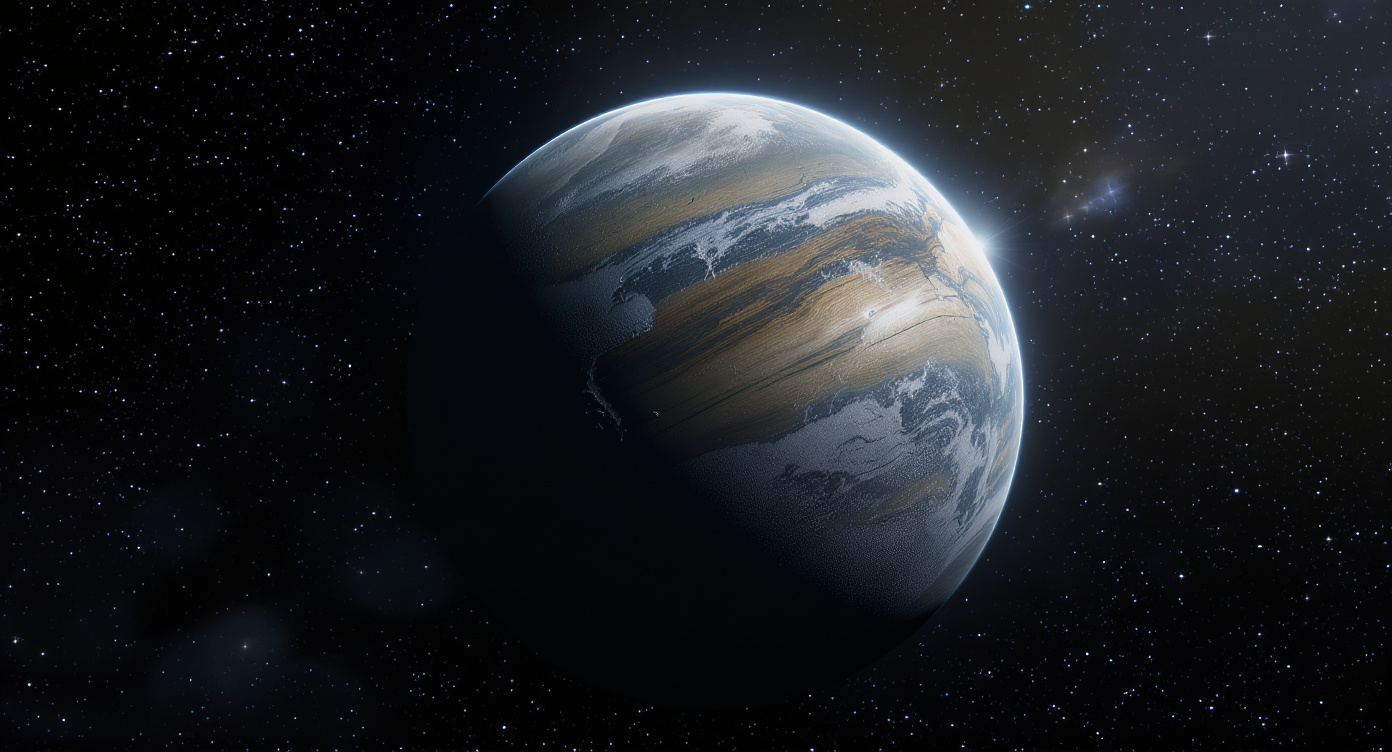
The first planet from the Sun—Mercury—stands out significantly from the other terrestrial bodies in the Solar System. About 70% of its mass is made up of an iron core, while the planet’s mantle is extremely thin. Traditional theories of planetary formation attribute this structure to collisions with objects of varying mass. However, a recent group of scientists has proposed a new hypothesis: Mercury most likely formed as a result of a collision between two celestial bodies of similar size, that is, two protoplanets.
The Mystery of Mercury
Mercury remains one of the most enigmatic planets in the Solar System. Despite its modest diameter of just 4,880 kilometers, its density is comparable to that of Earth and Venus. Data collected by the Messenger probe between 2011 and 2015 revealed that volatile elements have been preserved in Mercury’s mantle and on its surface. This complicates explanations of its origin, since powerful impacts or evaporation should have caused much of these substances to disappear.
A New Origin Hypothesis
In March 2025, astronomers from Brazil, Germany, and France suggested that Mercury acquired its current appearance after colliding with a so-called “proto-Mercury”—an object whose mass was two to six times greater than that of Mars. This event likely occurred within the first tens of millions of years of the Solar System’s existence. According to the hypothesis, the catastrophic collision caused Mercury to lose most of its crust and mantle.
An international research team led by Patrick Franco of the Paris Institute of Earth Physics used computer modeling to show that the most probable scenario is a “grazing” collision between two protoplanets of equal size and mass during the late stages of Solar System formation.
Modeling Results
At certain velocities (22.3 km/s) and angles (32.5°) of impact, one of the objects would lose a significant portion of its mantle, becoming a celestial body dominated by an iron core. The mass and composition of the resulting object matched modern Mercury to within 5%. Moreover, such collisions between bodies of similar mass are much more common in planetary formation models than more exotic scenarios.
The authors note that the success of this scenario depends on several factors: even small changes in angle or speed could lead either to minor mantle loss or to a complete merger of the bodies. In short, Mercury likely arose from a unique, yet entirely plausible, event. The results of the study were published in the journal Nature Astronomy.
Open Questions and Criticism
However, the new model does not explain why volatile substances remained on Mercury’s surface after such a powerful impact. This is especially puzzling given that comets rarely reach Mercury’s orbit (much less often than Earth’s). To determine whether Mercury could have acquired volatiles later—through comet impacts or cosmic dust, for example—and to check if the proposed scenario aligns with the planet’s current position and structure, Franco and his colleagues plan to model the dynamic evolution of the debris.
Some astronomers criticize the giant impact hypothesis, pointing out that the likelihood of such events for planets is much lower than for asteroids, as the probability decreases with increasing body size. Nevertheless, in recent years, giant impact hypotheses have been proposed not only for Earth (the formation of the Moon), but also for Venus, Mercury, and Pluto. If all these assumptions were correct, the Solar System would have experienced several extremely improbable events.