

Scientists have uncovered the mechanism behind the birth of massive stars
Astronomers have, for the first time, closely tracked the birth of a massive star, uncovering a complex system of gas flows and structures that regulate its growth. This discovery sheds light on how giant stars form and explains why their emergence takes hundreds of thousands of years.
Cursus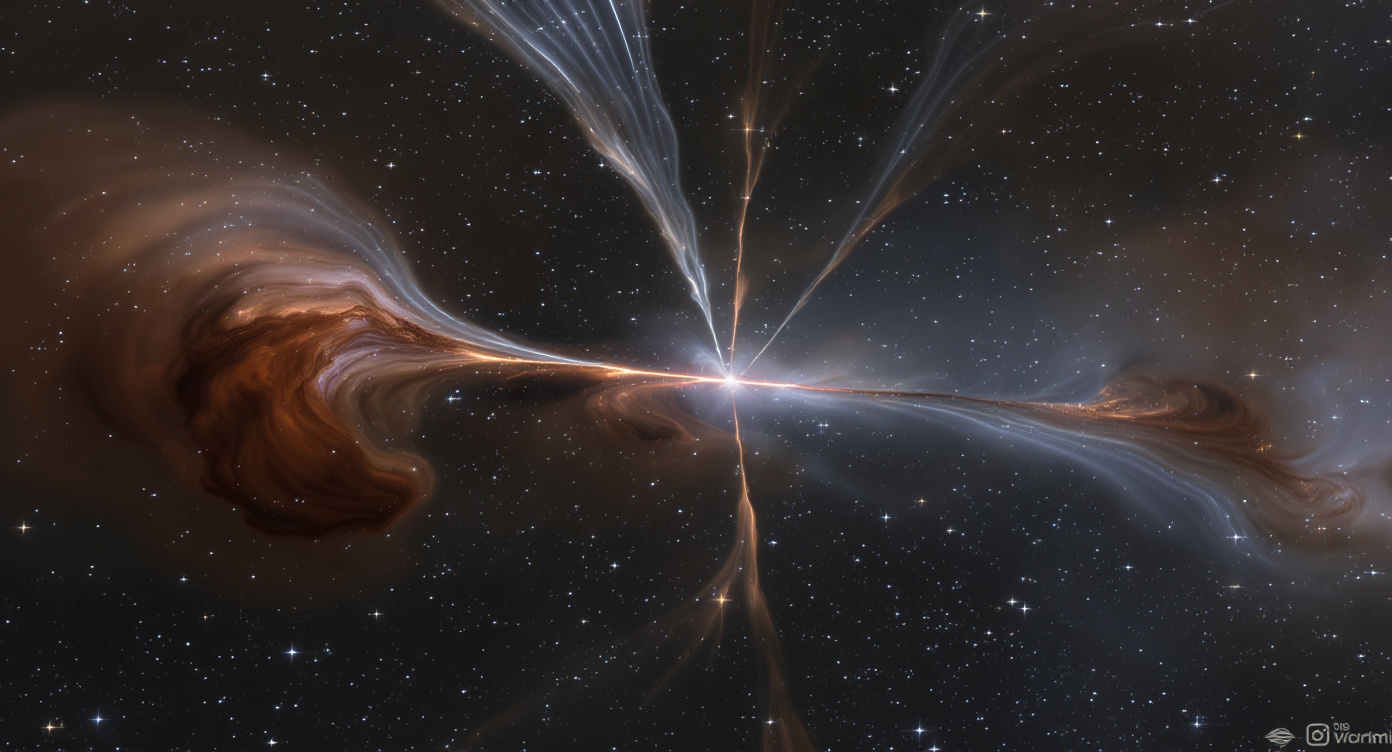
By observing the massive star-forming region IRAS 18134-1942 with the ALMA radio interferometer and the VLA telescope array, scientists have, for the first time, recorded the birth of a massive star. Researchers were able to trace how gas, located thousands of astronomical units from the center of the cloud, gradually moves toward the protostar.
Unlike low-mass stars, which form as a result of gravitational collapse in compact and isolated clouds, the emergence of massive stars is a much more complex process. Such stars are born in a dynamic and turbulent environment, and until recently, scientists could not confidently explain how material is delivered to the accretion disk that feeds the star. Studying these objects (which typically have a mass greater than eight solar masses) is crucial for understanding the structure and evolution of galaxies, since their radiation, stellar winds, and supernova explosions significantly alter the interstellar medium.
An international team of astrophysicists led by Mai Xiaofen from the Shanghai Astronomical Observatory of the Chinese Academy of Sciences discovered a whole complex of structures at the center of IRAS 18134-1942, located about 4,000 light-years from Earth—from giant gaseous arms to a tiny accretion disk—all working together as a single system.
Organization of Matter Flows
The results of the study, published in the journal Science Advances, showed that matter moves according to a clearly organized scheme: three powerful spiral arms, each about 20,000 astronomical units long (0.32 light-years), channel gas into a central bar (bridge) stretching about 7,500 astronomical units (0.118 light-years). This bar acts as a kind of transport hub, where material accumulates and is redirected toward more compact formations.
From the bar, gas flows in narrow streams to a small "pseudodisk," within which a true protostellar disk is forming—the main "engine" of the system, ejecting jets of matter from the star's poles. The inner disk is tilted relative to the outer disk by more than 60 degrees, and their rotation directions are opposite. This indicates that gas is delivered to the center in uneven portions, causing the axis of rotation to "wobble" and shift. Previously, such an effect had only been observed in Sun-like stars.
Bursts of Activity and the Role of Intermediate Structures
Astrophysicists also recorded bursts of methanol masers—unique cosmic radio beacons. The intensity of one of the signals increased tenfold in just a few months, indicating sudden accretion bursts, when the protostar rapidly absorbs new portions of material.
The gas flow, moving along the spirals and bar, reaches about 10⁻⁴ solar masses per year, but only about two orders of magnitude less actually reaches the star through the disk. This led the authors to conclude that intermediate structures act as a "filter" or "regulator," determining the star's growth rate. This feature may explain why massive stars form not instantly, but over hundreds of thousands of years.
Cosmic Resemblance
Interestingly, the system visually resembles a miniature version of a barred spiral galaxy with an active core, but with a young star of about 8–16 solar masses at its center instead of a supermassive black hole. This discovery not only helps to unravel the mysteries of giant star formation, but also points to a remarkable similarity in the processes occurring at different cosmic scales.