

How to Choose the Impact Point to Deflect an Asteroid
Even a successful asteroid deflection does not always guarantee the elimination of threats to Earth—it is crucial to precisely choose the impact point to minimize the risk of a future close encounter. Scientists are developing algorithms and using data from the asteroid Bennu to improve the effectiveness of planetary defense strategies.
Cursus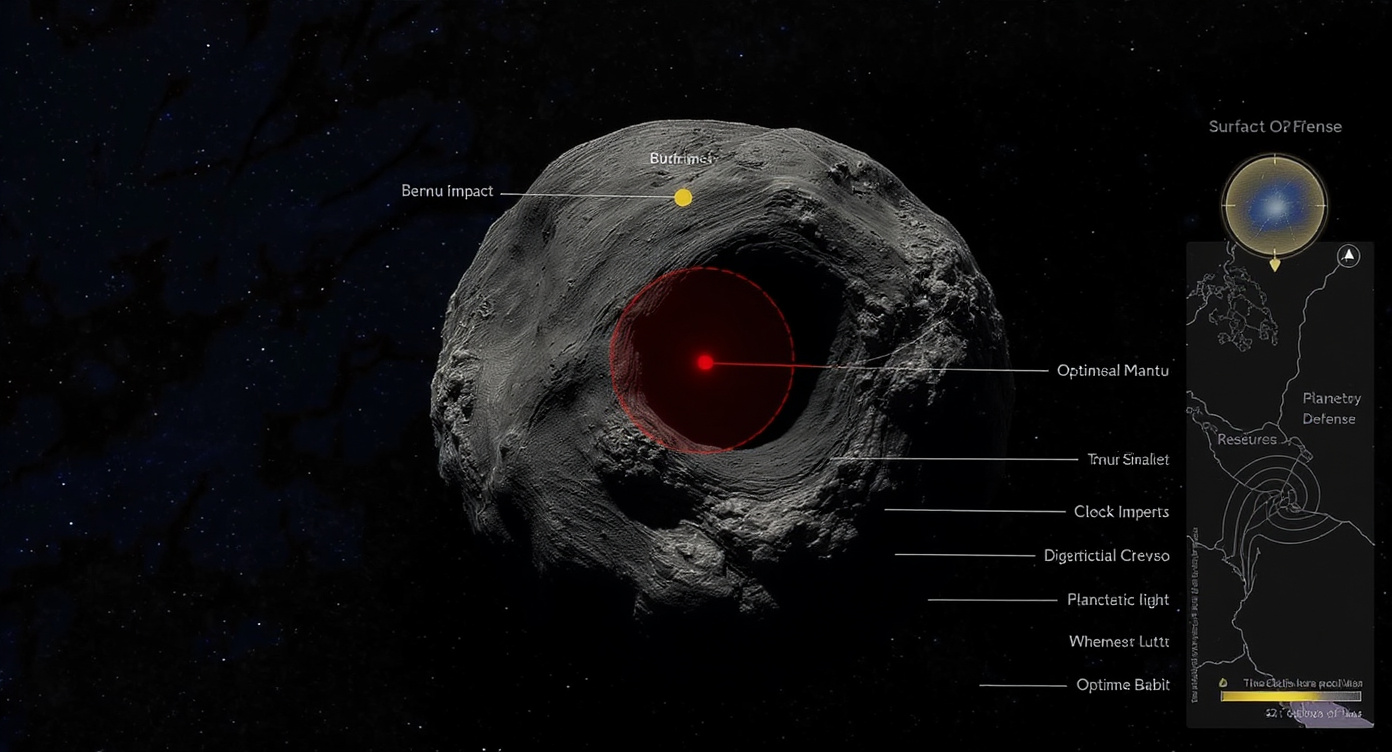
Research has shown that even if a large celestial body heading toward Earth can be deflected by an impact, this does not always guarantee the prevention of a catastrophe. There are many scenarios in which an asteroid or comet could once again end up on a collision course with our planet.
The First Attempt at Planetary Defense
In 2022, humanity conducted its first "rehearsal" for defending Earth against cosmic threats: the DART spacecraft deliberately collided with the asteroid Dimorphos, a satellite of the larger asteroid Didymos. This binary system periodically crosses the orbits of Earth and Mars and is generally considered safe. However, calculations indicate that in the next century, the pair could approach Earth as close as 4.6 million kilometers, and objects of this size are already classified as potentially hazardous.
Unexpected Results of the Experiment
The impact results exceeded scientists’ expectations: it was initially assumed that Dimorphos’s orbital period around Didymos would decrease by only a few minutes, but in reality, it shortened by a full half hour. This is explained by the fact that the calculations only considered the force of the impact itself, while in practice, additional thrust was generated by material ejected from the surface.
The DART spacecraft was aimed precisely at the center of the asteroid to maximize the effectiveness of the trajectory change. According to data from the LICIACube satellite, which recorded the event, the impact hit almost exactly the intended spot.
New Approaches to Asteroid Deflection
Recently, experts from the University of Illinois and NASA’s Jet Propulsion Laboratory explained that when facing a collision threat with Earth, the target point on the asteroid should be chosen differently. At a joint conference of the European Planetary Science Congress and the Division for Planetary Sciences of the American Astronomical Society, they noted that even a successful deflection might only delay a disaster. After some time, the celestial body could again enter a region where Earth’s gravity pulls it back onto a dangerous trajectory. Astronomers call such regions "gravitational keyholes." If an asteroid passes through one of these, its impact with Earth becomes almost inevitable, and there may not be enough time for a second deflection attempt.
Therefore, when selecting the impact point, it is crucial to minimize the risk of the asteroid entering these hazardous zones. The optimal point depends not only on the object’s direction of motion but also on its shape, surface features, and other physical characteristics.
Algorithms and Tests on Asteroid Bennu
Researchers have developed a special algorithm to calculate the safest impact point and tested it on the well-studied asteroid Bennu. Scientists have at their disposal not only detailed images of this asteroid but also samples of its soil, delivered by the OSIRIS-REx probe in 2023. Incidentally, there is a small risk that Bennu (about 560 meters in diameter) could strike Earth in 2182. As a result of this work, a surface map of Bennu was created, highlighting the optimal locations for an impact.
The Importance of Accurate Data
Scientists emphasize that such calculations require extremely precise data about the asteroid. The question arises whether we will have time to send a reconnaissance probe in advance. If not, we will have to rely solely on ground-based observations, which could reduce the effectiveness of our defense.
Image: Surface map of asteroid Bennu with the optimal impact point marked / © Rahil Makadia et al, 2025