

Black holes do not account for all dark matter
Recent studies show that low-mass black holes cannot account for all the dark matter in the Universe. However, debates about the nature of dark matter continue, and new discoveries may change scientists' perspectives.
Cursus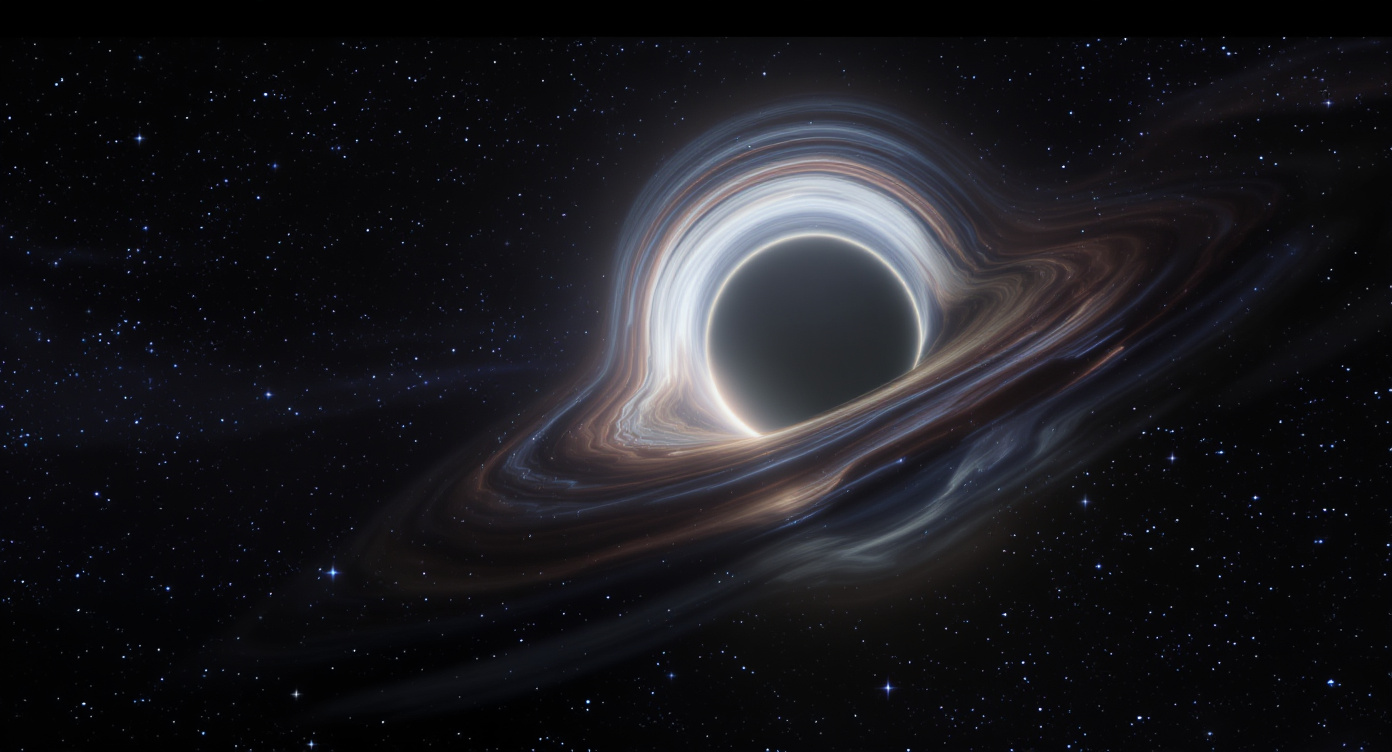
In recent years, astronomers using telescopes have discovered numerous black holes whose origins cannot be explained solely by the evolution of stars over the lifetime of the Universe. Against this backdrop, the hypothesis that all dark matter could consist of such black holes has gained popularity. However, attempts to disprove this theory often encounter even greater challenges than the hypothesis itself.
Recently, scientists reported the discovery of a black hole with a mass of 50 million suns, estimated to have formed within the first billion years after the Big Bang. Explaining how such a massive object could have formed in such a short time is nearly impossible, especially considering that the galaxy in which it was found is less massive than the black hole itself.
Similar cases have been recorded before. These black holes are called "primordial," suggesting they originated in the first seconds of the Universe's existence. Due to their presumed abundance, some researchers link them to the origin of dark matter—a mysterious substance that is not observed in the disks of galaxies but surrounds them in so-called dark halos.
This hypothesis has met with skepticism among those researchers who still hope that dark matter consists of particles. One such scientific group published an article with a bold headline on the Cornell University preprint server, claiming their work was a "nail in the coffin" for the theory of dark matter made of primordial black holes. The article was submitted to the journal Publications of the Astronomical Society of the Pacific.
In their study, the scientists analyzed wide binary systems (binary stars with large distances between components) in the dwarf galaxy Bootes I, located 200,000 light-years from us and orbiting the Milky Way. Of 52 candidates for wide binaries, the distances between stars ranged from 1.05 to 2.4 trillion kilometers (7,000 to 16,000 times the distance between Earth and the Sun).
The calculations showed that the number of wide binaries found in these regions is incompatible with a large number of black holes with masses less than five solar masses within Bootes I. A similar frequency of wide binaries is observed in our own Galaxy. Based on this, the authors concluded that black holes with masses less than five suns are rare and cannot make up more than one percent of the total dark matter mass in the Universe. Therefore, dark matter must consist of something else.
However, as noted several years ago, such calculations are based on the assumption of a uniform distribution of "primordial" black holes throughout the Universe. In practice, proponents of the black hole dark matter hypothesis have believed for about a decade that these black holes should cluster into compact spherical groups with masses up to hundreds of thousands of suns. These clusters are found in the dark halos of galaxies and contain virtually no stars or gas. As a result, their influence on wide binaries in ordinary galaxies cannot be detected—because they simply aren't there.
In the coming years, the debate over "primordial" (or relic, according to the "Phoenix Universe" theory) black holes is likely to intensify, as a significant increase in their detections is expected over the next decade. This could either strengthen the position of those who see black holes as the source of dark matter or prompt a wave of new studies from their opponents.