

Insecticides prevent bees from escaping on water
Bees are able to move efficiently across water by using a unique strategy and navigating toward dark areas to escape. However, insecticides disrupt their coordination, reducing their chances of survival.
Cursus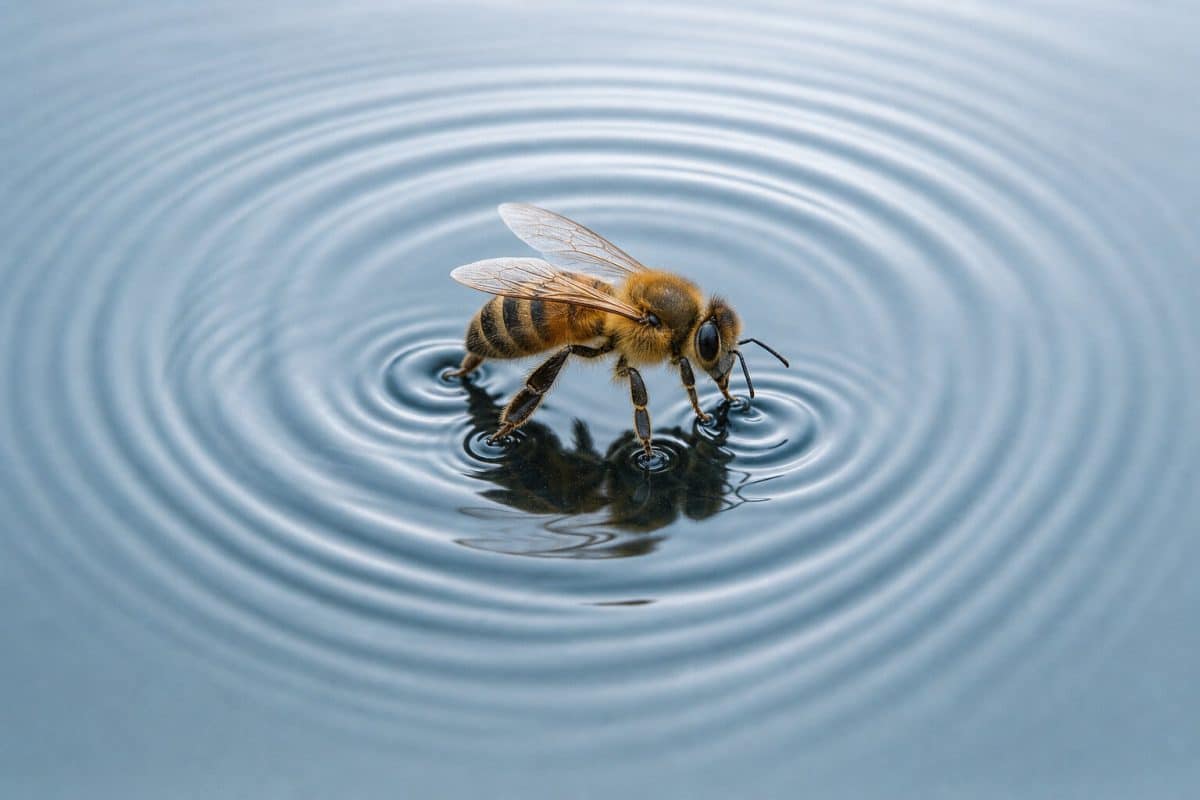
When a bee falls into water, it doesn't sink; instead, it can move quite quickly across the surface, resembling the motion of a hydrofoil boat. Research has shown that when bees find themselves in water, they purposefully head toward the darkest areas in their surroundings, which likely helps them locate the shore and escape.
Features of Bee Movement on Water
In 2019, it was discovered that honey bees are highly efficient at moving across the surface of water. This ability is unusual for insects, which are adapted for flight rather than swimming. Bees use a unique strategy to move at the air-water boundary. Surface tension keeps the bee afloat, but wet wings lose their ability to generate lift. Despite this, the bee continues to beat its wings, creating a hydrofoil effect: an area of higher pressure forms beneath the wings and lower pressure above, generating aerodynamic thrust. Additionally, the wing movements create waves in the water, which also help propel the bee forward.
Orientation and Instincts
Experiments have shown that bees do not move randomly on water; instead, they deliberately orient themselves toward darker areas, which are more likely to be the shore or vegetation. This behavior is called scototaxis—preference for dark zones. In tests with honey bees (Apis mellifera) placed in a dish of water with a dark area at the edge, most individuals moved toward the dark region. Similar behavior was observed in solitary mason bees (Osmia excavata), with females reaching the dark edge faster than males.
The Impact of Insecticides
Studies also examined the effect of thiamethoxam—a widely used insecticide—on bees' ability to orient themselves on water. Bees exposed to the insecticide stopped showing a preference for dark areas and moved about the water in a disorganized way, often taking longer routes to the edge of the dish. Analysis showed that thiamethoxam impaired the insects' coordination of movement, rather than their ability to visually orient themselves.
Importance for Survival
In nature, bees often encounter water: some worker bees collect water to regulate hive temperature, while others may accidentally end up on the surface of ponds or streams. The ability to quickly reach the shore in such situations is vital and helps ensure the survival of the entire colony.
Conclusions
The results of these experiments indicate that insecticides can negatively affect not only bees' ability to collect nectar or learn, but also their capacity to swim and escape from water—an ability that is crucial for maintaining healthy populations of these insects.