

Animals in Costa Rica use trees as toilets
In the cloud forests of Costa Rica, researchers have discovered that sloths, margays, and other mammals use the canopies of certain trees as communal toilets. This finding changes our understanding of animal behavior and their communication within tropical ecosystems.
Natura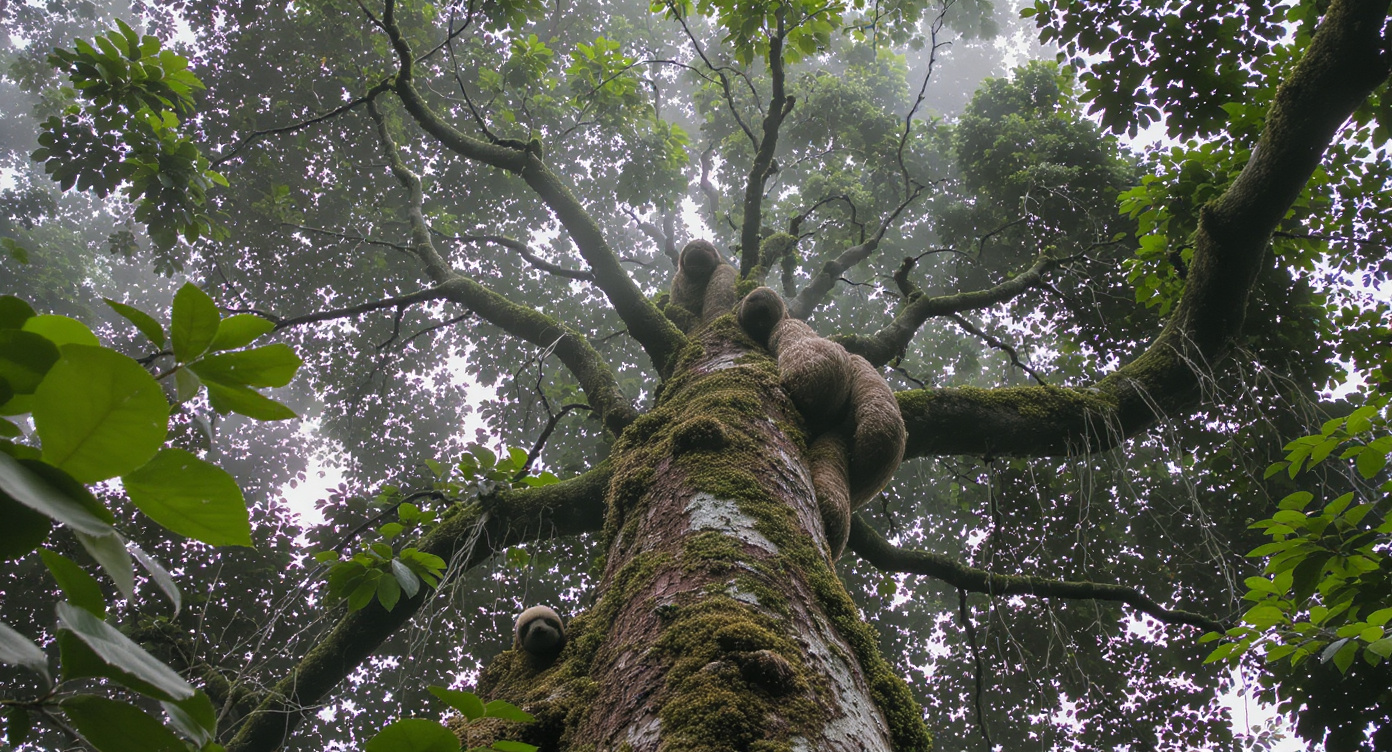
In the cloud forests of Costa Rica, researchers have discovered that margays, sloths, monkeys, and opossums use the canopy of a particular tree species as a communal spot for relieving themselves. This unusual behavior was found by chance during the installation of camera traps and could change our understanding of sloth habits, as well as broaden our knowledge of animal communication.
Animal Behavior in Cloud Forests
In the tropical montane evergreen forests of Costa Rica, known as cloud forests, life thrives not only on the ground but also high up in the tree canopies. Studying animal behavior at such heights is challenging due to dense vegetation and the rarity of animals descending to the forest floor. For a long time, it remained unclear how these species managed their physiological needs and interacted with one another.
It was previously known that some terrestrial mammals use communal latrines to exchange information and mark territory. However, the existence of such places in the canopies of tropical forests had not been documented before.
The Discovery in Ficus tuerckheimii Canopies
Sloths, whose toilet habits have long been a mystery, were of particular interest. It was believed that sloths descended to the ground solely to defecate, exposing themselves to predators.
During an expedition in the Monteverde Reserve, at a height of 30 meters, researchers discovered a natural platform made from the branches of a Ficus tuerckheimii tree, covered in the droppings of various species. Later, similar sites were found on other trees of the same species, indicating a systematic behavior among the animals.
Observation Results
Camera traps were set up on one of these platforms, and over two months, the cameras recorded 181 visits by 17 different mammal species. Among the visitors were opossums, white-faced capuchins, coatis, howler monkeys, weasels, and long-tailed cats (margays), which marked their territory with urine. Porcupines not only relieved themselves but also rubbed against the branches, intensifying the scent.
Two-toed sloths attracted special attention, as they, contrary to previous beliefs, defecated directly in the tree canopies without descending to the ground.
On average, animals visited the platform nearly three times a day, using it not only for physiological needs but also to leave scents, mark territory, and possibly maintain social connections. This suggests that such "canopy toilets" may serve as information exchange points between species.
Prevalence of the Phenomenon and Tree Features
In parallel, 169 trees of 29 species were surveyed to determine how widespread these canopy toilets are. Communal latrines were found only on 11 trees, all belonging to the species Ficus tuerckheimii.
The structure of this tree promotes the formation of such platforms: its branches create a structure at height resembling an inverted bowl with a depression in the center, providing shelter from wind and predators. The long branches (up to 12 meters) can even connect different parts of the forest, acting as "corridors" for safe animal movement.
Scientific Significance
The study results were published in the journal Ecology and Evolution. The discovery reveals previously unknown aspects of animal behavior in tropical forests and highlights the role of certain tree species in forming unique ecosystem connections.