

NASA investigates the mysterious metallic core of Psyche
The asteroid Psyche, the largest metallic object in the belt between Mars and Jupiter, may be a fragment of a planetary core. A NASA mission launched in 2023 will help uncover its origin and structural features.
Cursus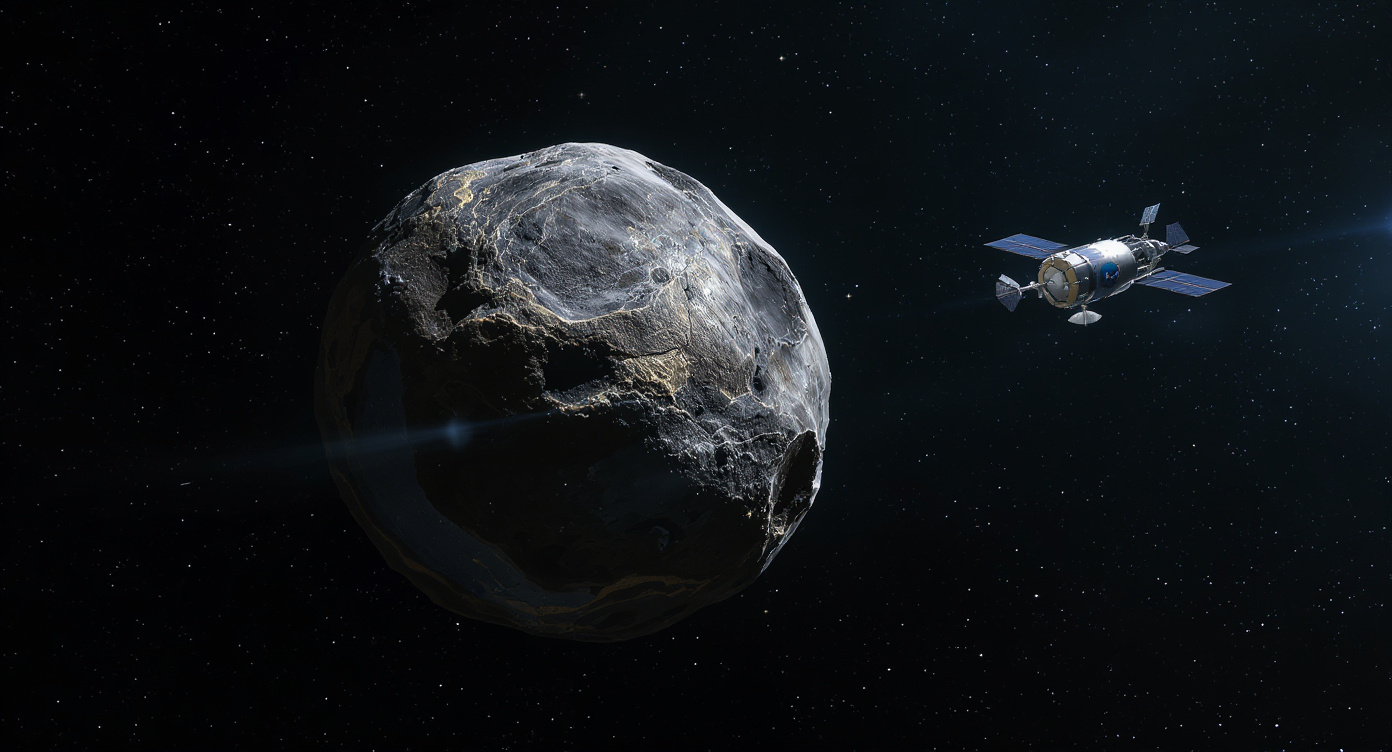
Asteroid 16 Psyche has remained a subject of scientific study for nearly two centuries since its discovery. Research has focused on uncovering its origin and composition.
Psyche is located in the asteroid belt between Mars and Jupiter and spans about 140 miles in width. Unlike most asteroids, which are primarily made of silicates or carbon, Psyche contains a significant amount of metals, making it the largest known metallic asteroid.
Scientists are debating whether Psyche could be a fragment of a planetary core. If this is the case, studying the asteroid could provide valuable insights into the structure of planetary cores. There are several hypotheses regarding its formation. One theory suggests that Psyche was once part of a larger body whose rocky outer layers were destroyed by powerful collisions, leaving only the metallic core. Another hypothesis points to the possibility of metal and rock mixing as a result of destructive impacts. There is also a scenario in which Psyche represents a partially formed, metal-rich planet.
To study the asteroid, NASA launched the Psyche mission in 2023. The spacecraft is expected to reach Psyche in 2029. During the mission, scientists plan to measure the surface composition, gravity, magnetic field, and density variations of the asteroid.
To predict the mission’s outcomes, a three-dimensional model of Psyche was created and tested in various scenarios by changing the speed and size of colliding objects. Special attention was given to the asteroid’s porosity: a more porous body absorbs more impact energy, resulting in deeper craters. Tests were conducted with different sizes of impactors on two models—one with a metallic core and another with a mixed structure of rock and metal. Simulations showed that an object three miles wide could create an observable crater.
The simulations also revealed differences in crater shapes, the nature of ejecta, changes in density, and the distribution of metal on the surface. After the spacecraft arrives in 2029, real observations will be compared with the simulation results. This will provide new information about the formation of planetary interiors and the characteristics of early collisions in the Solar System.