

Neutron star merger reveals the secret of gold
Astronomers have detected a powerful gamma-ray burst caused by the merger of neutron stars in a distant galaxy. This event sheds light on the origin of heavy elements such as gold and platinum in the universe.
Cursus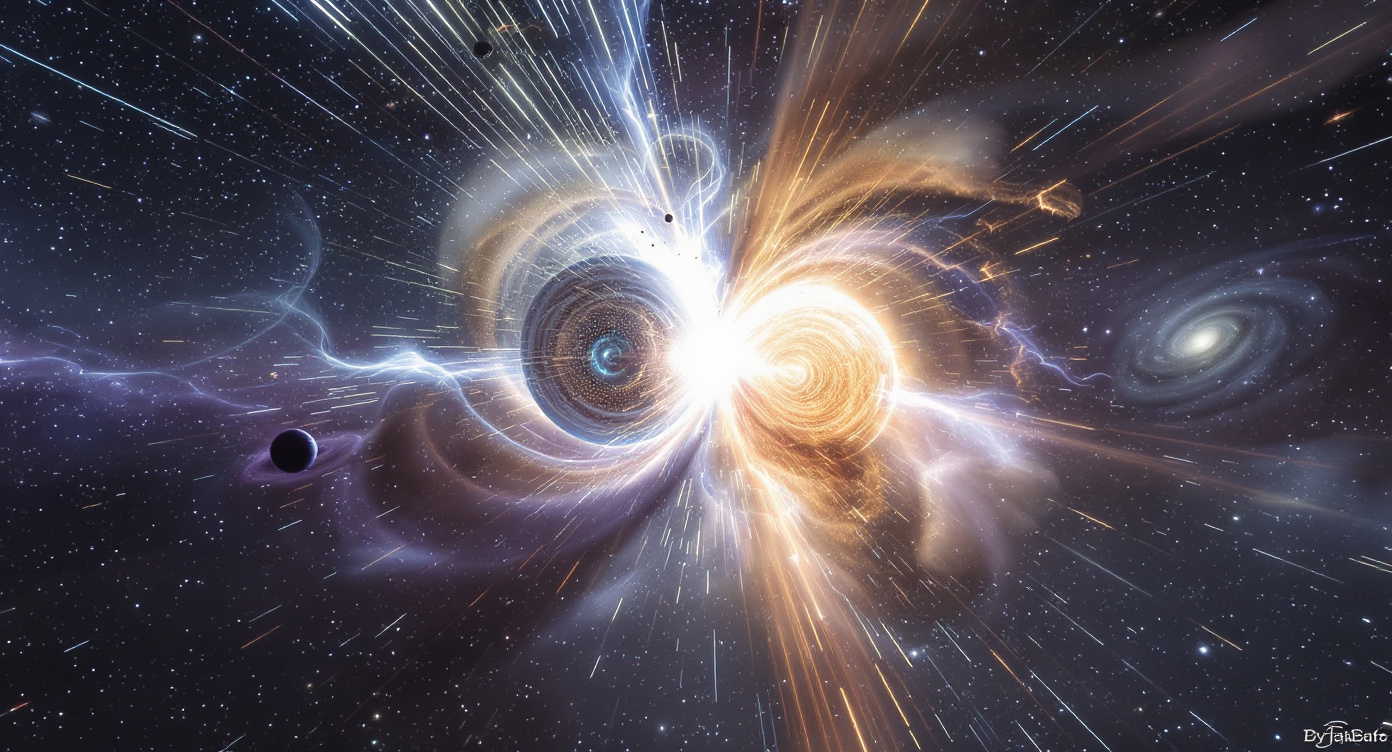
Studies have recorded an intense burst of energy, which is believed to be associated with the collision of two neutron stars. This event provides new insights into the processes of formation and distribution of heavy elements throughout the Universe.
Discovery of the Gamma-Ray Burst
In 2023, the Fermi space telescope detected a gamma-ray burst (GRB), one of the most powerful phenomena in the Universe. Short gamma-ray bursts occur when two neutron stars draw close and collide under the influence of gravity. A neutron star is an extremely dense core left behind after a massive star explodes as a supernova.
Event Localization
Using the Chandra X-ray Observatory and the Hubble Space Telescope, astronomers pinpointed the exact location of the burst—a faint galaxy about 8.5 billion light-years away. The burst, designated GRB 230906A, took place within a stream of debris formed by the collision of galaxies. This elongated stream of matter is known as a tidal tail, and it was within this structure that the event occurred.
Formation of Heavy Elements
The merger of neutron stars also triggered a kilonova—a bright flash that arises during such collisions. As the stars merged, nuclear reactions occurred, leading to the synthesis of heavy metals through the r-process of nucleosynthesis. Elements such as gold, platinum, uranium, and other heavy metals were created and ejected into space. From this enriched material, future stars may form, and such events may explain the origin of gold on Earth.
Implications for the Milky Way
In about 4 to 5 billion years, our Milky Way galaxy is expected to collide with the Andromeda galaxy. This could result in the formation of new neutron stars, their eventual mergers, and the appearance of similar gamma-ray bursts.