

Single-celled relatives of animals are capable of forming groups
A new study has shown that the closest unicellular relatives of animals can form multicellular structures either by cell division or by the fusion of individual cells, choosing their strategy depending on environmental conditions. This discovery changes our understanding of the origins of multicellularity and the evolution of animals.
Cursus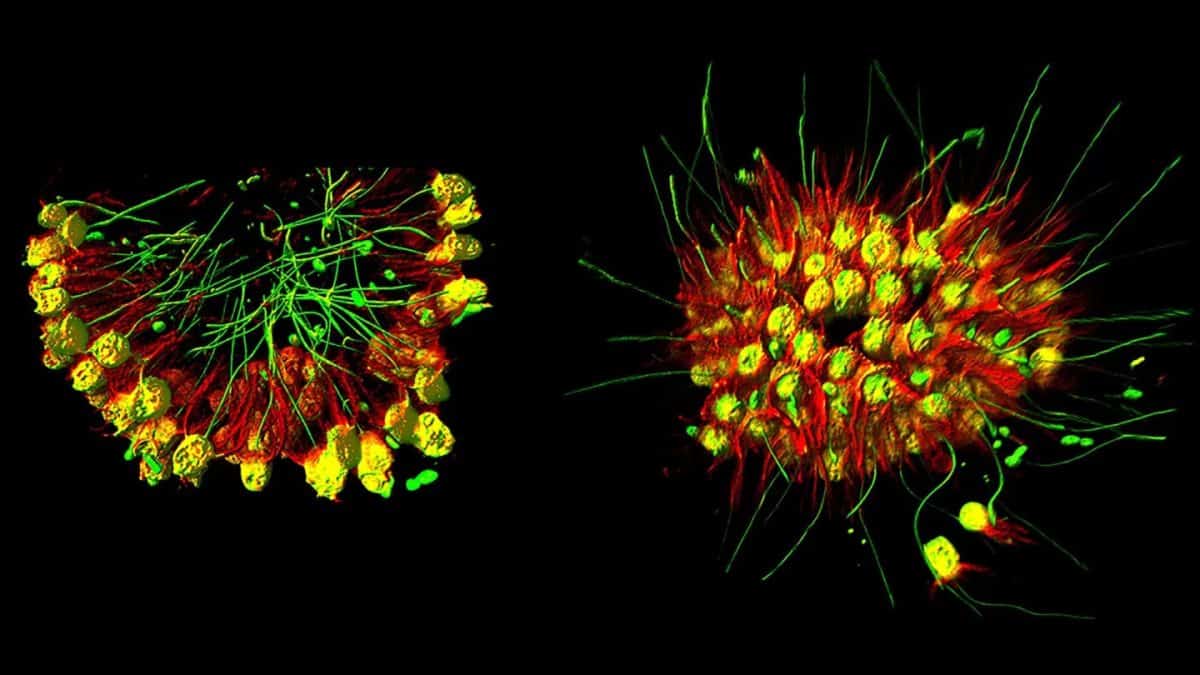
Research has shown that the closest unicellular relatives of animals—choanoflagellates—are capable of forming multicellular structures in two different ways: through cell division and by merging separate cells into a single group. Previously, it was believed that these organisms could only clone themselves, but it has now been discovered that under stress, they actively come together.
The Evolution of Multicellularity
The transition to multicellularity remains one of biology’s key mysteries. For a long time, it was thought that development could only proceed along two strictly separate paths: either a single cell divides and remains connected to its offspring (cloning), or many independent cells gather together (aggregation). Animals, including humans, develop via the first scenario—from a single fertilized egg. It was assumed that their closest unicellular relatives, the choanoflagellates, also followed only this path.
Features of Choanoflagellates
Choanoflagellates are microscopic aquatic organisms that feed on bacteria. They have a flagellum for movement and a collar of filaments for capturing food. Genetically, these creatures are the closest relatives to animals, and studying them helps us understand how multicellular organisms originated.
New Insights into Behavior
Until recently, science only knew about cloning in these organisms. For example, the species Salpingoeca rosetta forms colonies exclusively through cell division. It was believed that the two methods of cell aggregation were mutually exclusive. However, the discovery of a new choanoflagellate species prompted scientists to observe their behavior in natural conditions.
Research on the Island of Curaçao
To study the mechanisms of multicellularity, researchers traveled to the island of Curaçao in the Caribbean Sea. In Shete Boka National Park, they examined numerous coastal pools that periodically dry up and refill with saltwater. The species Choanoeca flexa inhabits these waters.
Flexibility in Colony Formation
In laboratory conditions, colonies were separated into individual cells and their behavior was observed. It was found that single cells not only divided but also quickly found each other, merging into new groups. The fusion process took several minutes, and within a day, the chaotic clusters of cells organized themselves into orderly layers, similar to those formed naturally.
The Influence of the Environment
Experiments showed that the choice of strategy depends on environmental conditions. In coastal pools, water salinity constantly changes due to evaporation. At normal salinity, C. flexa uses both methods to form colonies. When the salt level exceeded 73 parts per thousand, multicellular structures broke down into individual cyst-like cells, which developed a protective shell and entered dormancy to survive drought. After water was added, the cysts awakened and reformed the colony, using both division and fusion with neighbors.
The Role of Population Density
Cell density also influenced the choice of strategy. At low concentrations (about 100 cells per milliliter), division predominated. When density increased to 100,000 cells per milliliter, the organisms switched to aggregation. It was noted that different strains could recognize their own kind: cells preferred to merge with relatives, ignoring outsiders.
Evolutionary Advantages
This dual strategy gives C. flexa an evolutionary advantage. Cloning is reliable but slow, while aggregation allows for the rapid formation of a large organism, increasing the efficiency of hunting bacteria. In environments where a body of water can dry up in just a few days, the speed of colony restoration becomes critically important for the survival of the species.
A New Understanding of the Origins of Multicellularity
The study showed that the boundary between the two developmental paths of life is not as strict as previously thought. The closest relatives of animals can switch between cloning and aggregation depending on conditions. Now, it remains to be seen how widespread this ability is and whether ancient animal ancestors could also gather into groups before fully transitioning to development from a single cell.