

Ancient sharks were giants before reptiles appeared.
A new study has revealed that giant sharks emerged and took on the role of top marine predators much earlier than previously thought, successfully competing with ancient marine reptiles.
Cursus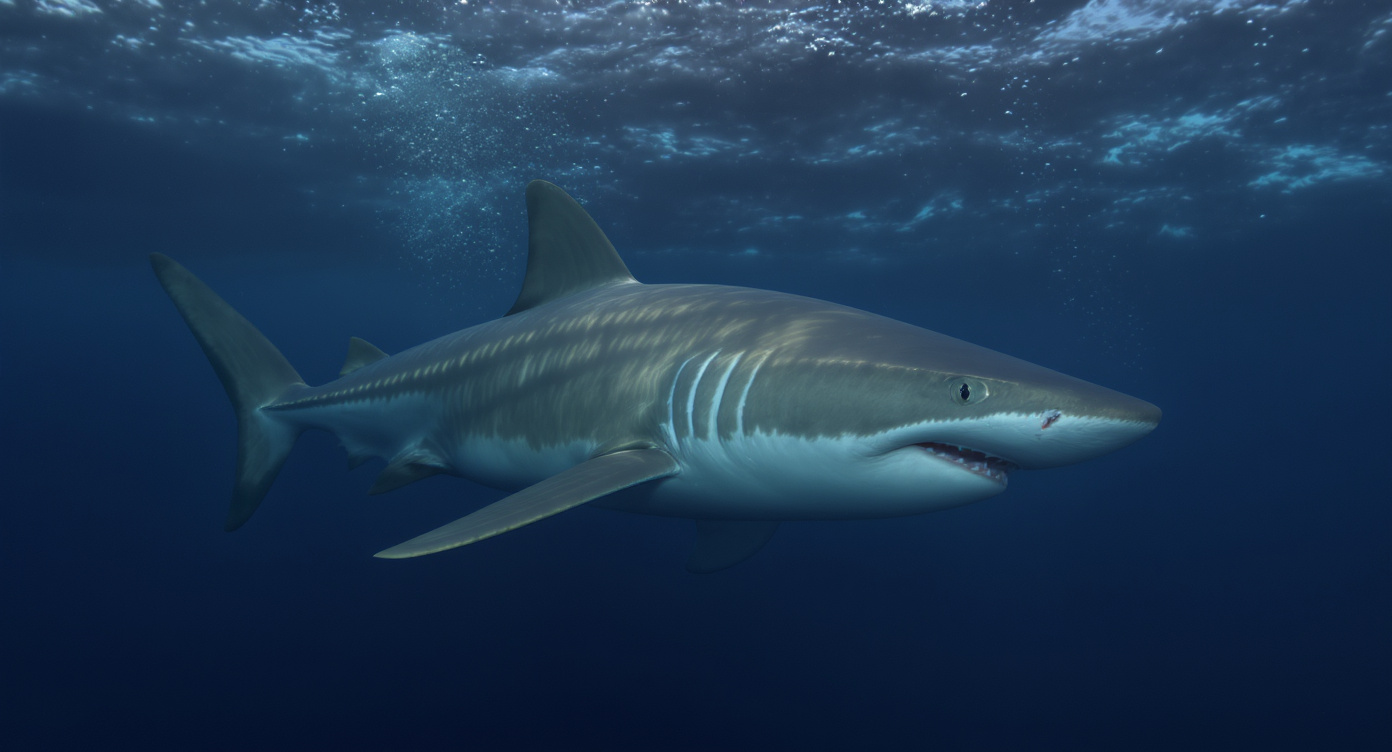
A study conducted in Australia has challenged previous beliefs about the late emergence of apex marine predators among sharks. Scientists discovered fossilized vertebrae of a shark weighing around three tons, indicating that such giants existed long before it was thought possible for sharks to compete with marine reptiles.
Revisiting Old Theories
Earlier scientific models described shark evolution as a slow process, during which small predatory species gradually increased in size and only reached gigantic forms about 100 million years ago. According to these theories, before that time, large reptiles were considered the dominant marine predators, while sharks occupied secondary ecological niches. Genetic and paleontological data also pointed to a late evolutionary leap in sharks, but new discoveries now cast doubt on this timeline.
An Unexpected Discovery in Australia
On the coast of Australia’s Northern Territory, in the Darwin Formation, fossils were found that prove the existence of a giant shark 115 million years ago—a period when sharks were believed to be much smaller. The study, published in the journal Communications Biology, provides a detailed analysis of these vertebrae.
Reconstructing the Ancient Shark’s Appearance
To reconstruct the animal’s appearance, the research team compiled an extensive database of measurements from hundreds of modern sharks—from sand tigers to great whites. They built regression models linking vertebra diameter to body length and mass. Thresher sharks (Alopias), with their unusually long tails that skew statistics, were excluded from the calculations. The internal structure of the ancient vertebrae was examined using tomography, comparing the density of calcification with that of extinct shark families.
Giants of Ancient Seas
Modeling showed that these ancient sharks reached lengths of 6–8 meters and weighed over three tons. Such size allowed them to occupy the ecological niches of top predators, previously thought to be monopolized by large marine reptiles like plesiosaurs and pliosaurs. Sharks became direct competitors to giants such as the 11-meter-long Kronosaurus. The ancient relatives of modern great white sharks hunted fish and aquatic tetrapods, successfully rivaling marine reptiles for dominance in coastal and oceanic waters.
Rethinking Evolutionary Strategy
It turns out that gigantism was not a late adaptation, but an ancient strategy that enabled sharks to compete with Mesozoic marine reptiles millions of years earlier than previously assumed. The study’s authors note that only medium-sized marine reptile remains have been found in the Darwin Formation, supporting the idea that sharks already dominated as large predators during that era.