

Leaders in the pack pay for their status with sleepless nights.
A new study has found that high-ranking baboons sleep less and more restlessly than their subordinates, sacrificing sleep quality for safety in the center of the group. Leadership in the animal kingdom is associated with chronic sleep deprivation.
Cursus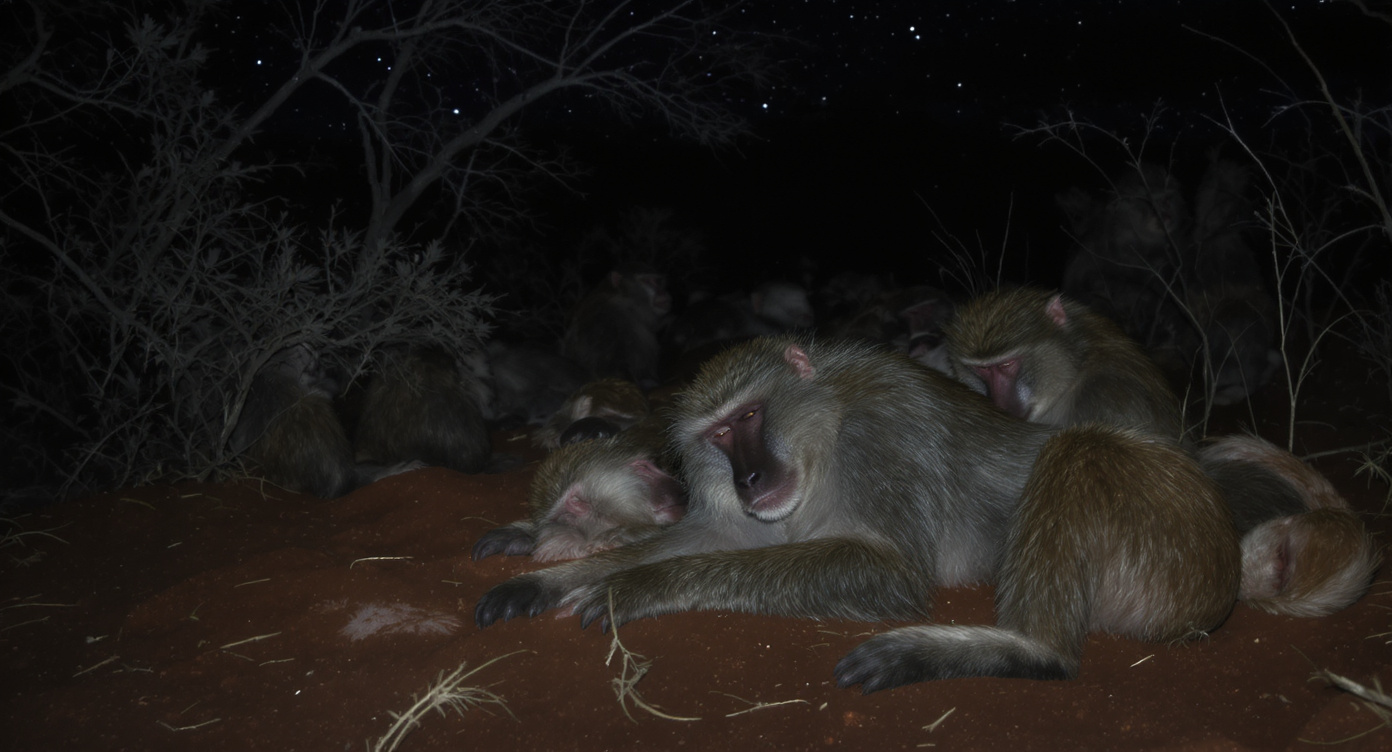
Zoologists have discovered an unexpected downside to holding a dominant position in the wild. Contrary to the common belief that leaders get the best resources, high-ranking baboons actually sleep less and less soundly than their subordinates. It turns out that the safety of the center of the group comes at the cost of chronic sleep deprivation.
A Trade-off Between Safety and Comfort
Living in a group always requires balancing protection and comfort. While a troop helps shield animals from predators like leopards, it also brings noise and crowding. In primate societies with strict hierarchies, dominant individuals usually have access to the best resources: food, mates, and sleeping spots.
Testing the Leaders’ Sleep Hypothesis
Scientists had assumed that alpha individuals would sleep more soundly than others, since they could choose the optimal resting place and other group members would avoid disturbing them. To test this, researchers equipped wild chacma baboons in South Africa with GPS collars and highly sensitive accelerometers. These devices tracked the animals’ movements 40 times per second, allowing precise identification of periods of deep rest, light sleep, and wakefulness. The collected data formed the basis for a “disturbance network” model, showing how one animal’s awakening affects the rest of the group.
Unexpected Results
The study’s findings contradicted the original hypothesis: the higher a baboon’s rank, the poorer its sleep quality. The difference in rest time between dominant and subordinate individuals reached up to two and a half hours. For example, if the leader slept six hours a night, a subordinate could rest for up to eight and a half hours. The reason lay in the social structure of the sleeping group: seeking maximum protection from predators, high-ranking individuals took positions at the center of the group, where sleeping density was highest.
The Price of Leadership: Chronic Sleep Loss
In the crowded central sleeping area, any movement, change of position, or commotion from neighbors would immediately wake the leader. Moreover, awakenings in the center often triggered a chain reaction, and alpha individuals, being at the hub of social connections, responded to disturbances more frequently than others.
This research shows that social hierarchy imposes hidden physiological costs on leaders. The evolutionary advantages of high status are balanced by the need to endure constant sleep disruptions caused by the proximity of subordinates.