

The unusual shape of the dwarfs was explained by their rings.
Astronomers have proposed a new hypothesis to explain the stability of rings around dwarf planets and asteroids: their unusual shapes and uneven gravitational fields help these rings persist longer than usual.
Cursus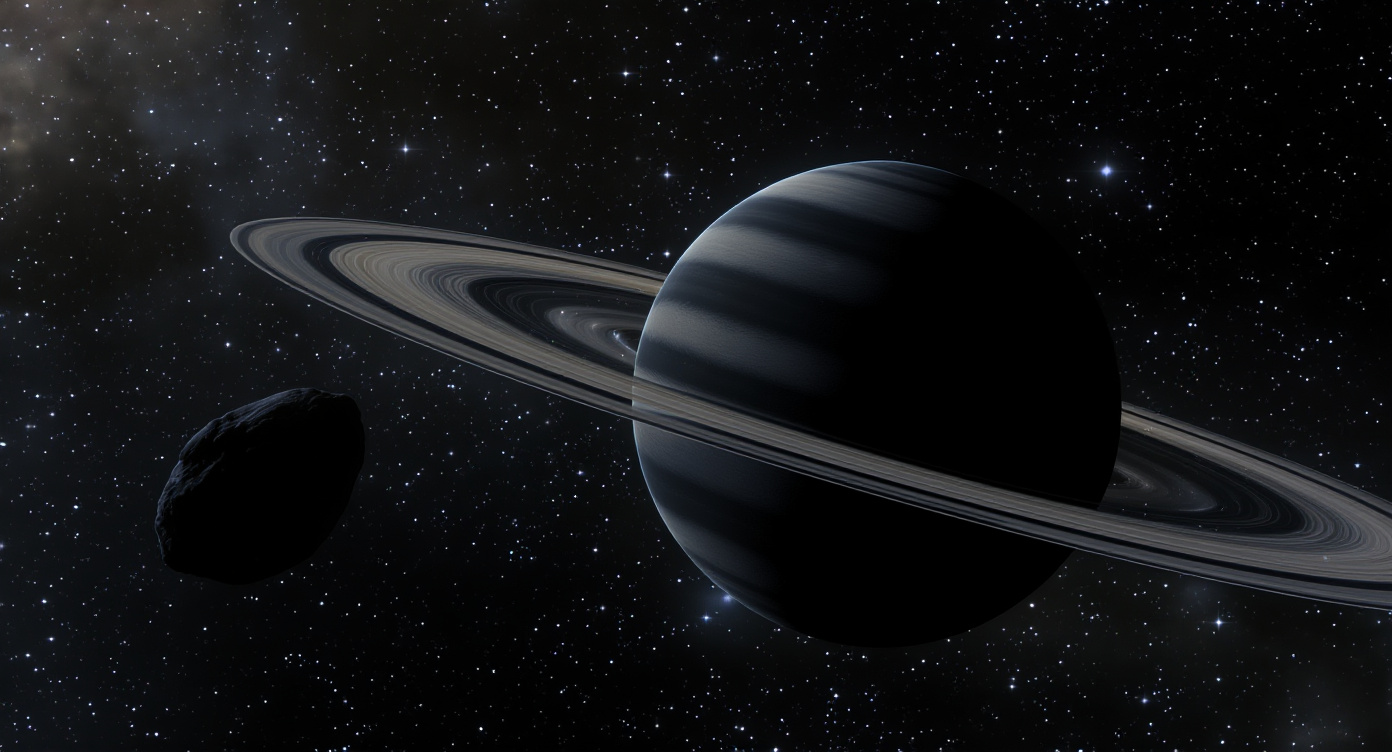
Astronomers have proposed a new hypothesis about the origin of rings around small celestial bodies. According to their research, rings can form and persist thanks to the asymmetric shapes of dwarf planets and asteroids, which create uneven gravitational fields.
Ring systems have been discovered around several minor bodies in the Solar System. The dwarf planet Quaoar, for example, has two rings, and recent observations have revealed another object nearby—possibly a moon or an additional ring.
The asteroid Chariklo, with a diameter of 258 km and located between the orbits of Jupiter and Uranus, also possesses a ring system. Data from the James Webb Space Telescope have shown changes in its structure: one ring has become almost invisible, while the other has grown denser. Rings are also believed to exist around the dwarf planet Haumea and the asteroid Chiron.
Traditionally, it is thought that ring material appears after collisions or the destruction of moons. However, it remains unclear how debris forms stable rings. In theory, such accumulations are unstable: particles should either fall onto the surface, merge into a moon, or disperse into space. For small bodies, cosmic debris can exist for at most a few thousand years.
Saturn’s rings are stabilized by so-called “shepherd moons”—for example, the moons Prometheus and Pandora help maintain the F ring. But no such moons have been found around dwarf planets or asteroids.
Argentinian astronomers have suggested an alternative explanation: uneven gravity caused by the asymmetric shapes of these objects. Chariklo has an elongated, irregular form, Haumea resembles a bean, and Quaoar deviates from a perfect sphere. Particles moving above the surface experience varying gravitational forces depending on the terrain, leading to collisions and changes in their orbits.
Computer modeling has demonstrated that, over time, the orbits of debris align and synchronize, forming a narrow, dense ring. Meanwhile, the ring’s radius gradually increases, and the central body slows its rotation to conserve angular momentum.
Ultimately, an orbital-spin resonance is established. In confirmed cases, a 1:3 ratio is typical—while the ring completes one revolution around the object, the object itself rotates three times on its axis.