

Scientists have solved the mystery of gullies on Mars
Gullies have been discovered on Mars that resemble those found on Earth, but scientists are skeptical that they were formed by water. A new study suggests that these features may have been created by landslides of dry sand and dust.
Cursus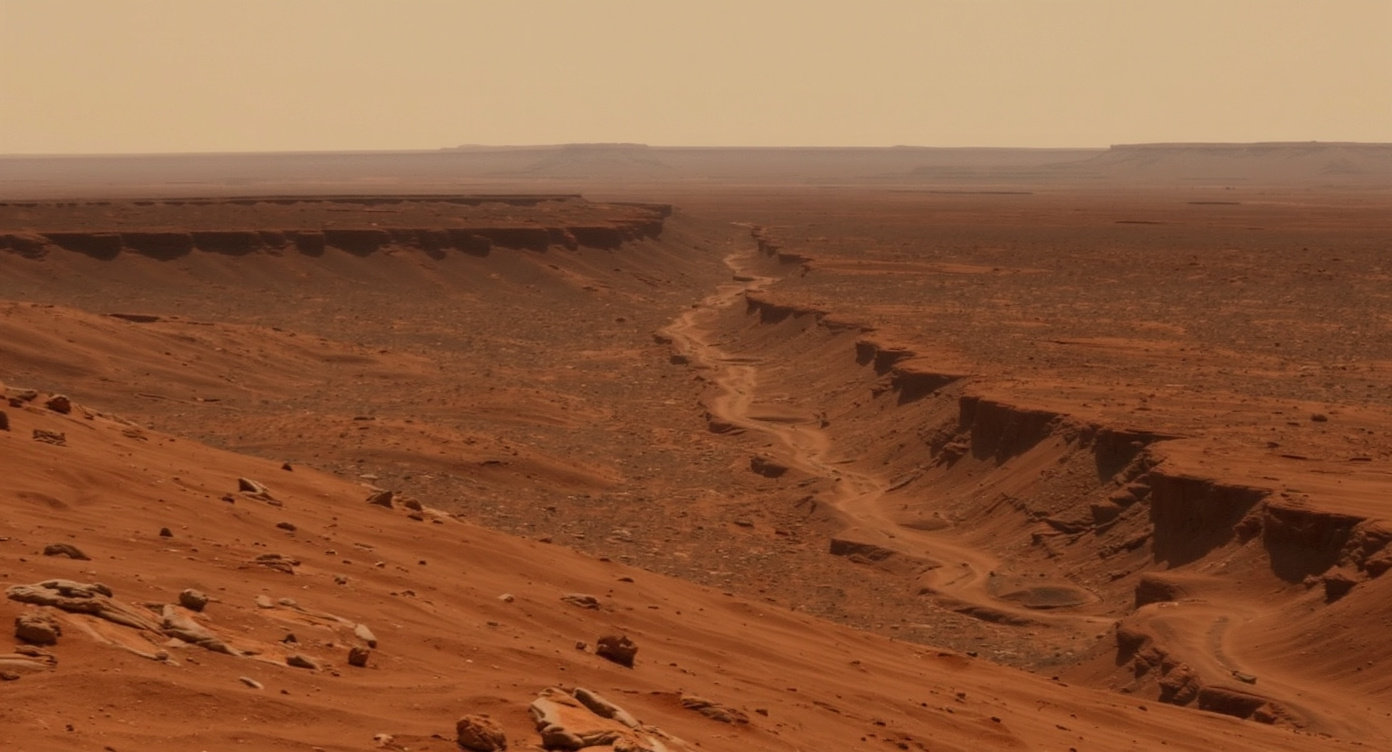
Numerous gullies have been discovered on the surface of Mars, resembling those found on Earth, which are typically formed by flowing water. However, planetary scientists consider it unlikely that these structures were created by melting glaciers, since the atmospheric pressure on Mars is too low for liquid water to exist.
Gullies are among the most common geological formations on Mars, with tens of thousands identified. They are most frequently found at mid and high latitudes, while they are almost absent near the equator. This distribution may suggest a connection between gullies and meltwater, as the equator is too warm for glaciers to form.
Every Martian summer, dark vertical streaks appear and lengthen on the slopes of gullies. One hypothesis is that these are formed by flows of extremely salty water, but more recently, the prevailing theory is that these streaks result from the movement of dry sand and dust.
The existence of gullies requires explanation, as they look like traces left by large amounts of water flowing downhill. These structures are geologically young—no more than a few million years old—whereas Martian bodies of water disappeared billions of years ago. After that, the planet’s atmosphere became so thin that meltwater could no longer accumulate on the surface: at low pressure, ice turns directly into gas when heated.
Researchers from Sorbonne University (France) have tried to determine how gullies could have formed under such conditions. In their article published on the arXiv.org preprint server, they suggest that the process may have been triggered by fluctuations in Mars’ axial tilt. It is known that the planet’s axial tilt can change from 15 to 45 degrees over hundreds of thousands of years. Currently, it is just over 25 degrees, but in the past, it was higher, leading to intense evaporation of polar ice and the formation of glaciers at lower latitudes.
Later, as the tilt decreased, mid-latitudes received more warmth. However, even beneath the surface, liquid water could not form, as the heat did not penetrate deeply enough.
The most likely scenario, according to scientists, is the melting of semi-transparent glaciers containing soil and salt impurities. Sunlight could melt these glaciers in a unique way: soil particles embedded in the ice would heat up and transfer warmth to the surrounding frozen water. The water would then evaporate, creating a local greenhouse effect that allowed small amounts of liquid water to accumulate.
According to this theory, water would seep out under its own weight and flow down the slopes in streams. However, even this scenario is considered unlikely by scientists. The remaining hypothesis is that gullies may have formed not by water, but by landslides of dry sand and dust.