

Mysterious radio rings discovered in the Milky Way
Astronomers have discovered 164 mysterious ring-shaped structures within the plane of the Milky Way, whose origins remain unknown. Some of these rings are visible only in the radio spectrum, and research into their nature is ongoing.
Cursus
The MeerKAT radio telescope has discovered numerous small rings within the plane of our Galaxy, the origins of which remain a mystery. Some of these structures are visible exclusively in the radio spectrum.
Unusual Objects in the Milky Way
Hundreds of supernova remnants and thousands of planetary nebulae—clouds of material ejected by dying stars—are already known in the Milky Way. Supernova remnants are formed by massive stars whose outer layers are blown apart in powerful explosions, while planetary nebulae arise more gently as less massive stars shed their outer shells.
In addition, the Galaxy contains other objects that create striking clouds. For example, Wolf–Rayet stars, named after their discoverers, lose material even before exploding as supernovae and become surrounded by clouds of their own dust. White dwarfs in binary systems can absorb matter from their companions, leading to outbursts and the formation of distinctive nebulae. The Milky Way also hosts star-forming regions—dense clouds of gas and dust where new stars and planets are born.
Discovery of New Rings
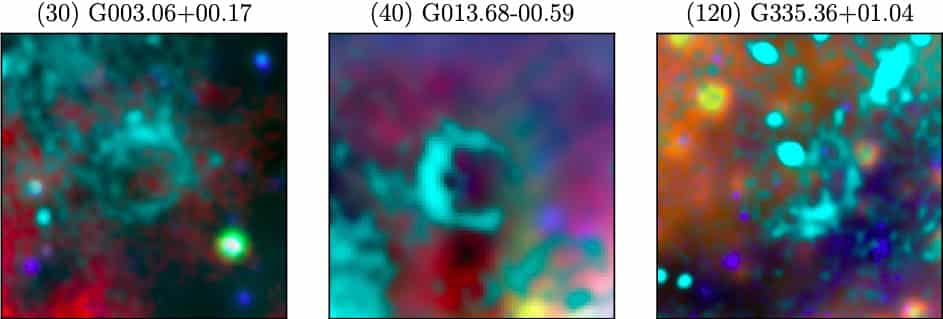
Recently, astronomers identified 164 new objects that cannot yet be confidently classified into any known category. The discovery was reported by an international team of scientists in the journal Monthly Notices of the Royal Astronomical Society.
These objects have a ring-like shape, but their sizes and distances remain undetermined. All are located within the galactic plane, with most found near the center of the Milky Way. This suggests they are likely situated within our Galaxy, rather than being distant background objects.
Observation Features
These rings were first detected using the MeerKAT radio telescope in South Africa. Attempts to observe them in other wavelengths have not always been successful: some structures are visible only in the radio spectrum.
There is a hypothesis that some of these objects may not be related to the Milky Way, but could be distant galaxies. Several years ago, so-called Odd Radio Circles were discovered surrounding certain galaxies, and it is possible that some of the new findings are similar objects.
Another hypothesis involves gravitational lensing, where massive objects—such as entire galaxy clusters—distort and magnify the images of more distant galaxies, giving them the appearance of arcs or rings.
Possible Explanations
About half of the discovered rings also emit in the infrared spectrum, which may indicate the presence of large amounts of dust—a typical sign of ejected stellar shells or star-forming regions.
Central sources have been found in about 40% of the objects—possibly pulsars, white dwarfs, or other stars. However, there is not yet enough data to determine their nature with certainty. In total, scientists have provisionally classified 93 radio rings, but the origins of most remain unclear.
Research is ongoing, and new data may help unravel the mystery of these enigmatic structures in our Galaxy.