

Ancient hyenas fed on the bones and hides of their prey.
A study of fossilized excrement from the Odessa catacombs has revealed that ancient hyenas of the genus Pliocrocuta were already feeding on large bones and animal hides 3.6 million years ago. This evidence confirms that their dietary habits were similar to those of modern scavengers.
Cursus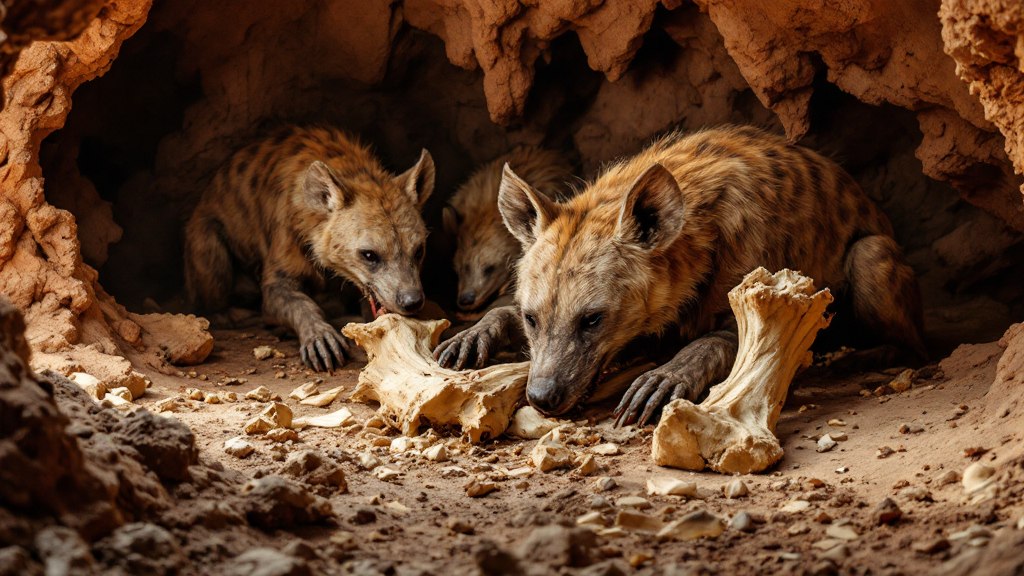
The ancestors of modern hyenas belong to a group of animals capable of digesting large bones. Until recently, there was no direct evidence as to whether these ancient forms were active predators or primarily scavengers. The study of 3.6-million-year-old fossilized droppings found in the Odessa catacombs revealed fragments of digested bones, confirming that this extinct genus, Pliocrocuta, had such a dietary strategy.
Evolution and Specialization of Hyenas
Throughout their evolution, the hyena family produced a variety of forms, but their main adaptation became the ability to process large bones. For a long time, scientists debated the dietary preferences and evolutionary development of these animals. Earlier, the main research methods included analysis of skull and tooth shapes, microscopic examination of enamel, and the study of stable isotopes. These indirect methods pointed to a bone-rich diet but did not provide a clear answer about how they obtained their food.
The Importance of Coprolites in Dietary Studies
The most reliable source of information about the diet of ancient animals is coprolites—fossilized excrement. For modern hyenas, especially cave-dwelling ones, such finds are well studied, but coprolites from Neogene species are extremely rare.
Research in the Odessa Catacombs
An international team of researchers examined a collection of 36 coprolites discovered last century in the Odessa catacombs, a network of karst caves filled with reddish-brown clays. Among the predators of this region, the hyena genus Pliocrocuta dominated, accounting for over 90% of the hyena bone remains found. This species was identified as the most likely producer of the coprolites studied.
Methods and Results of the Analysis
The scientists conducted macrotomography, described the external morphology of the coprolites, and measured their length and width. Scanning electron microscopy allowed them to study the chemical composition of the samples and their inclusions. The results were published in the journal Scientific Reports.
The analysis confirmed that hyenas inhabited this region 3.6 million years ago and were already consuming large bones at that time. The chemical composition of the coprolites consisted of microcrystalline fluorapatite with high levels of calcium and phosphorus, characteristic of a bone-rich diet. Numerous small bone fragments with smoothed edges and pitted surfaces, indicating exposure to gastric juices, were found inside and on the surface of the samples.
Additional Findings
The coprolites also contained evidence of skin consumption—hollow channels left by hair were discovered. Among modern hyenas, only specialized scavengers like brown and striped hyenas eat skin along with fur and do not regurgitate it, unlike more active predators who usually expel swallowed hair.
Similarity to Modern Scavengers
The shape and proportions of the studied coprolites closely resemble those of Pleistocene brown hyenas—pure scavengers. This further supports their connection to a lineage for which scavenging was the main feeding strategy.