

Astronomers have discovered a giant protoplanet with moons in the process of forming.
Astronomers have discovered an object in the CT Cha system whose mass is 14 to 24 times greater than that of Jupiter, surrounded by a disk of gas and dust—a rare opportunity to observe the birth of moons around a young planet. The chemical composition of this disk is noticeably different from the material surrounding the star, raising new questions for scientists about how moons and planets form.
Cursus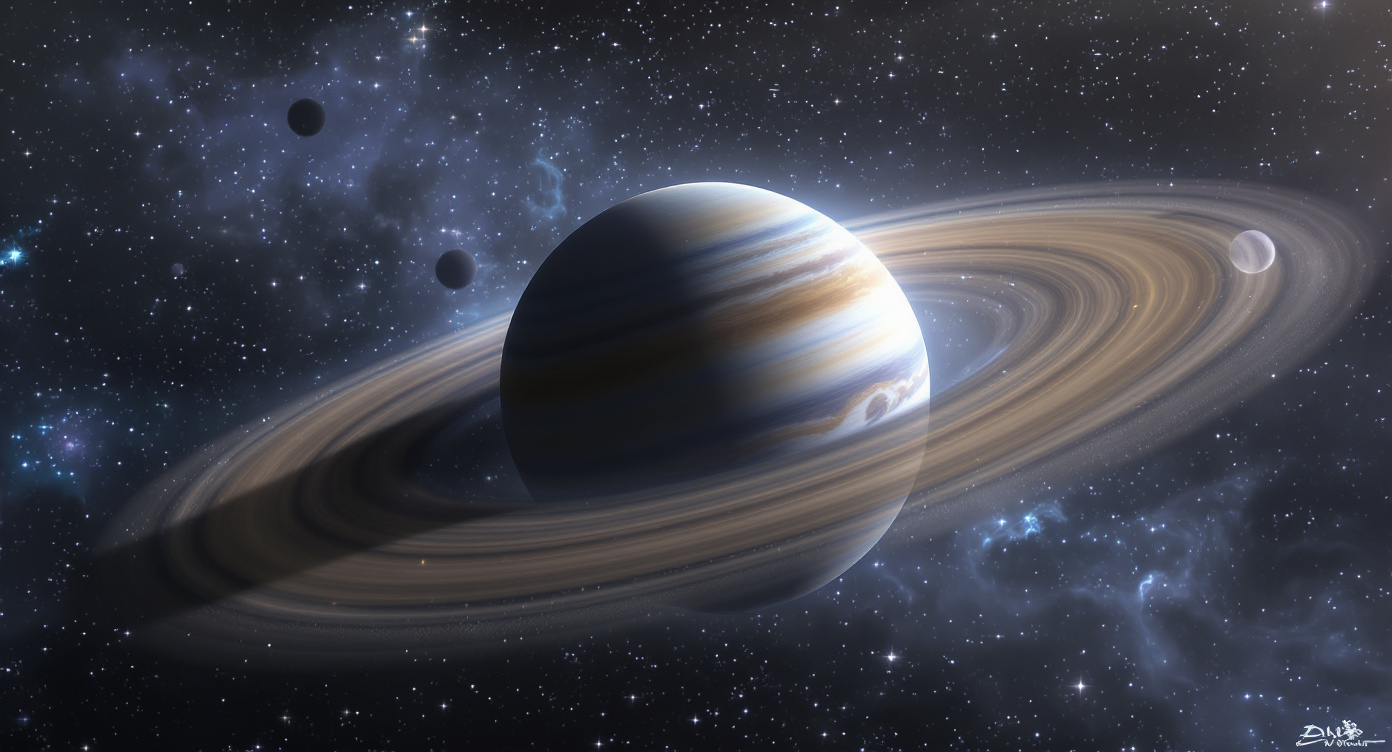
In the protostar system located about 625 light-years from Earth, astronomers have discovered an object whose mass is at least 14 times greater than that of Jupiter. This object is surrounded by its own gas and dust disk—a rare opportunity to observe the process of moon formation around a newly formed planet.
Jupiter’s Moon System as a Miniature Model
To date, Jupiter is known to have 97 moons. After Galileo first observed the four largest of them in the early 17th century, scientists began to view this group as a scaled-down version of the Solar System. The Galilean moons—Io, Europa, Ganymede, and Callisto—along with four other satellites, orbit the gas giant almost in the plane of its equator.
Some of these moons display unique features: while Ganymede completes one orbit around Jupiter, Europa manages two, and Io completes four. This kind of harmony is called orbital resonance.
All these characteristics suggest that Jupiter’s eight largest moons formed at the same time as the planet itself, when the Sun was still surrounded by a protoplanetary disk and the nascent Jupiter had its own protolunar disk.
A New Discovery in the CT Cha System
Recently, something similar was found in the CT Cha star system, located about 625 light-years away from us. According to estimates, this system formed just 1.6 million years ago, which is extremely young compared to the Solar System’s age of 4.6 billion years. The unusual discovery was reported by astrophysicists from Switzerland and the USA in an article for The Astrophysical Journal Letters.
The parent star, CT Cha A, has a mass about 0.9 times that of the Sun, making it almost like our own star. It has a companion, CT Cha b, which is located about 100 times farther from the star than Jupiter is from the Sun. Astrophysicists cautiously refer to it as a “planetary-mass object,” although by mass it is not quite a planet: CT Cha b weighs as much as 14–24 Jupiters. Objects heavier than 13 Jupiter masses are usually classified as brown dwarfs—an intermediate stage between a planet and a star.
Within such objects, weak thermonuclear reactions occur during the first millions of years of their existence, providing their own radiation. Nevertheless, in a certain sense, CT Cha b still fits the definition of a planet: researchers are confident that it formed not as an independent celestial body, but as a satellite of a much larger and more massive object.
Formation of Its Own Satellite System
CT Cha b, through its gravity, has created something like a “state within a state”: it is surrounded by its own gas and dust disk, in which, most likely, an entire collection of moons will soon form. Observations show that this disk extends more than eight astronomical units from CT Cha b.
For comparison, Jupiter is 5.2 astronomical units from the Sun, meaning it is 5.2 times farther than Earth. Thus, CT Cha b is forming its own system, comparable in size to a part of the Solar System.
Chemical Composition of the Disk: Mysteries and Differences
Scientists have noted that the composition of this massive protolunar disk is strikingly different from the material in the protoplanetary disk surrounding the star. The latter, based on the spectrum of reflected radiation, contains a large amount of water, while water is almost absent in the disk around CT Cha b. Instead, a whole set of hydrocarbons is observed there—acetylene, ethane, benzene, methylacetylene, diacetylene, as well as carbon dioxide. These substances are not found in the disk of the parent star.
The reasons for this difference remain to be determined. Researchers suggest that the companion’s own radiation has already significantly altered the chemical composition of the surrounding material.