

Scientists have revealed how an antibiotic destroys the protective barrier of bacteria
British scientists have, for the first time, provided a detailed look at how an antibiotic destroys the protective structures of bacteria using a specialized microscope. This discovery will aid in developing new ways to combat resistant infections.
Cursus
Using a specialized microscope, scientists have, for the first time, observed how an antibiotic interacts with E. coli bacteria. High-resolution images revealed exactly how the drug destroys the bacteria’s protective structures. This discovery could pave the way for new strategies to combat antibiotic-resistant bacteria, which are difficult to treat with standard therapies due to their slow metabolism.
Arms Race: Antibiotics vs. Bacteria
The modern fight against bacteria resembles an endless arms race: researchers develop new antibiotics, while microbes evolve new defense mechanisms. Gram-negative bacteria, which include the pathogens responsible for pneumonia, meningitis, typhoid fever, and other serious diseases, are especially challenging to defeat.
The main strength of these bacteria lies in their unique cell wall structure. In addition to the primary cytoplasmic membrane, they are surrounded by a second, extremely tough outer membrane made of lipopolysaccharide macromolecules. This dense barrier is nearly impenetrable to most drugs, making gram-negative bacteria highly resistant.
Polymyxins: The Last Line of Defense
When standard antibiotics fail, doctors are forced to turn to polymyxin drugs—often considered a last resort. It has long been known that polymyxins attack the outer membrane of bacteria, but the details of this process remained unclear. Researchers did not fully understand how this “killing mechanism” worked or why even powerful drugs sometimes proved ineffective.
New Research: How the Antibiotic Breaks Bacterial Defenses
A team of British scientists led by biologist Andrew Edwards from Imperial College London set out to investigate this question in detail. In their study, published in Nature Microbiology, they used a combination of biochemical techniques and a scanning atomic force microscope capable of visualizing objects just a few nanometers in size. With this tool, the researchers observed E. coli bacteria treated with polymyxin B.
On the previously smooth surface of the bacterial cell, strange bulges and swellings began to appear, which then burst outward like bubbles. Within minutes, the bacteria rapidly lost their protective lipopolysaccharides, which the scientists detected in the surrounding solution.
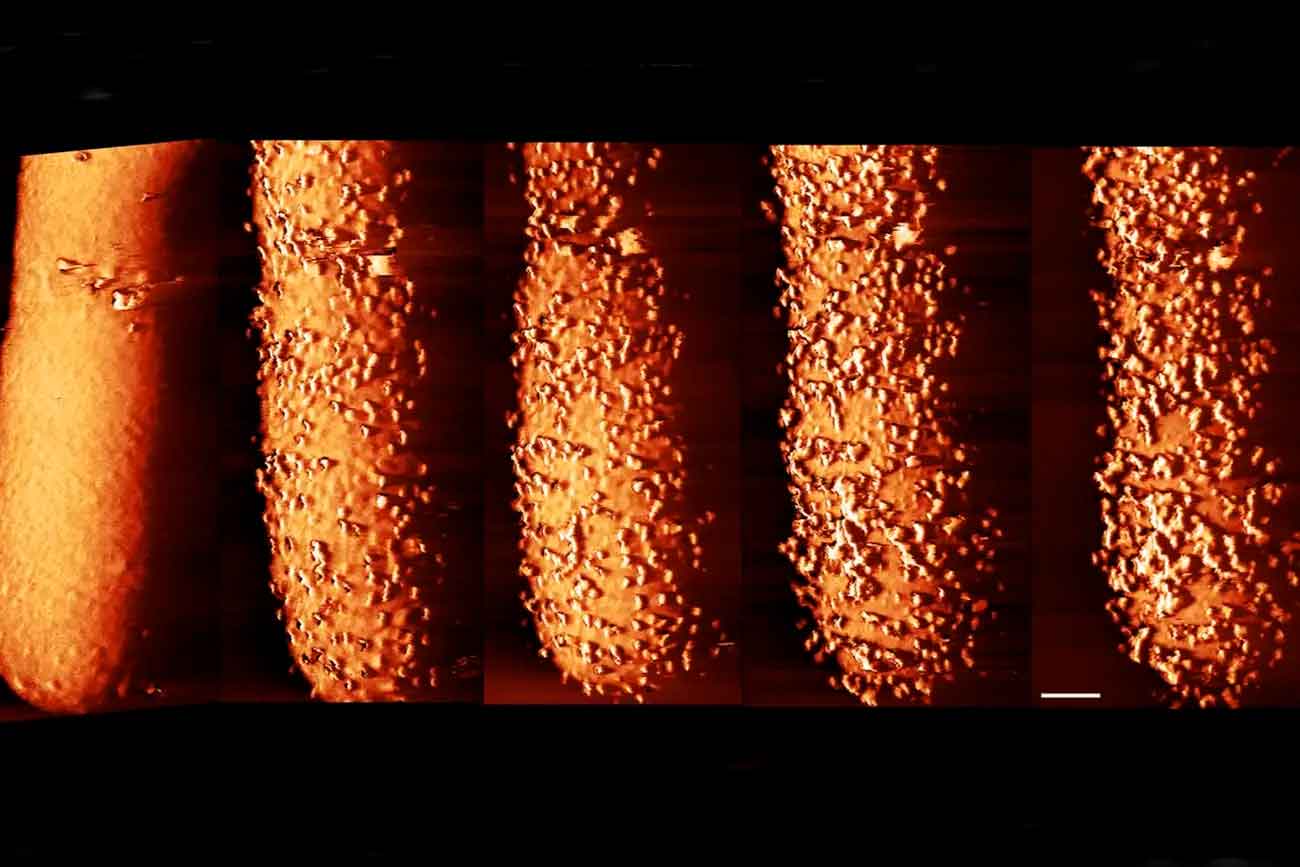
Images of E. coli exposed to polymyxin B. Shown are changes in the outer membrane of the bacteria. From left to right: untreated; after 15 minutes of antibiotic exposure; after 30 minutes; after 60 minutes; after 90 minutes / © Carolina Borrelli, Edward Douglas et al., Nature Microbiology
It turned out that the antibiotic doesn’t destroy the cell wall in a single blow, but acts more like a “sapper.” Its presence confuses the bacteria, which frantically try to reinforce their defenses by adding new “bricks” of lipopolysaccharides. In this rush, the bacteria lose control: as they strengthen one part of the wall, old elements fall out elsewhere, creating temporary gaps.
“The antibiotic acts like a crowbar: it helps these bricks fall out of the wall. The outer membrane isn’t completely destroyed, but local defects—holes—appear, through which the antibiotic penetrates to the inner membrane and delivers a fatal blow,” explains Edwards.
Why the Antibiotic Sometimes Fails
However, there’s another important side to this story. Scientists discovered why polymyxin B sometimes fails to work. The described mechanism only affects active, growing bacteria.
When conditions become unfavorable—such as when nutrients run out—microorganisms can enter a dormant state, a kind of hibernation. In this state, their metabolism slows, they stop growing and reproducing, but they don’t die; they simply wait. Edwards and his colleagues found that dormant bacteria stop producing their “armor,” making polymyxin B harmless to them—there’s simply nothing for the drug to attack.
How to “Wake Up” Bacteria and Defeat Them
To overcome this defense, the researchers tried to “wake up” dormant E. coli by adding sugar—a simple nutrient source—to the environment. The experiment was successful: the bacteria emerged from dormancy, resumed producing lipopolysaccharides, and polymyxin B once again became effective, destroying them.
According to the study’s authors, in theory, it might be possible to wake up dormant bacteria in a patient’s body using certain sugars, and then eliminate them with antibiotics. However, this approach carries risks: reactivating pathogens could lead to rapid bacterial growth and worsen the disease.
A more promising direction, scientists believe, is the development of combination therapies, where some drugs bypass the dormant state without waking the microbes, while others target the now-understood mechanism. This strategy could help defeat even the most resistant pathogens.