

The largest simulation of the Universe in history has been created.
Scientists have unveiled Flagship 2—the largest simulation of the Universe ever created, encompassing more than 3.4 billion galaxies. This virtual catalog will help researchers study the evolution of galaxies and prepare for new discoveries in astronomy.
Cursus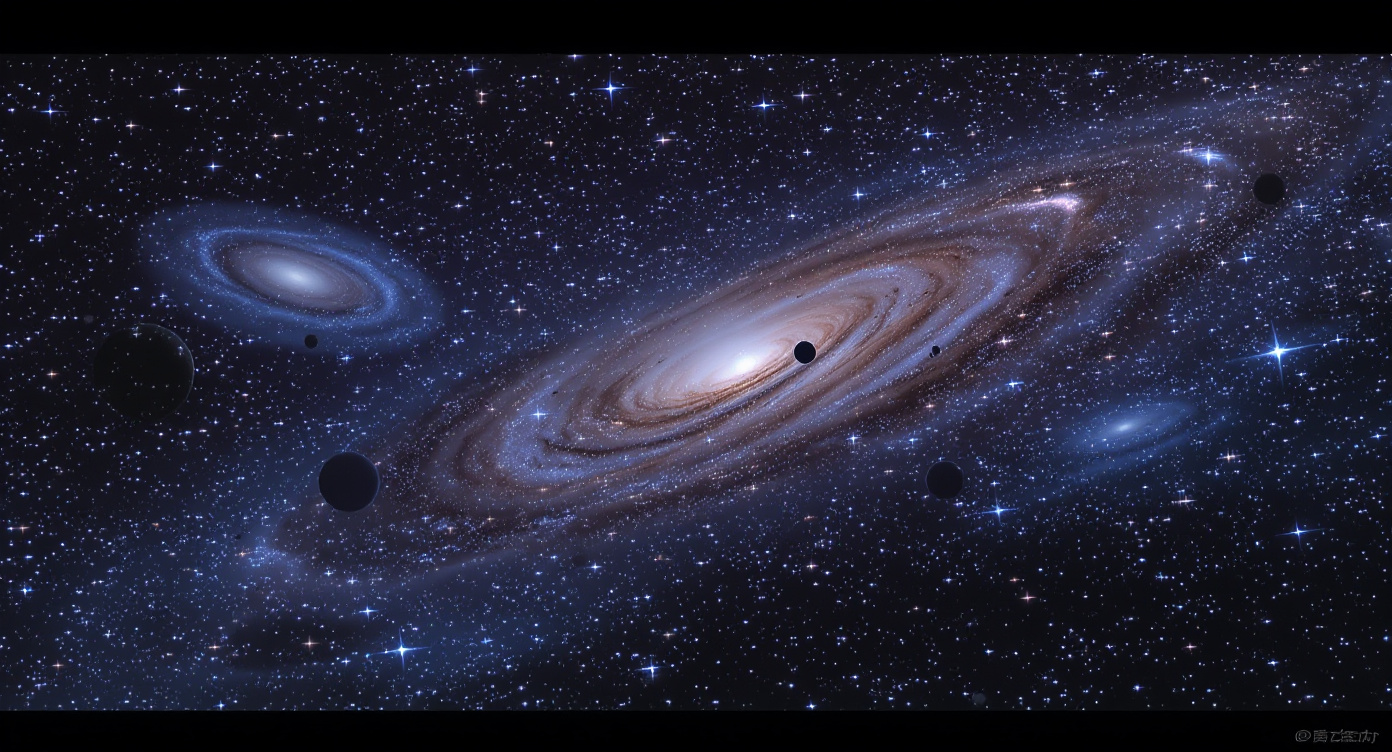
Researchers have unveiled Flagship 2—the largest simulation of the Universe to date, encompassing more than 3.4 billion galaxies. For each galaxy, over 400 parameters were modeled, including brightness, position, shape, and velocity. This vast "virtual sandbox" will enable scientists to reproduce the data that the Euclid space observatory is expected to collect in the coming years.
The Euclid Telescope Mission
In 2023, the European Space Agency (ESA) launched the Euclid telescope into orbit. Its mission is to scan a third of the sky over six years and create a detailed 3D map of the Universe. The telescope is equipped with a 1.2-meter mirror, a VIS optical camera, a photometer, and a NISP spectrometer, allowing it to observe billions of galaxies at distances up to 10 billion light-years in both optical and near-infrared wavelengths.
The main goal of the mission is to uncover the nature of dark matter and dark energy, as well as to trace the formation and evolution of the "cosmic web"—the large-scale structure of the Universe formed by galaxies and their clusters. Already, Euclid has helped astronomers identify 26 million galaxies and discover 1.5 trillion stars between the galaxies of the Perseus cluster.
Technologies and Scientific Foundation of Flagship 2
The new simulation, developed by the Euclid consortium, is based on computational models created at the University of Zurich. These models describe the movement of four trillion particles interacting under the force of gravity. This approach made it possible to identify about 16 billion dark matter halos, within which virtual galaxies are "embedded." The parameters of these galaxies were calibrated using data from previous surveys, such as the Sloan Digital Sky Survey (SDSS) and the Hubble Space Telescope's COSMOS program.
The Scientific Significance of the Simulation
Thanks to its high realism and accurate reproduction of the cosmic web's structure, Flagship 2 not only prepares scientists for future observations but also opens new opportunities for studying galaxy evolution over more than 10 billion years, testing predictions of the standard ΛCDM cosmological model, and developing strategies for analyzing upcoming sky surveys. The resource is available to researchers on the CosmoHub platform and can be used beyond the Euclid project, becoming a benchmark simulation for other astronomical initiatives.
Prospects and Potential of Flagship 2
The Flagship 2 catalog contains such an extensive set of galaxy characteristics that many of them can already be compared with real observational data, and the potential for future discoveries is immense. According to scientists, Flagship 2 will become a crucial tool in modern astronomy and usher in a new era in the exploration of the Universe and its hidden components.