

Giant lava tunnels have been discovered on Venus
An international team of scientists has, for the first time, confirmed the existence of massive lava tunnels beneath the surface of Venus, comparable in size to those found on the Moon. This discovery reshapes our understanding of the planet's geology and is significant for future research.
Cursus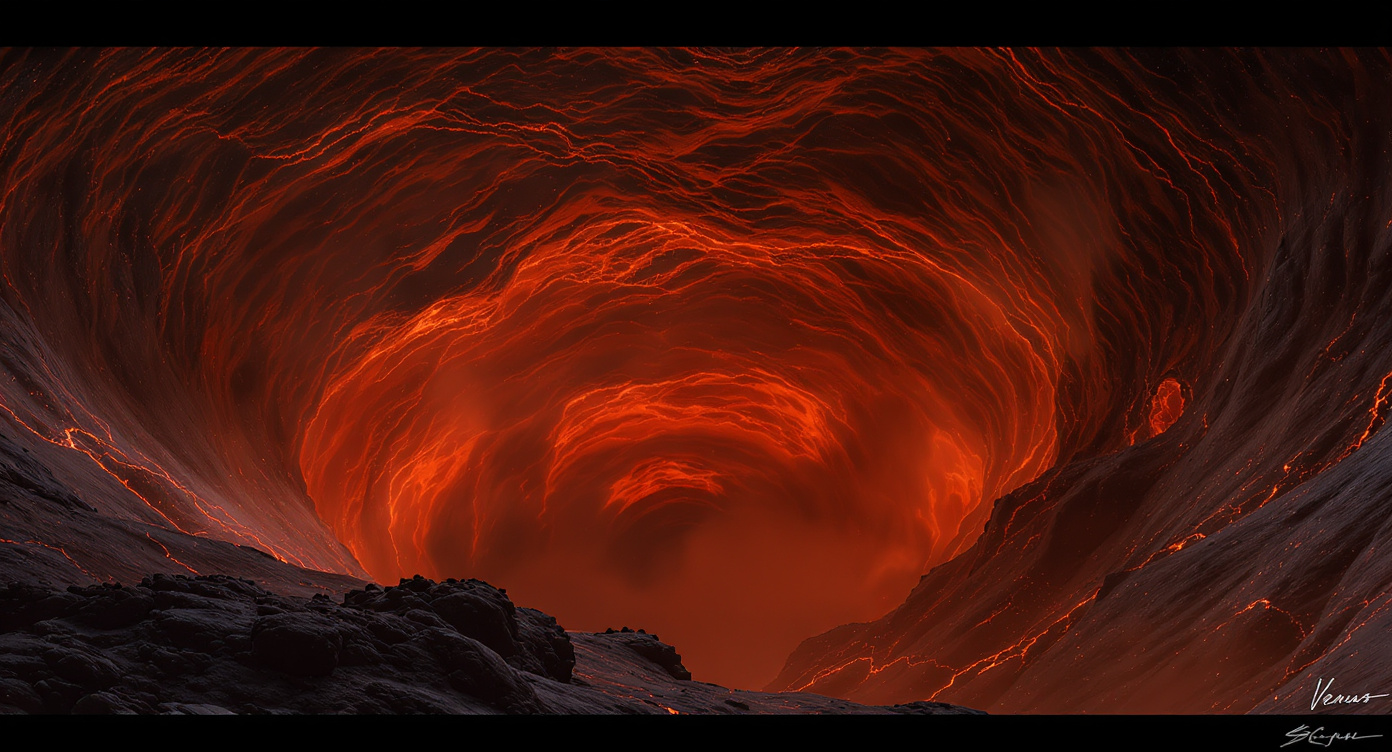
Beneath the surface of Venus, hidden under its scorching crust, scientists have discovered vast underground tunnels formed by ancient lava flows. This conclusion was reached by an international team of planetary scientists after analyzing archival data. The scale of these formations turned out to be so immense that researchers did not expect to find anything similar.
How Lava Tubes Form
Lava tubes are natural underground tunnels that form during volcanic eruptions when lava flows cool unevenly. As hot lava moves down the slopes of a volcano, its outer layer quickly solidifies upon contact with air and the ground, creating a hard crust. Beneath this crust, the lava remains liquid and continues to flow, while the crust acts as a natural insulator. Once the eruption ends, most of the lava drains away, leaving behind a hollow space—a tunnel within the solidified lava, known as a lava tube. The size of these tubes can vary greatly, from narrow passages to vaults several meters high and stretching from hundreds of meters to tens of kilometers in length.
Lava Tubes in the Solar System
Such structures are well known on Earth, for example in Hawaii and Iceland. Similar cavities have also been found on other bodies in the Solar System, particularly on the Moon and Mars. On smaller celestial bodies with low gravity, lava tubes can be especially wide and tall, since the stone arches experience less stress and collapse less frequently. On the Moon, lava tubes are so large that they are considered potential shelters for future colonists, offering protection from radiation, temperature extremes, and micrometeorites.
Venus: Unexpected Scale
Venus is often called Earth's "twin" due to its similar mass and size, so it was assumed that its lava tubes would be comparable to those on Earth. However, decades of observations of the planet, shrouded in dense clouds, had only hinted at the existence of such structures. Radar images from orbiting spacecraft revealed mysterious chains of pits and depressions winding along the slopes of giant volcanoes. This raised the question: are these features traces of hidden lava channels, or are they the result of other processes, such as tectonic faults? Until recently, there was no definitive answer.
New Discovery: Evidence of Lava Tubes
An international team of planetary scientists led by Barbara De Toffoli from the University of Padua (Italy) has presented the first indisputable evidence of lava tubes on Venus. The findings were announced at the Europlanet Science Congress in Helsinki in September 2025.
The researchers meticulously analyzed data from previous Venus missions, using radar images and detailed topographic maps. Their main focus was on large volcanoes with diameters over 100 kilometers. The scientists were not looking for isolated pits, but for systems—elongated chains that could indicate underground cavities.
Their approach proved successful: they identified four examples of such formations, all on the slopes of shield volcanoes where powerful lava flows once moved. No alternative geological explanation was found for these chains of pits—they are not associated with tectonic faults or crustal stretching. Every detail pointed to lava tubes: the structures followed the steepest parts of volcanic slopes, tracing the natural path of flowing lava, and their arrangement was winding, which is typical for lava flows. The ratio of depth to width of the depressions perfectly matched the parameters of collapsed tube ceilings observed on other planets.
Why Are Venusian Tubes So Large?
The most striking discovery was the sheer scale of these structures. The volume of Venus’s underground cavities, calculated from the length of the collapse chains, is comparable to that of lunar tubes, even though Venus is closer to Earth in terms of mass and gravity, where lava tubes are much smaller. This contradicts previous assumptions that the size of lava tubes depends directly on a planet’s gravity: the weaker the gravity, the wider the tunnels should be. On Earth, tubes are the smallest, on Mars they are larger, and on the Moon they are gigantic. Venus, it seemed, should follow this rule, but the new data showed otherwise.
Scientists suggest that a unique factor on Venus outweighs the influence of gravity. The reason may be the planet’s extreme conditions: surface atmospheric pressure is dozens of times higher than on Earth, and temperatures reach 470°C. This physical environment radically changes the behavior of lava. On other planets, lava and erosion usually carve deeper tubes. On Venus, however, the immense pressure appears to compress the tunnels from above, making them less deep but much wider and more robust.
The Significance and Future of the Discovery
The discovered cavities are not only comparable in size to lunar tubes, but also significantly surpass their terrestrial counterparts. This suggests that Venus may host some of the largest lava tubes in the Solar System, rivaling those on the Moon.
This discovery is highly significant for future Venus research. New missions are being prepared for the planet, including the European EnVision mission, scheduled for launch in December 2031. Onboard will be the Subsurface Radar Sounder, a radar capable of "peering" hundreds of meters beneath the surface. This instrument could confirm the discovery by detecting the tubes themselves and studying their internal structure.