

Northern Europe discusses road tolls due to drought
Northern European countries are discussing the introduction of road tolls to reduce the strain on road transport caused by drought and restrictions on navigation along the Rhine. Transport companies emphasize the need for long-term solutions, as alternative routes are unable to handle the increased volume of freight.
Vectus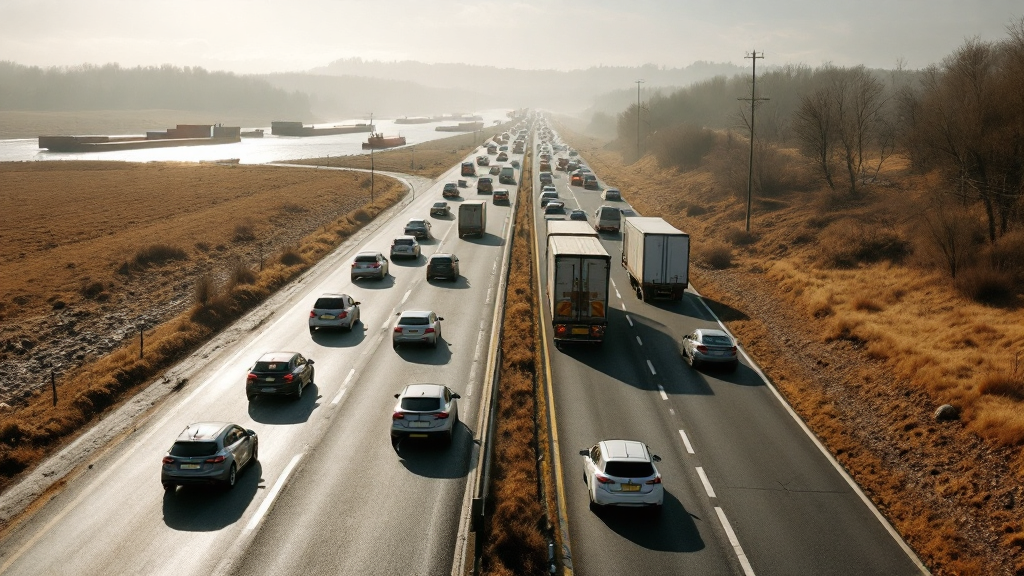
Transport company operators are proposing the introduction of road tolls across Northern Europe to reduce the number of cars on the roads. This measure is being considered in response to increasing traffic jams caused by low water levels on the Rhine, which have led to a shift of freight transport from waterways to road transport.
Impact of Weather Conditions on Transport
Due to the heatwave sweeping the continent, container barges have almost completely stopped operating, and there is no sign of improved weather conditions yet. As a result, the region's roads are experiencing additional congestion, partly linked to restrictions on inland waterway transport.
Seasonal Factors and Long-Term Solutions
The situation is further complicated by drought, but it has coincided with the summer holiday period, when road traffic is typically lighter. This has helped to partially mitigate the consequences. Nevertheless, transport organizations emphasize the need to find a long-term solution, as the problem persists throughout the year.
Potential Measures and Infrastructure Changes
Introducing a general road toll is seen as one of the most effective ways to address the issue, as it could help reduce private car journeys and support necessary infrastructure changes.
Limitations of Alternative Routes
Alternative rail and road routes for barge users do not always meet requirements. The rapid shift of cargo from barges to other modes of transport has exposed weaknesses in the logistics chain.
Freight Volumes and Capacity Constraints
Each year, around 275 million tons of cargo are transported along the Rhine, with containers accounting for 10% of this volume. This is equivalent to about 7,500 TEU per day moved via inland waterways. The railway network has already reached its capacity limit, allowing no more than 15% of cargo to be shifted to rail, leaving over 6,000 TEU per day for road transport.
Industrial Transport Specifics
The remaining barge traffic, especially for the German chemical and steel industries, cannot be fully transferred to rail or road. These sectors are forced to continue using barges, but with reduced loads—about 30% of normal capacity.
Additional Challenges on the River
On the central section of the Rhine, where most activity is concentrated, there are no locks, and increasing the number of vessels to compensate for underloading only worsens river congestion, which is now measured in days.
Situation in the Port of Antwerp
Authorities in Antwerp report that there is enough space in the port for vessels, despite the additional load. This ensures that every ship can find a berth and demonstrates the port's ability to respond flexibly to unexpected situations.