

The Hayabusa2 mission has encountered a mystery on the asteroid
New observations have revealed that asteroid 1998 KY26, the target of the Hayabusa2 mission, is three times smaller and rotates twice as fast as previously thought. This discovery complicates the mission and requires a revision of the scientific plans.
Cursus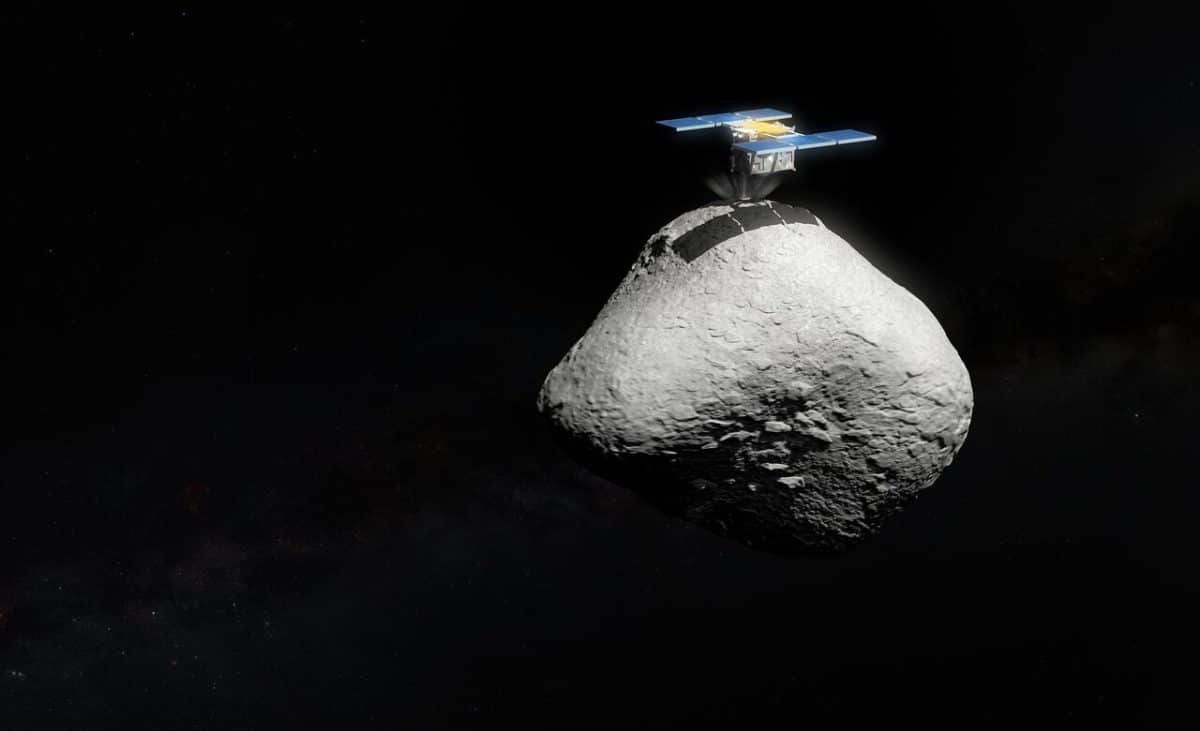
The planned flyby of the Hayabusa2 automatic interplanetary station near the small asteroid 1998 KY26 is scheduled for July 2031. However, new observations have revealed that this object's size is three times smaller than previously estimated, and its rotation speed is twice as fast as expected. These discoveries turn an already challenging mission into a true scientific mystery.
Objectives of the Hayabusa2 Mission
The main goal of the Hayabusa2 spacecraft is to collect soil samples from C-type asteroids—dark, carbon-rich bodies formed from ice and dust in the distant regions of the Solar System about 4.5 billion years ago. In 2014, the Japanese space agency JAXA launched the probe toward the near-Earth asteroid Ryugu. By 2019, the spacecraft reached its target, collected samples, and a year later delivered them to Earth. Analysis of this valuable cargo revealed traces of a rare mineral that was not expected to be present.
A New Research Target: Asteroid 1998 KY26
The next target for Hayabusa2 is asteroid 1998 KY26—the smallest object of its kind ever studied. It was discovered in 1998 during the Spacewatch survey at the Kitt Peak National Observatory (USA). Despite its well-studied orbit, new research brought an unpleasant surprise for scientists: the asteroid's diameter is only 11 meters instead of the expected 30, and its rotation period is just 5.35 minutes—twice as fast as previous estimates.
Astronomers reached these conclusions by observing the asteroid during its close approach to Earth in 2024 using the Very Large Telescope (VLT) of the European Southern Observatory. The results, published in the journal Nature Communications, showed an unexpectedly high surface albedo for 1998 KY26 (about 0.52), indicating it belongs to the rare Xe class (X group) with a high enstatite content.
Scientific Value and Practical Importance
This composition makes 1998 KY26 especially interesting for comparative studies: it may be the "building block" for larger bodies like Bennu and Ryugu. Previously, this asteroid exhibited anomalous accelerations that could not be explained by gravity alone—scientists suspected weak gas emissions, similar to comets. However, new data found no signs of gas or dust activity, disproving the "cometary nature" hypothesis.
Since the size and mass of 1998 KY26 are comparable to the Chelyabinsk and Tunguska meteoroids, studying it has practical significance for planetary defense: such bodies are considered among the most common potentially hazardous objects.
New Challenges for the Mission
The main challenge for the Hayabusa2 mission lies in the asteroid's tiny size and record-breaking rotation speed—the probe is unlikely to be able to "touch" its surface, making the artificial creation of a crater with a projectile, as was done on Ryugu, questionable. At the same time, the absence of dust around the object will make it easier for instruments to operate in close orbit.
Revising Plans and the Importance of Research
Thus, plans for studying 1998 KY26 will need to be revised. The authors of the scientific paper note that successful research on such objects is especially important, as it could change our understanding of their formation and destruction.