

Comet 3I/ATLAS astonishes scientists with its unusual speed
The interstellar comet 3I/ATLAS is moving twice as fast as its predecessors, and scientists are unable to explain its unusually high speed. The origin of this object remains a mystery.
Cursus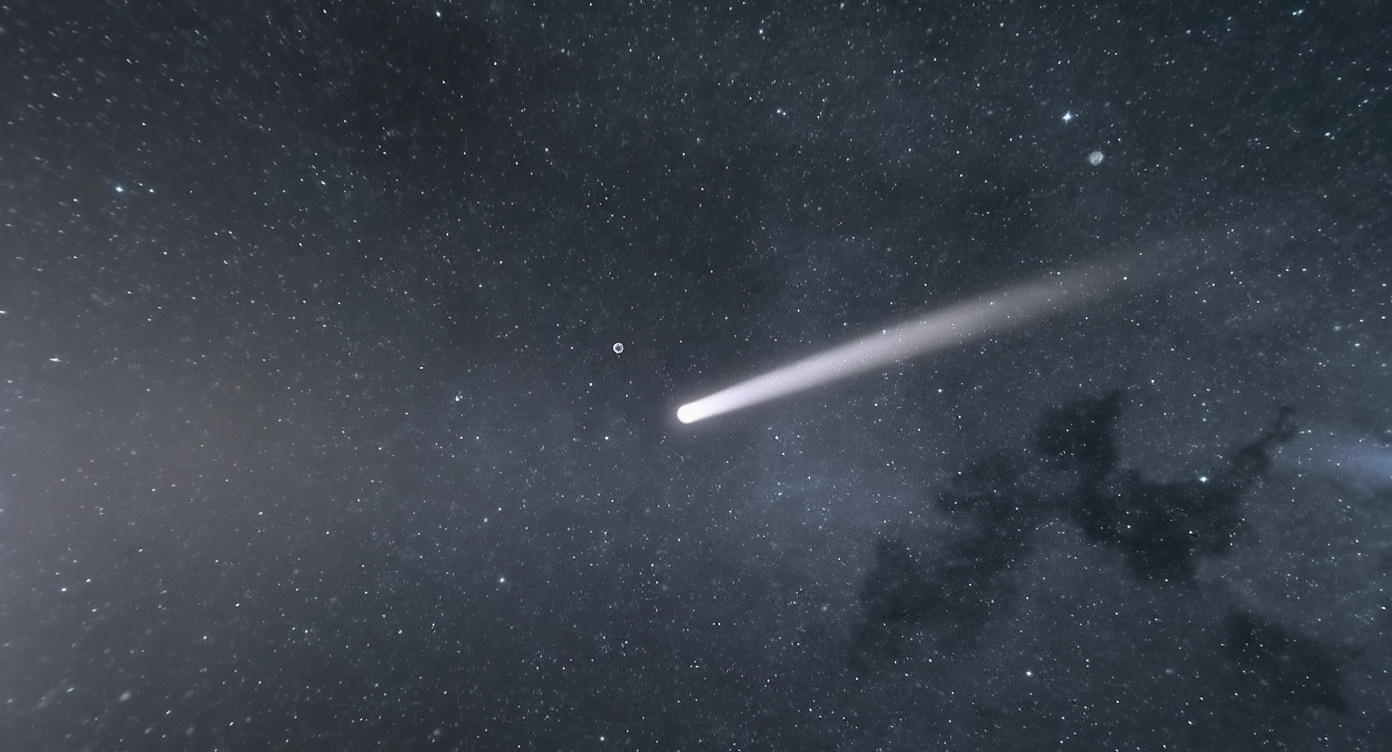
The third interstellar object discovered, 3I/ATLAS, is traveling at roughly twice the speed of its predecessors. According to calculations, it is unlikely that it could have reached such a high velocity when ejected from its home planetary system, nor could it have accelerated to this speed along its journey.
At the time of its discovery on July 1, 2025, comet 3I/ATLAS was just inside Jupiter’s orbit—about 670 million kilometers from the Sun. It is now approaching Mars, and on October 29 it is expected to reach perihelion—its closest point to our star. At that moment, the comet will be only 203 million kilometers from the Sun, tens of millions of kilometers closer than Mars’s orbit.
The comet’s speed relative to the Sun is estimated at 58 kilometers per second, which immediately caught scientists’ attention. For comparison, the first known interstellar visitor, ‘Oumuamua, traveled at 26 km/s, while the Borisov comet moved at 32 km/s. Thus, 3I/ATLAS is more than three times faster than the famous Voyager spacecraft, which left the Solar System thanks to multiple planetary gravity assists.
Recently, astrophysicists tried to determine the origin of this comet, or at least reconstruct its path. Using modern technology, researchers were able to trace the object’s trajectory over the past 100 million years, and also “rewound time” for 30 million stars in our Galaxy cataloged by Gaia.
It turned out that the comet passed close to 25 of these stars. The closest encounter occurred 1.64 million years ago with the binary system of red dwarfs G 137-54 and G 137-55—the comet passed less than one light-year from them, moving at 28 km/s relative to the system. With some other stars, the approach speed exceeded 100 km/s.
Analysis showed that none of the systems considered could have been the “home” of 3I/ATLAS: the gravitational influence of their stars and planets is insufficient to eject a celestial body into interstellar space at such a speed. Moreover, scientists do not consider it possible for the comet to have accelerated to this velocity by passing near other systems—the acceleration gained would be too small, and even with gradual “accumulation” of speed, the observed result is unattainable.
Therefore, it remains to be assumed that 3I/ATLAS has always traveled this fast. Exactly how it achieved such velocity is a question scientists have yet to answer.