

Scientists have discovered real teeth on the forehead of a chimera
Researchers have discovered that the growths on the foreheads of male deep-sea chimaeras are actually real teeth that develop outside the oral cavity and are used to hold onto the female during mating. This is a unique evolutionary phenomenon among vertebrates.
Cursus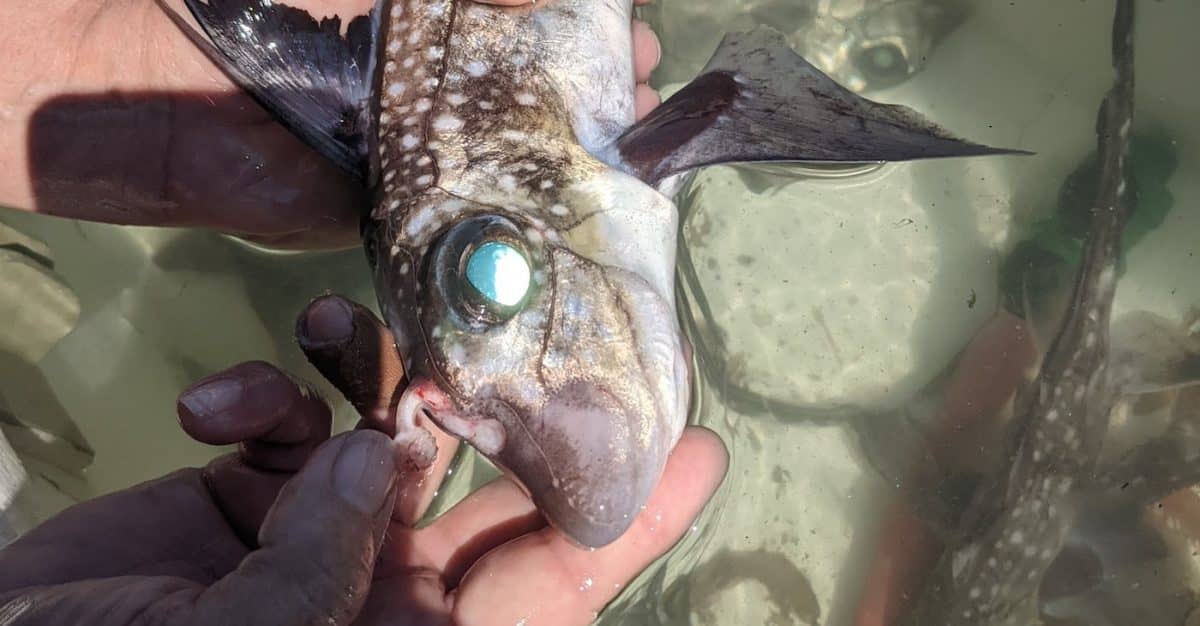
Scientists have discovered that the spiny growth on the foreheads of male deep-sea chimaera fish are actually real teeth that develop outside the oral cavity. This unique organ, which has no equivalent among other vertebrates, serves to hold the female during mating.
Teeth Outside the Mouth: Biological Background
Teeth are complex structures whose development is strictly genetically regulated and usually limited to the oral cavity. However, in rare cases—such as certain developmental pathologies in humans (teratomas)—fully formed teeth can develop in other parts of the body, indicating the presence of a universal genetic program that is only activated in specific locations.
Chimaeras: Mysterious Deep-Sea Relatives of Sharks
Deep-sea cartilaginous chimaera fish, also known as "ghost sharks," are distant relatives of sharks and rays. Males of these species have a club-shaped outgrowth on their foreheads called a tenaculum, which they can extend from a special cavity. This organ is covered with sharp spines resembling teeth, but for a long time it was unclear whether these spines were true teeth or modified scales like those found in sharks.
Studying the Structure and Origin of the Tenaculum
To investigate this phenomenon, scientists studied modern chimaeras of the species Hydrolagus colliei and fossil remains of their ancient relative Helodus simplex, which lived about 315 million years ago. Using histological analysis and computer tomography, researchers found that the "forehead" teeth form in the same way as oral teeth: from a dental plate, with the presence of pulp and dentin. Genetic analysis showed that the same genes are active in the cells forming the tenaculum as in those involved in tooth development in the mouth.
Ancient Chimaeras and the Evolution of Teeth
Study of Helodus simplex fossils revealed that in this extinct species, the tenaculum was significantly longer and located closer to the upper jaw. It is likely that the ability to form teeth "migrated" evolutionarily from the jaw to this new appendage. Meanwhile, the skin denticles on other parts of the chimaera's body, such as the pelvic claspers, form without the involvement of a dental plate and are simply regular scales, confirming their different origins.
An Evolutionary Paradox
Interestingly, modern chimaeras have lost the ability to replace teeth in their jaws, but have retained this ability on their foreheads. This is the first well-documented case of true teeth developing outside the oral cavity in vertebrates. The discovery demonstrates how, under unusual conditions, evolution can repurpose existing genetic programs to create new organs with unexpected functions.