

The Phantom Twist drone has become almost invisible to the naked eye.
Engineers at Northwestern University have developed the Phantom Twist drone, which becomes nearly invisible to the human eye thanks to its high-speed rotation. This design allows the device to blend seamlessly into its surroundings and reduces its impact on both animals and people during observation.
Ingenium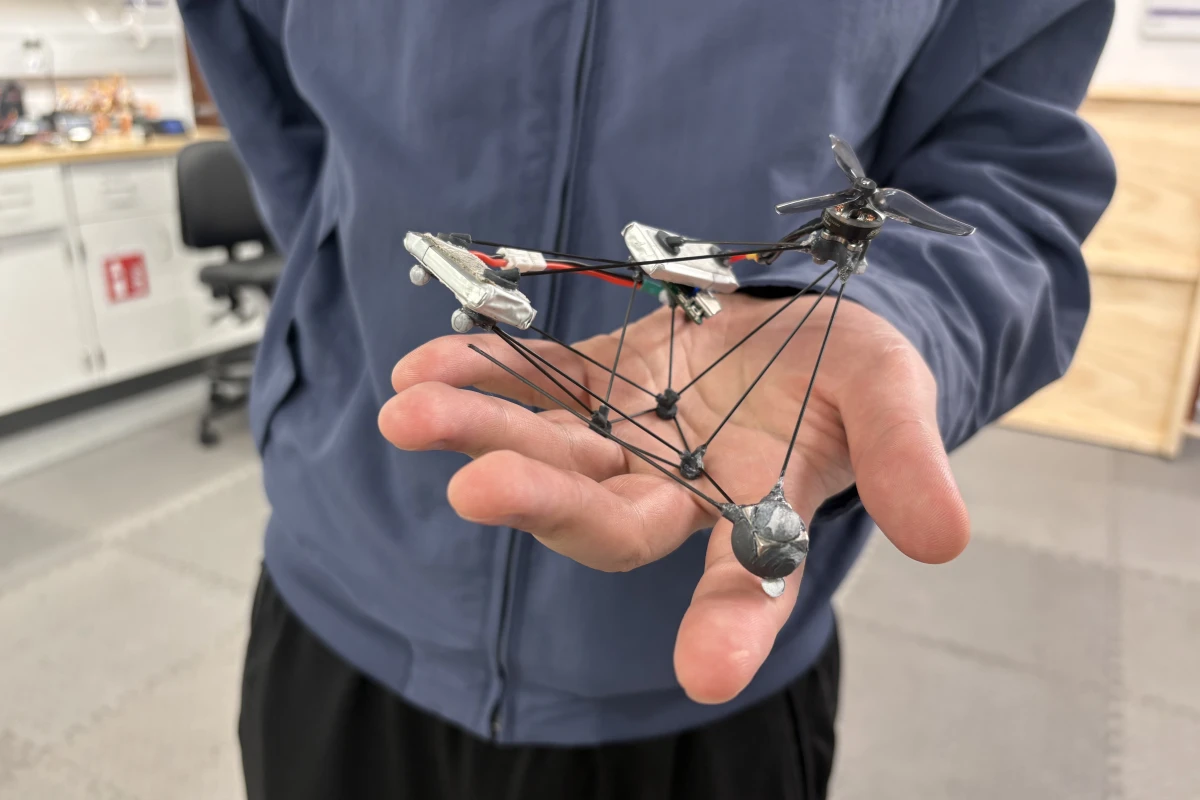
Engineers at Northwestern University have developed a drone that becomes nearly invisible—not through camouflage or transparent panels, but thanks to its high-speed rotation. This design prevents the human eye from focusing on the object, significantly increasing the device’s stealth and making it almost impossible to observe.
Phantom Twist Design Features
The device, named Phantom Twist, can spin up to 25 times per second, surpassing the human visual system’s ability to process details. As a result, the drone doesn’t become completely invisible, but appears as a faint, semi-transparent blur that blends into the background. The development was presented at the Robotics: Science and Systems 2026 conference in Sydney, Australia.
Unlike most camouflage methods that aim to make drones resemble their surroundings, this project focuses on the peculiarities of human motion perception. The idea of reducing visibility through constant movement had previously been largely unexplored.
Applications and Advantages
Drones are increasingly used for wildlife observation, infrastructure monitoring, and studying wetlands. However, their presence can affect the behavior of animals and people. A less noticeable drone can perform the same tasks without causing significant side effects.
Historical Context
The article mentions an earlier project, the Boomerang Drone, described in 2006, which also attempted to use rapid rotation to reduce visibility but failed to achieve the necessary speed for full blurring. It also draws an analogy with the 1944 “Yehudi light” project, where active lighting was used to camouflage aircraft over the sea.
Technical Differences
Phantom Twist differs from standard quadcopters: instead of four separate rotors, it uses a single motor and a single propeller, with the propeller and body rotating in opposite directions. In conventional quadcopters, only the propellers spin while the body remains stationary, but in this new design, the entire device rotates, eliminating static parts.
Design Process
To select the optimal design, a computer model generated about 20,000 possible configurations capable of stable flight. Using artificial intelligence and optimization algorithms, the positions of the motor, propeller, circuit board, counterweight, and batteries were repeatedly adjusted. Each model was tested against 100 real backgrounds and evaluated using a special metric simulating human vision: the lower the score, the better the camouflage. The 500 best variants underwent further optimization, after which the final prototype was assembled.
Operating Principle and Effectiveness
The human eye requires time to accumulate a signal, similar to a camera’s exposure. When an object spins rapidly, it appears blurred and loses detail. Thanks to the drone’s near-complete transparency and minimal opaque parts, it visually blends with the background, creating a light haze effect. Tests showed that such a drone is about ten times less noticeable than a standard quadcopter.
Limitations and Future Prospects
Despite its visual stealth, the drone’s propeller still produces audible noise, and supporting wires and rods remain partially visible. In the future, the use of more transparent materials and quieter motors is planned, which could bring the device closer to full invisibility. However, the same effect that reduces the drone’s impact on wildlife could also be used for less benign purposes.