

A floating hydrogen platform reduces emissions in ports
A British company has introduced a modular floating hydrogen platform that supplies ships with clean energy without the need to rebuild port infrastructure. This solution can reduce CO2 emissions by 77% compared to diesel generators, although it is more expensive than traditional energy sources.
Vigor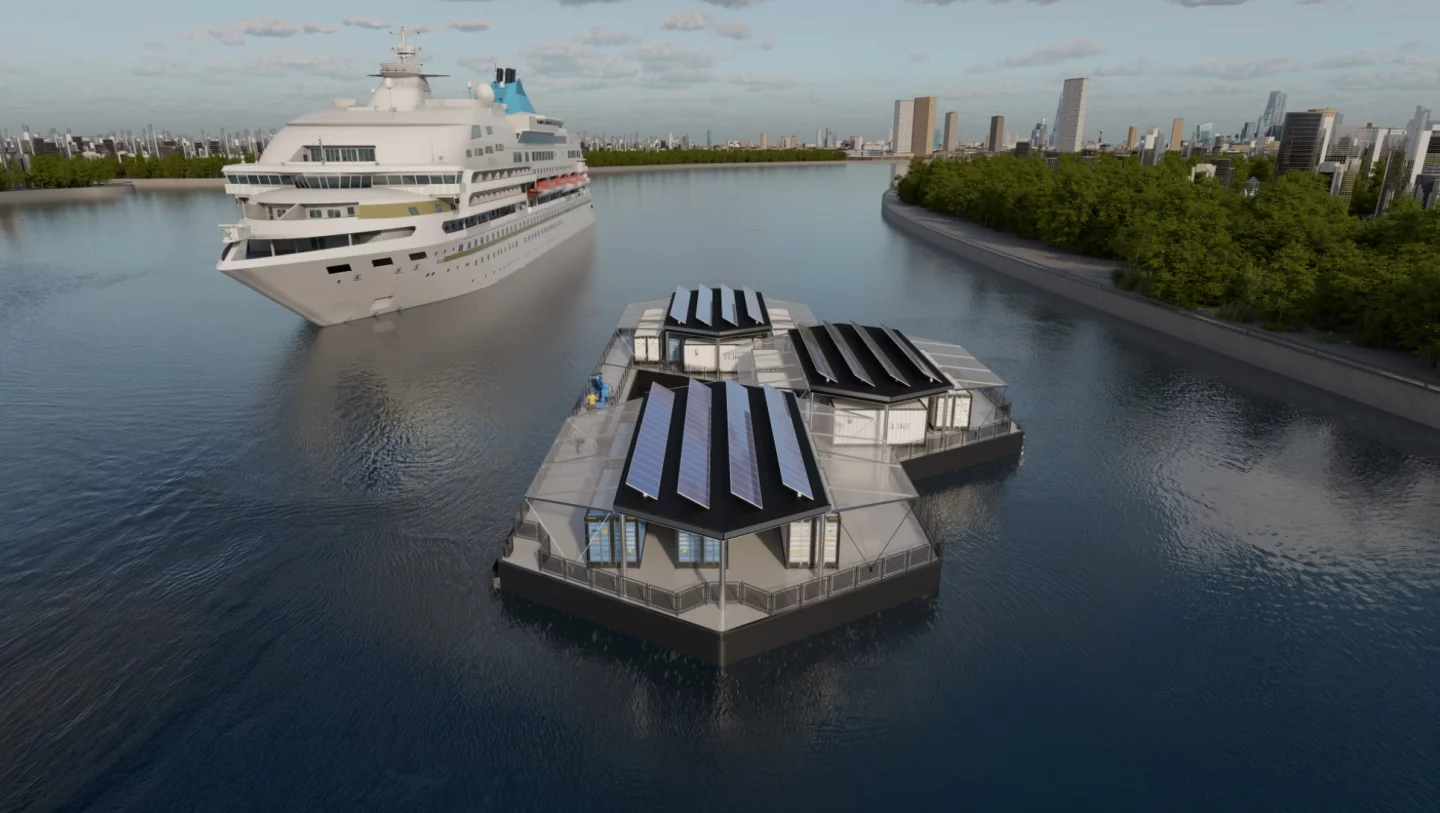
Retrofitting port berths for shore power connections typically takes three to seven years to obtain permits, build, and upgrade electrical networks. As an alternative, a British company has developed a floating hydrogen platform that can supply electricity to ships without the need for major infrastructure changes or lengthy waiting periods.
Platform Description
The Hydrogen Power Hub is a modular floating platform created by a consortium led by Elire Maritime from the UK. The system has undergone six months of engineering trials, overcoming the last technical hurdles before commercial deployment. The platform can deliver up to 5 MW of continuous clean energy directly to docked vessels, without connecting to the grid or requiring construction work in the port.
The platform consists of three hexagonal modules with a total area of about 1,200 square meters. At full capacity, it can supply 91 MWh of energy per week, enough to serve medium-sized cruise ships. The core of the system is a set of modular hydrogen fuel cells with a total output of 1.3 MW, which convert hydrogen into electricity through a chemical reaction, producing only water as a byproduct.
Operating Principle
The fuel cells operate continuously, consuming between 7,500 and 8,000 kg of hydrogen per week and gradually charging an onboard battery with a capacity of 45 MWh. When a ship arrives, the stored energy can be quickly transferred, much like a large power bank. The platform is also equipped with solar panels generating up to 146 kW of additional energy, providing some autonomy between hydrogen refueling, which is carried out about twice a week by a support vessel.
Environmental Impact
Docked ships often continue to use diesel auxiliary engines to power onboard systems, leading to emissions in port cities. Using the Hydrogen Power Hub can reduce port emissions by 77% compared to conventional diesel generators, saving around 47 tons of CO2 per ship per week and eliminating particulate pollution.
Technological Features
One of the platform’s innovations is its hydrogen storage system, developed by Rux Energy UK. It uses nanoporous materials that allow for compact and low-pressure gas storage, offering safety and logistical advantages over high-pressure tanks.
The platform’s design was tested in wave tanks at the University of Strathclyde to verify the strength and connections between modules under storm conditions. The system’s electrical architecture can operate fully autonomously, and the hydrogen integration meets safety standards. Engineers found no technical barriers to full-scale construction.
Economic Aspects
The main drawback of the platform is its cost. According to Elire, the electricity produced on the platform costs £0.25–0.50 per kWh (about $0.33–0.67), while grid or diesel electricity costs £0.15–0.25 (~$0.20–0.33), making the latter two to three times cheaper. However, the platform offers rapid deployment and mobility, allowing quick adaptation to changing shipping routes and avoiding the risk of underused stationary infrastructure.
Implementation Prospects
The consortium, funded under the sixth round of the UKRI Clean Maritime Demonstrator Competition, has begun preliminary talks with the ports of London, Singapore, Hamburg, Brisbane, and Riga. These ports already face emission reduction requirements but cannot afford years-long delays due to new infrastructure construction.