

Microsoft brings the era of practical quantum computers closer
Microsoft has unveiled the Majorana 2 quantum chip, featuring significantly more stable qubits—a breakthrough that brings the arrival of commercially viable quantum computers closer, potentially as soon as 2029. This new technology could accelerate scientific discoveries and solutions in fields such as medicine, energy, and beyond.
Crius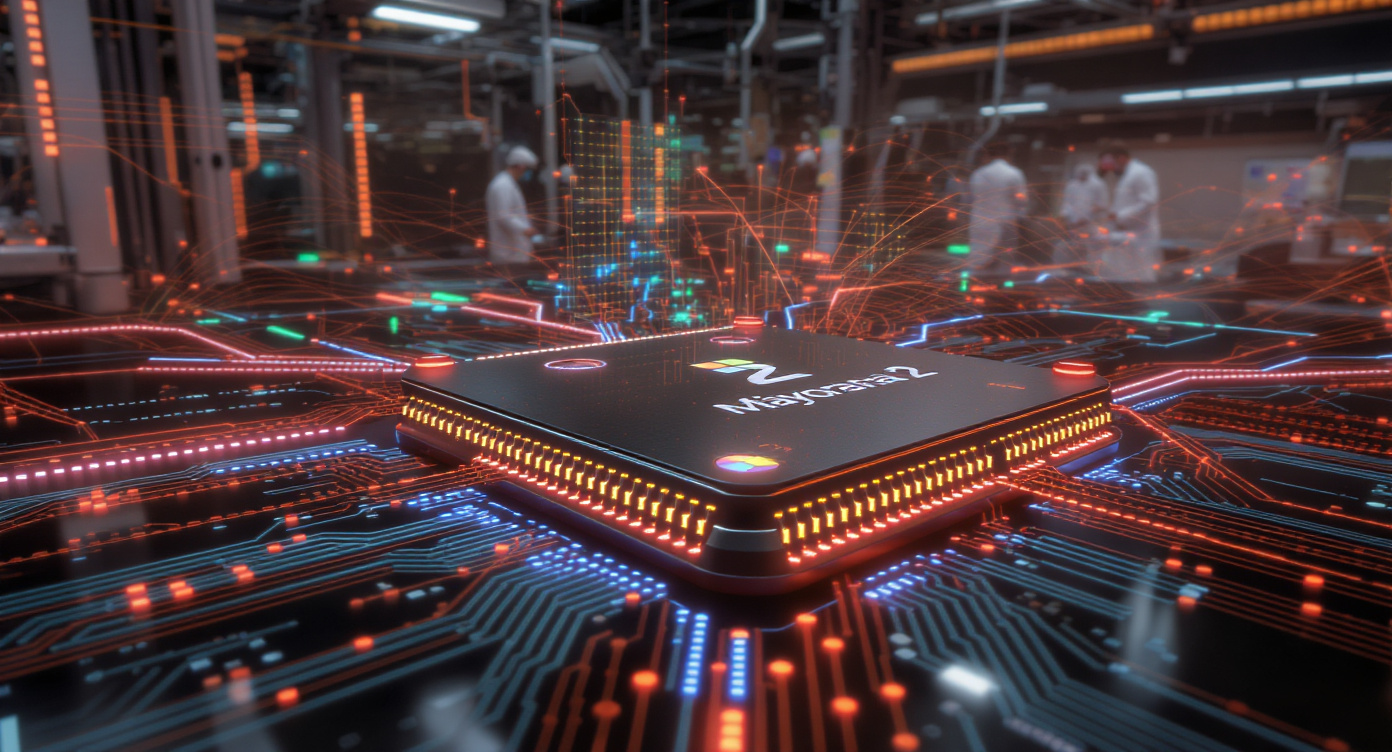
Microsoft has unveiled the next generation of its quantum chip, Majorana 2, which, according to the company, brings the practical use of quantum computing closer to reality. The company reports a significant increase in qubit stability and has set a target to create commercially viable quantum systems by 2029.
Features of Majorana 2
Majorana 2 is the latest version of Microsoft’s topological quantum chip. The company highlights a substantial improvement in reliability, which could accelerate the arrival of commercially useful quantum computers in the coming years. The new qubits are more robust, capable of maintaining their quantum state for up to a minute in some cases, and operate at microsecond speeds, all while remaining compact enough for large-scale deployment.
According to Microsoft, the average qubit lifetime in Majorana 2 is 20 seconds, and in certain cases, it can reach up to one minute. This far exceeds the performance of conventional quantum systems, where qubit stability is typically measured in microseconds. The advancements in reliability, speed, and size, the company believes, open up opportunities to solve practical problems in healthcare, energy, sustainable development, and the food industry over the next decade.
Qubit Overview
A qubit (quantum bit) is the quantum equivalent of a traditional computer bit. Unlike classical bits, which can only be 0 or 1, qubits can exist in multiple states simultaneously, allowing quantum computers to perform certain calculations much more efficiently. The main challenge lies in the fragility of qubits, which can quickly lose their quantum state due to external influences. This remains the primary obstacle to the advancement of quantum technologies.
Application Prospects
Majorana 2 is not intended to speed up smartphones or laptops in the near future. Its main purpose is to move toward practical quantum computers that could help develop new medicines, discover new materials, improve batteries, optimize logistics networks, and solve scientific problems that are currently beyond the reach of modern supercomputers.
Context and Additional Developments
The announcement of Majorana 2 comes amid ongoing attention to Microsoft’s quantum research. Previously, some researchers expressed doubts about the evidence supporting claims regarding Majorana 1 and the topological qubit architecture, noting a lack of published data to confirm the existence of the Majorana particle.
Alongside the hardware presentation, Microsoft has launched the open research platform Microsoft Discovery, powered by artificial intelligence. This platform is designed to assist scientists in data analysis, automate measurements, optimize manufacturing processes, detect hidden defects, and accelerate scientific discoveries.