

Social circles emerged before the appearance of humans.
The study revealed that chimpanzees and bonobos form social bonds based on the same principles as humans, distinguishing between close companions and acquaintances. This pattern of social organization emerged long before humans appeared and reflects an ancient evolutionary mechanism for optimally distributing attention and resources.
Cursus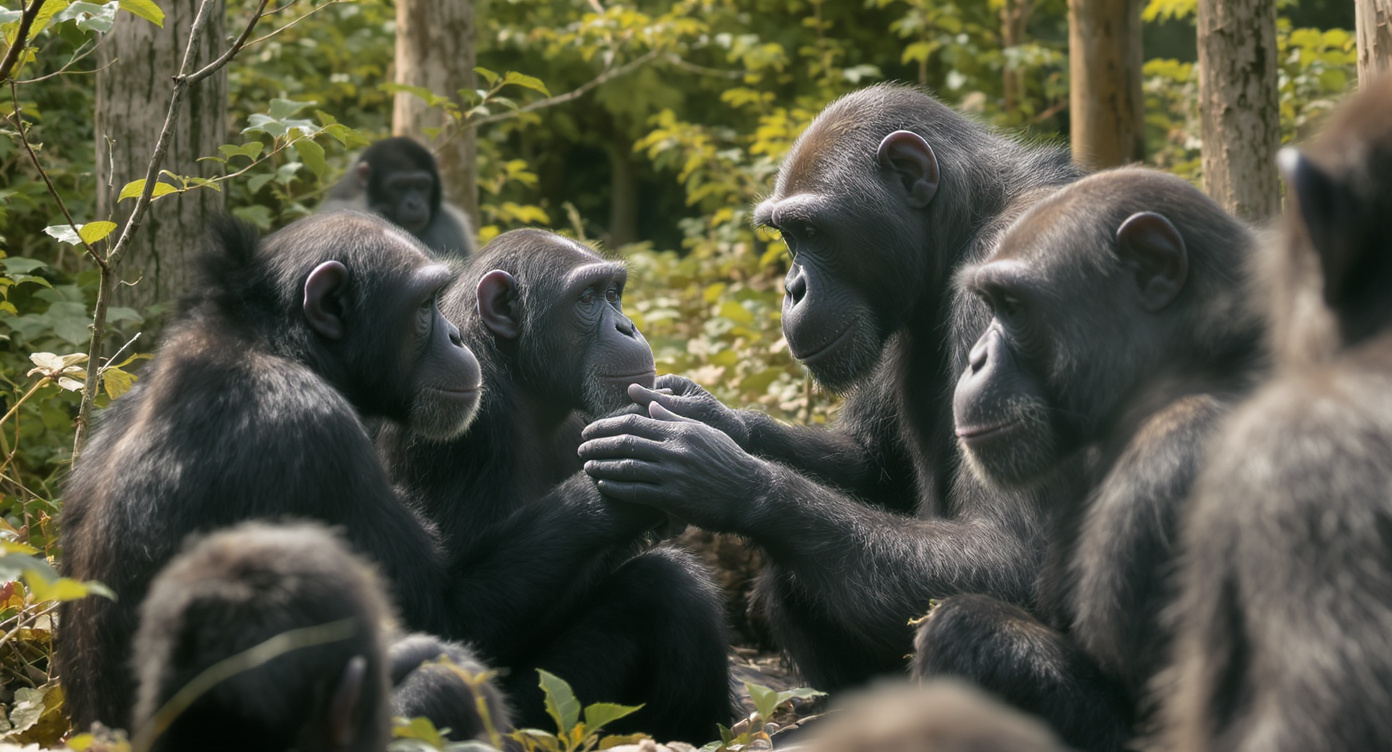
The closest relatives of humans—chimpanzees and bonobos—form social bonds based on the same principles as people do, according to the theory of social circles. Research has shown that this pattern emerged long before humans appeared.
Studying the Structure of Social Connections
Scientists from Utrecht University (Netherlands) and Carlos III University in Madrid (Spain) found that chimpanzees and bonobos organize their social relationships in a way similar to humans. The results of their study were published in the journal iScience.
Among humans, relationships are built in layers: there is a close inner circle of a few individuals who receive the most time and attention, as well as a broader periphery of acquaintances with whom contact is less intense. This structure is described by the theory of social circles, which explains the features of human socialization through evolutionary limitations of the brain. For a long time, it was unclear how universal this model is and whether it is a uniquely human trait.
Research Methodology
To test the universality of the model, the researchers analyzed grooming behavior in 24 groups of chimpanzees and bonobos. For great apes, grooming serves to strengthen social bonds and express trust. Using a mathematical model, they measured how each individual distributed their time among members of their group.
Results and Observations
Most apes devoted a disproportionately large amount of attention to a small circle of preferred partners, while maintaining weaker ties with others. As group size increased, the apes became more selective, much like what is observed in human societies.
Differences Between Species
Chimpanzees focus their attention on a small number of trusted partners, and as they age, their inner circle narrows. A similar trend is seen in humans. Bonobos, on the other hand, distribute grooming more evenly and do not limit their social circle with age. This is linked to the nature of their society: bonobos live in more fluid and egalitarian groups, and their social ties often extend beyond a single group, which is rare among chimpanzees.
Evolutionary Continuity
The structure of social interactions in chimpanzees and bonobos suggests that dividing one’s social environment into close friends and mere acquaintances is not a uniquely human cultural invention. Rather, it is likely an ancient evolutionary mechanism that arose long before humans, serving as a way to optimally allocate limited resources—time, energy, and attention—for survival within a group.