

The mysterious "golden orb" turned out to be part of a sea anemone.
After two and a half years of research, scientists have determined that the mysterious "golden orb" found on the floor of Alaska Bay is actually a discarded part of the shell of the giant deep-sea anemone Relicanthus daphneae. Analysis suggests that this discovery may be linked to the unique reproductive features of this rare marine creature.
Cursus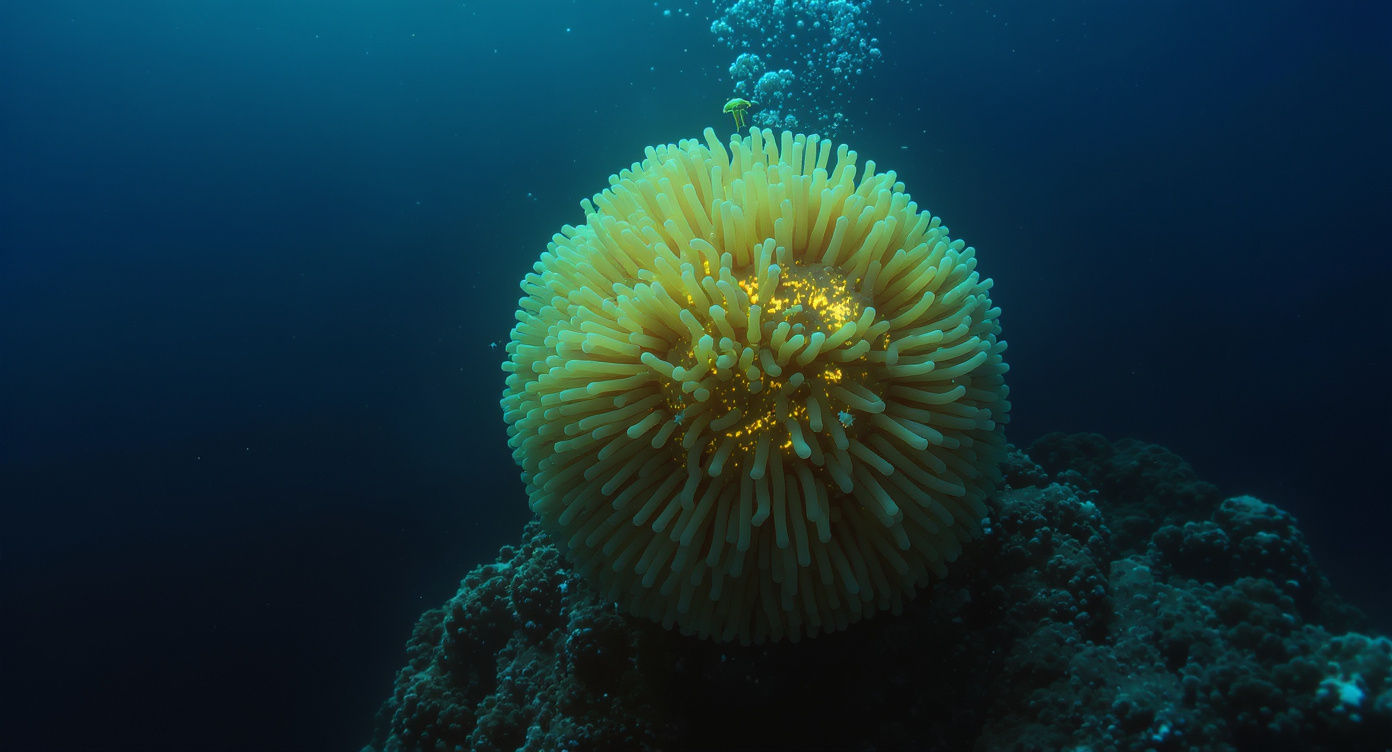
Two and a half years after the discovery of an unusual "golden orb" on the floor of the Gulf of Alaska, experts have finally determined its origin. Research has shown that this object is a discarded part of the shell or base of a giant deep-sea anemone.
Discovery of the Object
In the summer of 2023, during an expedition by the U.S. National Oceanic and Atmospheric Administration (NOAA), the remotely operated underwater vehicle Deep Discoverer found a spherical golden formation tightly attached to a rock at a depth of about 3,250 meters in the Gulf of Alaska. The object measured approximately 10 centimeters in diameter and had an opening on one side. The find sparked widespread public interest and led to numerous theories about its nature.
To study it further, the object was separated from the rock using a robotic arm and delivered to the Smithsonian National Museum of Natural History. Scientists considered several possibilities, including that it might be the shell of a deep-sea animal egg, a dead sponge, or a coral.
Research and Analysis
Identifying the object proved to be a complex task, requiring collaboration among specialists in morphology, genetics, deep-sea biology, and bioinformatics. Initial analysis revealed that the object did not have the typical anatomy of an animal but was composed of fibrous material with a layered surface containing stinging cells (cnidocytes). This indicated it belonged to the cnidarians, a group that includes jellyfish, anemones, and corals.
The cnidocytes found were identified as spirocysts, which are only present in members of the subclass Hexacorallia (six-rayed coral polyps).
Genetic Studies
To clarify its classification, scientists used DNA barcoding, a method that identifies an organism's taxon based on short genetic markers. However, this approach was unsuccessful due to the presence of DNA from numerous microscopic organisms on the object's surface. Only full genome sequencing made it possible to determine that the genetic material matched the genome of Relicanthus daphneae—a giant deep-sea sea anemone.
This species was first described in 2006. R. daphneae lives on the ocean floor near hydrothermal vents, has a cylindrical body up to a meter in diameter, and tentacles that can reach up to two meters in length.
The Nature of the Object
Research has shown that the "golden orb" is the remnant of the cuticle of R. daphneae. The cuticle is a thin, multilayered covering secreted by the outer tissues of some anemones, forming flexible, leaf-like structures. Observations in the wild have shown that the cuticle can peel off and remain on the sea floor as the animal moves. Among known specimens of R. daphneae, the cuticle is rarely found, possibly due to the anemone's ability to detach from it.
Possible Role in Reproduction
There is also a theory that the spherical outgrowth may be related to the reproductive process of R. daphneae. Some sea anemones are capable of pedal laceration—a type of asexual reproduction in which the base of the polyp (the pedal disc), which attaches the anemone to the substrate, separates. The upper part of the animal moves away, leaving behind a piece of tissue from which a new, genetically identical polyp develops. Thus, the "golden orb" could be the remnant of the pedal disc of R. daphneae.