

Origami robot moves without motors or gears
Engineers at Princeton University have developed a soft robot that moves without motors or gears, using heat and origami-inspired principles. This new technology opens up possibilities for flexible and compact robotic systems.
Ingenium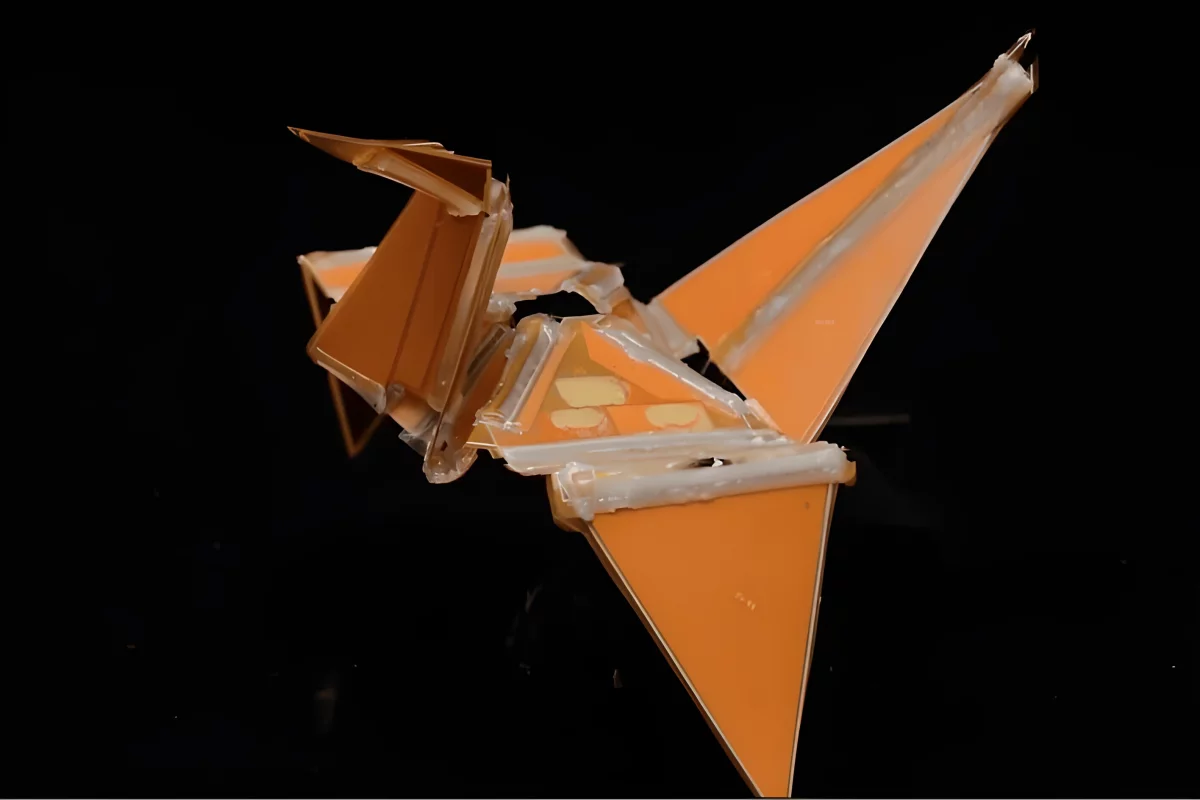
Engineers at Princeton University have developed a robot capable of moving without the use of motors or gears. Instead, it relies on heat and origami-inspired principles for movement. This new soft robotic system is based on a combination of advanced thermoresponsive materials, flexible embedded electronics, and carefully designed folding structures, allowing it to operate without traditional mechanical components.
Features of Soft Robotics
Soft robotics focuses on creating robots from flexible and deformable materials and systems. This flexibility makes such devices especially suitable for tasks that rigid machines cannot handle, such as manipulating delicate objects, operating in confined spaces, or serving as medical implants and drug delivery systems inside the body.
Overcoming the Limitations of Traditional Actuators
Most soft robots still depend on motors, actuators, or external pneumatic systems for movement, which limits their size, weight, and flexibility. The Princeton team addressed this challenge by combining materials with unique properties and engineering methods inspired by origami.
Design and Materials
The core of the design is a special polymer—an elastomer with a liquid crystal structure. Unlike conventional flexible materials, it has internal molecular order. Using a custom 3D printer, the researchers programmed the orientation of molecules in specific zones during printing, creating regions that respond differently to heat.
By arranging these zones in precise patterns, the team built "hinges" directly into the material. When heated, these hinges contract in a predictable way, causing the structure to fold and unfold in a predetermined sequence.
Embedded Electronics and Control
Precise control of heating in individual zones is achieved through integrated electronics. Flexible printed circuit boards with heating elements are embedded directly into the hinges during printing, simplifying manufacturing and making the system compact. Built-in temperature sensors send data to control software, which compensates for minor errors that may occur during repeated folding and unfolding of the robot.
Proof of Concept
To demonstrate the concept, the team created a robot in the shape of a crane—a classic origami figure—that can flap its wings on command. The crane was able to move repeatedly and return to its original shape without noticeable wear or deformation. While this is not a fully functional robot, the viability of the concept has been proven in practice.
Development Prospects
Eliminating mechanical actuators opens up new possibilities for soft robotics. Currently, the system is at the experimental stage and is being demonstrated in laboratory conditions. However, its design is already geared toward mass production using commercially available materials and scalable manufacturing methods.