

The universal rhythm of communication unites animals and humans.
Studies have shown that most animals and humans use a similar rhythm to transmit signals—about 2 hertz—which is linked to the way nerve cells function. This universal tempo forms the basis of both natural communication and popular musical rhythms.
Cursus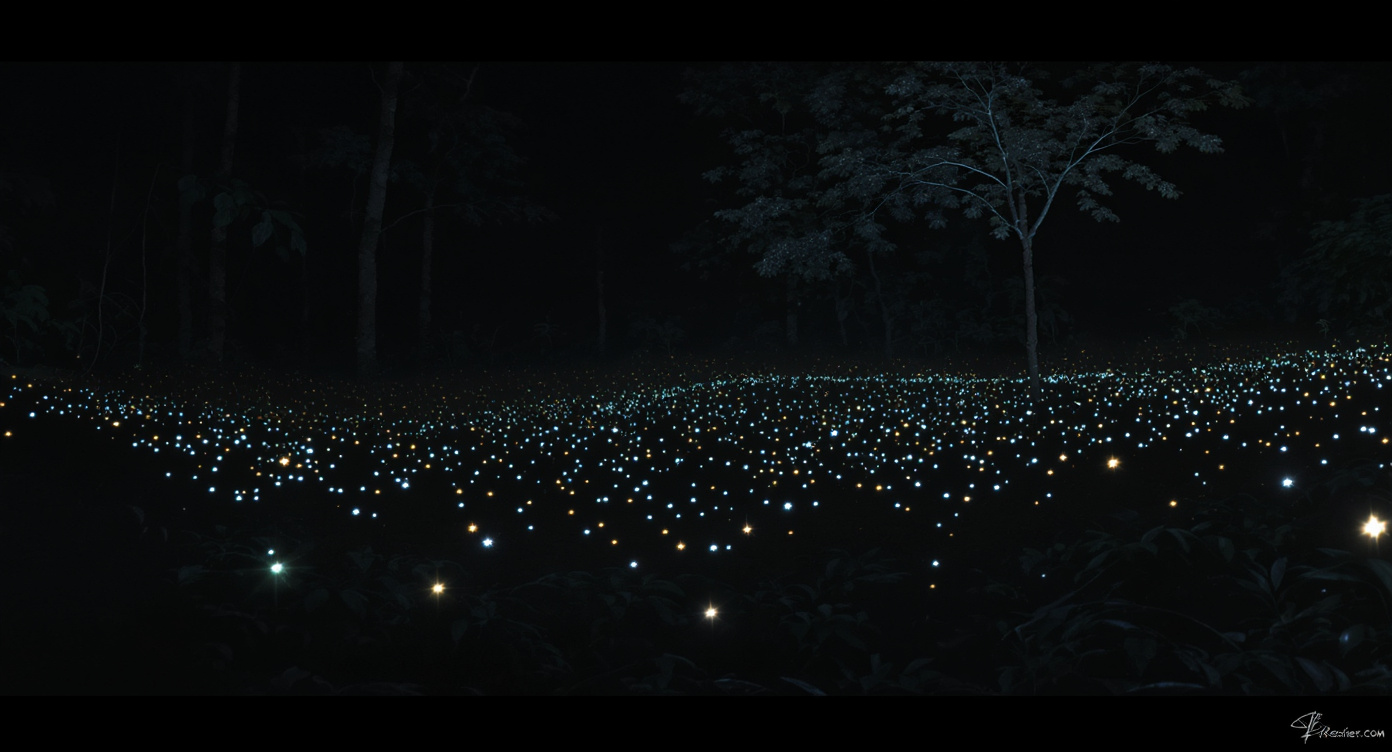
Research has shown that various animals, including fireflies and whales, transmit signals within a narrow frequency range of 0.5 to 4 hertz. Computer modeling revealed that this universal tempo is determined not by the characteristics of vocal organs, but by the speed at which nerve cells in the receiving organism process signals.
Observations in Nature
During an expedition in Thailand, scientists from the USA observed synchronization between the singing of local crickets and the flashing of fireflies. It was suggested that such synchronization is not accidental.
Data Analysis
To test this hypothesis, researchers analyzed scientific publications and the xeno-canto wildlife sound database. They selected rhythmic signals from birds, bats, amphibians, insects, and mammals. The results showed that species with mass differences of up to one hundred million times (for example, insects and whales) use a similar communication range—between 0.5 and 4 pulses per second. In neurology, this range corresponds to low-frequency delta rhythms in the brain.
Neural Network Modeling
The researchers proposed the hypothesis of neural resonance: the brain perceives external signals most effectively when their frequency matches its internal rhythms. To test this, they created a mathematical model of a neural network that accounted for biophysical constraints: a single nerve cell requires several hundred milliseconds to accumulate charge and generate a new impulse, which sets the neuron's natural operating frequency at about 2 hertz.
More than 1,500 variations of network architecture were tested, and virtual neural circuits were exposed to external signals of different frequencies. The effectiveness of resonance was measured by the order parameter (R). The model also included heterogeneity to simulate biological differences between cells.
Simulation Results
The simulation showed that the virtual neural network responds most efficiently to external stimuli when their frequency matches the base frequency of the neurons (about 2 hertz). The network topology had little effect on the outcome, while introducing biological randomness improved system performance, allowing it to detect and resonate even with signals that slightly deviate from the ideal rhythm.
Connection to Musical Preferences
The discovered universal tempo coincides with the rhythm popular in pop music: 120 beats per minute, which equals 2 hertz—the optimal frequency for resonance in neural circuits. Deviations from this rule are mainly found in gestural communication among large animals, where greater body mass prevents rapid limb movement.
The Evolution of Communication
The evolution of communication followed the path of adapting the sender to the receiver's capabilities. Animals did not need to develop unique decoding systems for each species. Natural selection calibrated the frequency of sound and light signals in accordance with the fundamental physical limitations of nerve cells, establishing a common rhythm of communication for the entire biosphere.