

Curiosity helps raccoons survive in cities
The experiment showed that raccoons continue to explore complex mechanisms even after receiving a reward, demonstrating curiosity for new knowledge. This tendency to investigate helps them successfully adapt to life in urban environments.
Cursus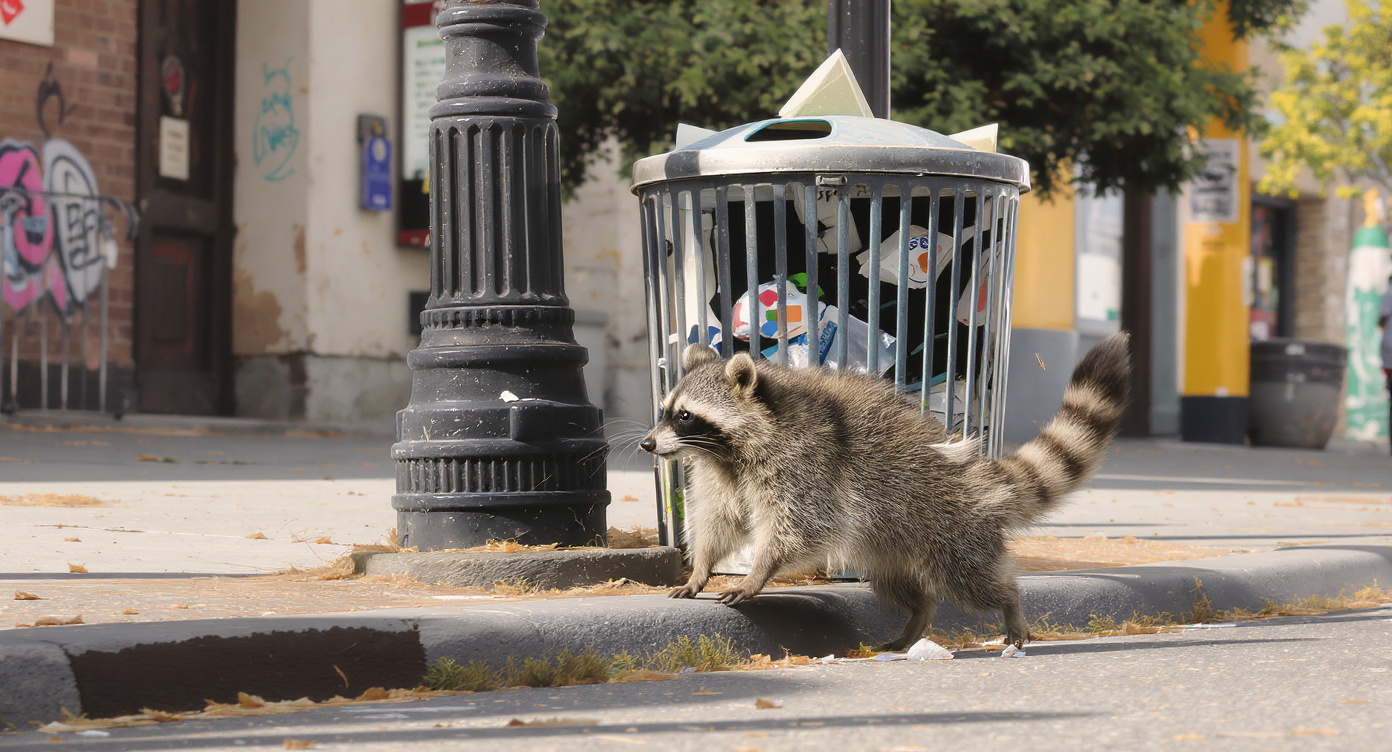
### Study of Raccoon Behavior in Solving Technical Problems

During the experiment, it was found that raccoons continued to open locks on a special box even after receiving a food reward. The animals showed interest in the mechanism not for the sake of food, but to understand how it worked. This ability to seek information without immediate benefit is considered a factor that contributes to the high survival rate of raccoons in urban environments.

#### Theoretical Foundations of Behavior

According to optimal foraging theory, wild animals in natural conditions strive to obtain the maximum number of calories with minimal energy expenditure. Each day, the animal chooses between exploring new places and using tried-and-true methods to conserve energy.

In cities, the usual living conditions change: food sources become unpredictable, and obtaining calories requires animals to be inventive, such as learning to open trash bins or door handles.

#### Experimental Methodology

The study assessed how the technical complexity of obstacles influenced raccoons' motivation to acquire new information. For this, a transparent plastic cube with nine locks of three difficulty levels was used:

- **Easy**: swing door, sliding latch, window that drops down.
- **Medium**: removing a hook or metal bolt, requiring two different movements.
- **Hard**: turning a handle, removing a padlock, working with a tension latch.

A treat—marshmallow, which elicited the most active response from raccoons—was placed inside the box. Experiments were conducted at night under red lighting and recorded on video. Sixteen adult Procyon lotor raccoons participated, of which 14 successfully completed the full testing course.

Each animal was given 50 attempts of 20 minutes each. Advancement to the next difficulty level occurred after 15 successful openings of the previous type of lock.

#### Observation Results

All physical interactions of raccoons with the box were recorded, with special attention to actions after retrieving the treat. Most animals continued to interact with the device even after the treat was removed, exploring untouched doors without expecting a new reward.

At the easy stage, raccoons on average opened almost two locks per attempt, changed the order of actions, and analyzed the structure of the box. The statistical power of the exploratory behavior effect was 98.7%. Natural curiosity served as an internal stimulus for the predators' brains.

Complex mechanisms forced the animals to change their strategy: increasing difficulty significantly reduced the number of successful openings. Video analysis showed that raccoons did not explore neighboring locks for entertainment, but focused on one working solution and used it methodically. The decrease in exploratory activity at the difficult stages was 75.7%. The animals could not figure out to lift the window at the medium stage after the experience with the window that dropped down.

#### Conclusions

The behavior of raccoons in the experiment explains their successful adaptation to life in large cities. The animals purposefully study how new objects work to expand their knowledge, which is similar to human behavior. Natural curiosity gives raccoons an evolutionary advantage when interacting with urban infrastructure, and their high cognitive flexibility allows them to switch to reliable solutions in time, maintaining a balance between exploration and using proven strategies.