

The Chinese photonic chip LightGen outperforms top GPUs
Chinese researchers have unveiled the LightGen photonic chip, which is capable of running large-scale AI models with performance up to 100 times greater than leading GPUs, while significantly reducing energy consumption.
Crius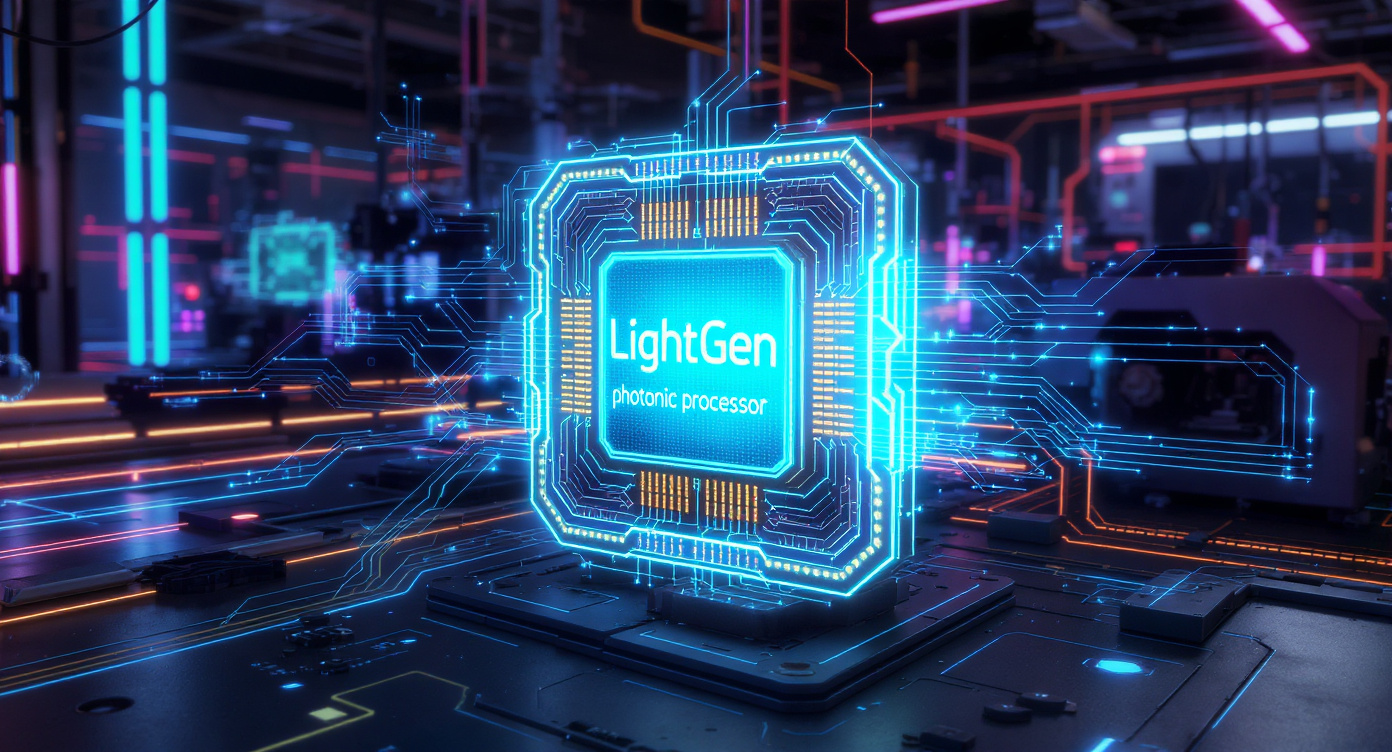
Researchers from China have developed a fully photonic processor capable of running large-scale artificial intelligence models with performance and efficiency that significantly surpass traditional silicon-based solutions.
A team from Shanghai Jiao Tong University and Tsinghua University has introduced an innovative optical computing chip called LightGen. This chip is specifically designed to meet the high demands of generative AI. According to an article published in the journal Science, LightGen marks a major step forward from electronic transistors to photonic neurons, offering a potential solution to the massive energy consumption challenges faced by the AI industry.
Unlike previous optical processors, which included only a few thousand neurons and were limited to simple tasks like image classification, LightGen utilizes advanced 3D packaging. This allows the integration of over two million artificial neurons into a device the size of a quarter of a square inch. Such scale enables the execution of complex generative tasks, such as high-resolution video creation and 3D modeling, which previously required powerful electronic GPUs.
A key innovation in LightGen’s design is the implementation of an "optical latent space." By using ultrathin metasurfaces and arrays of optical fibers, the chip can compress and process multidimensional data exclusively with light. This makes it possible to work with full-size images without splitting them into fragments, preserving crucial statistical information and dramatically increasing throughput. According to the researchers, the chip’s performance exceeds that of the leading Nvidia A100 GPU by more than 100 times.
In laboratory tests, LightGen successfully generated high-resolution semantic images and performed 3D manipulations, demonstrating quality comparable to state-of-the-art electronic neural networks. Although the technology currently relies on external laser systems and specialized manufacturing processes, it opens up new prospects for future high-speed, energy-efficient, and intelligent computing.
LightGen is paving a new path for the development of generative artificial intelligence, delivering greater speed and efficiency while also opening up new directions for research in high-performance and energy-efficient computing.