

The noise of the ocean threatens the endangered Kemp's ridley turtles
The study found that the endangered Kemp's ridley sea turtles are particularly sensitive to low-frequency noise, which overlaps with the range of human-made sounds in the ocean, making them vulnerable to acoustic disturbances.
Natura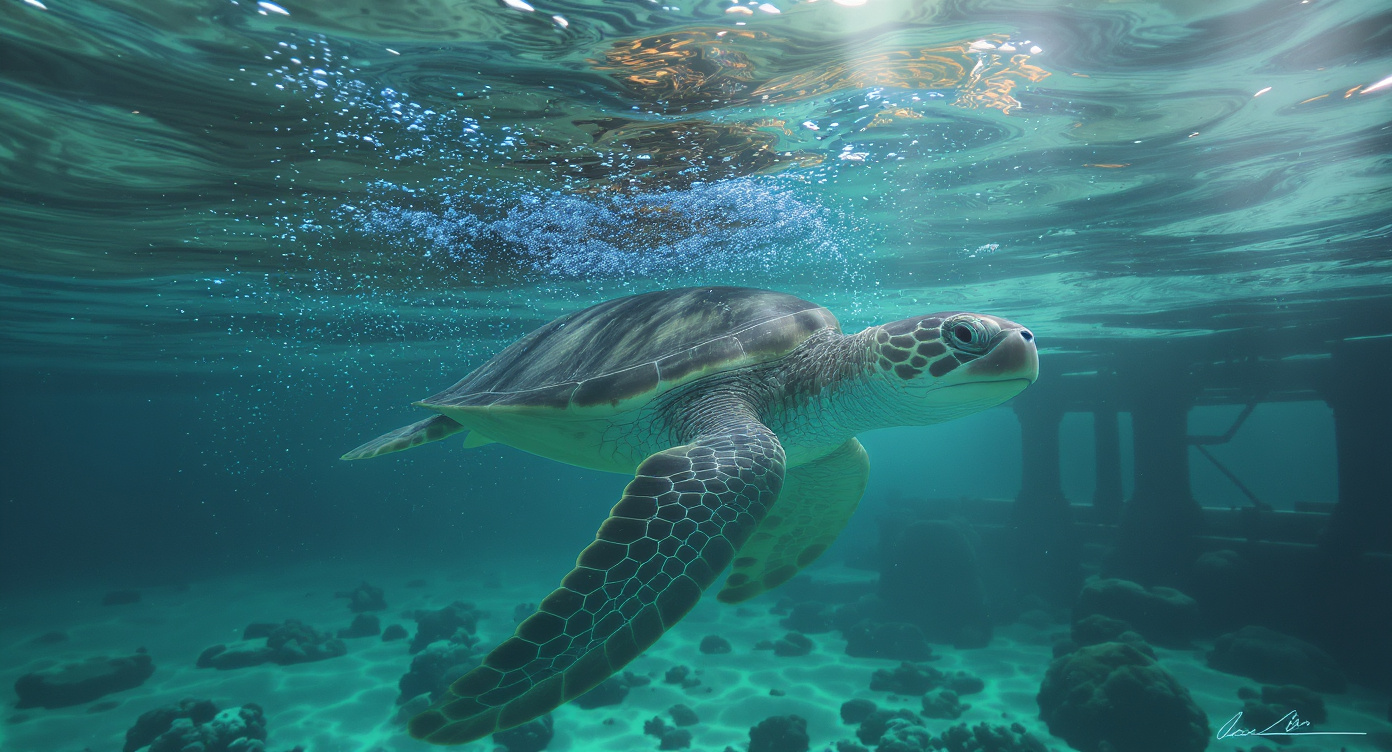
The Kemp's ridley sea turtle, a species listed in the Red Book, inhabits regions where anthropogenic noise levels are particularly high. Recent studies have shown that the auditory organs of these animals are especially sensitive to such noise.
Vulnerability and Habitat
The Kemp's ridley sea turtle (Lepidochelys kempii) is considered one of the rarest and least studied marine reptiles. This species is on the brink of extinction and is included in the Red List of the International Union for Conservation of Nature. The main habitats of these turtles are the coastal waters of the Gulf of Mexico and the western Atlantic Ocean.
These areas overlap with zones of intense human activity: shipping routes pass through here, seismic surveys are conducted, and marine energy projects are developed. For a long time, it was unclear how turtles perceive noise generated by humans. However, such noise can not only cause physical harm, stress, and hearing loss, but also "mask" vital sounds, making it harder for turtles to navigate, find food, locate mates, and avoid danger.
Research Methodology
Scientists studied the hearing of 13 Kemp's ridley sea turtles using auditory evoked potential (AEP) recordings. Some of the turtles were captured in the wild, while others were undergoing rehabilitation after injuries. The results were published in The Journal of the Acoustical Society of America.
Special electrodes were attached to the turtles' heads to record weak electrical signals in the auditory nerves in response to sound stimuli. This approach does not require lengthy training and allows for rapid assessment of hearing sensitivity. The turtles were placed in an experimental pool, where short tonal signals of various frequencies—from 50 to 1600 hertz—were played through an underwater speaker. The sound level was gradually reduced until the neural response was no longer detected. This threshold was considered the minimum audible level at that frequency.
Results and Conclusions
The researchers constructed an audiogram for the species—a graph showing the relationship between hearing acuity and sound frequency. It turned out that Kemp's ridley turtles are most sensitive to low-frequency ranges: they hear best in the 50 to 800 hertz band, with peak sensitivity between 200 and 300 hertz. At higher frequencies—1200 and 1600 hertz—the turtles did not respond even to very loud sounds.
The scientists noted that the frequency range to which Kemp's ridley turtles are most sensitive almost exactly matches the spectrum of the most common and powerful sources of anthropogenic noise in the ocean: the rumble of ship engines, the noise of drilling rigs, and low-frequency seismic airgun pulses. This makes the endangered species especially vulnerable to constant acoustic exposure in its natural habitat.
The authors of the study added that the obtained audiograms should be considered a conservative estimate, since the physiological AEP method typically shows slightly lower sensitivity than the actual behavioral responses of animals. Therefore, the real impact of noise on turtles may be even greater.