

An innovative coating destroys bacteria without the use of antibiotics.
An international team of scientists has developed an innovative antibacterial coating with microscopic spikes that physically destroy bacterial membranes and prevent the formation of dangerous biofilms. The coating is safe for human cells and does not cause bacteria to develop resistance.
Cursus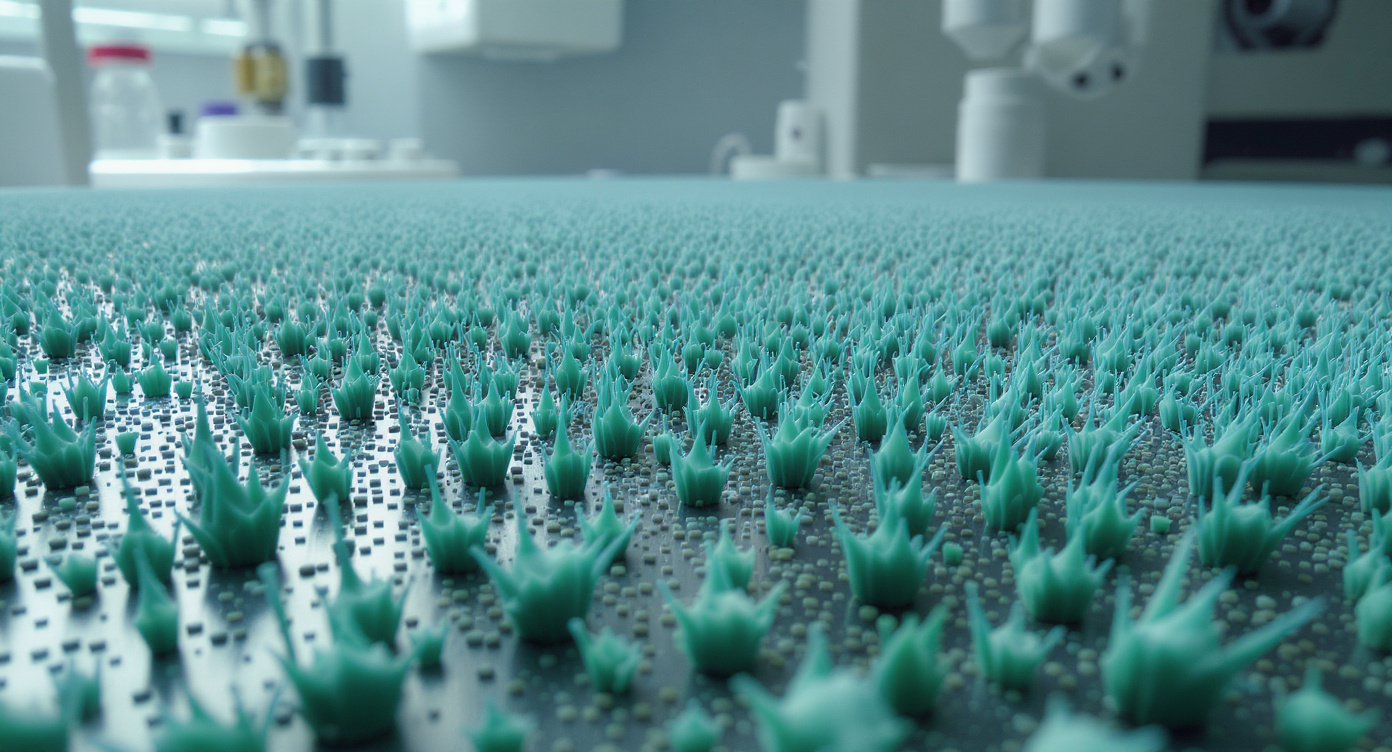
An international team of researchers has developed an innovative antibacterial surface based on metal-organic frameworks (MOFs). This surface is covered with microscopic spikes that physically destroy bacterial membranes upon contact, preventing the formation of dangerous biofilms.
The Problem of Biofilms
Bacteria can form biofilms—dense colonies protected by a slimy layer—on various surfaces. In this state, microorganisms become resistant to antibiotics and the immune system, often leading to chronic infections, especially in medical settings where biofilms can develop on catheters, prosthetics, and artificial joints.
Inspired by Nature
In nature, similar problems are solved mechanically: cicada wings and gecko skin are covered with nanostructures that physically destroy bacteria. Scientists have long tried to replicate this effect, but existing technologies were too complex and expensive for widespread use.
MOF Technology and the Creation Process
In this new study, researchers used metal-organic frameworks—porous materials made from metal ions and organic linkers, structurally similar to building blocks—to combat biofilms. The creators of MOFs were awarded the Nobel Prize in 2025 for their work.
The team employed a method called epitaxial growth, where one crystal grows on the surface of another. First, they synthesized zirconium-based MOF crystals of the UiO-66 type, which served as the foundation for further growth. Then, iron-based MIL-88B crystals were grown on top of them.
The result was hybrid nanoparticles resembling anti-tank obstacles: each particle has a core and sharp spikes protruding in all directions. The spikes are comparable in size to bacteria—about 300 nanometers long, with tips less than five nanometers in diameter.
Effectiveness and Safety
The researchers tested two coating methods: growing the spikes directly on the surface and applying a solution containing pre-formed spikes. The second method proved more effective—nanoparticles randomly settle on the surface, exposing several sharp tips at once and creating a dense "minefield."
In experiments with E. coli, the surface treated by the drop-coating method destroyed 83% of bacteria within 24 hours. Electron microscopy confirmed that cell death was caused by mechanical damage: the spikes pierced the bacteria, some cells ruptured, and in other cases, the damage triggered apoptosis (self-destruction).
Importantly, this coating is safe for human cells. Due to the significant size difference (human cells are hundreds of times larger than bacteria), the nanospikes are perceived by tissues merely as a slightly rough surface. The key advantage of this technology is that bacteria cannot develop resistance to it.